- Country name
- conventional long form: Republic of Costa Rica
conventional short form: Costa Rica
local long form: República de Costa Rica
local short form: Costa Rica
etymology: the name means "rich coast" in Spanish; Christopher COLUMBUS named it in 1502, referring to the region's abundant vegetation and water - Government type
- presidential republic
- Capital
- name: San José
geographic coordinates: 9 56 N, 84 05 W
time difference: UTC-6 (1 hour behind Washington, DC, during Standard Time)
etymology: Spanish settlers originally named the city Villa Nueva in 1736; it was later renamed for Saint Joseph - Administrative divisions
- 7 provinces (provincias, singular - provincia); Alajuela, Cartago, Guanacaste, Heredia, Limon, Puntarenas, San Jose
- Legal system
- civil law system based on Spanish civil code; Supreme Court reviews legislative acts
- Constitution
- history: many previous; latest effective 8 November 1949
amendment process:
proposals require the signatures of at least 10 Legislative Assembly members or petition of at least 5% of qualified voters; consideration of proposals requires two-thirds majority approval in each of three readings by the Assembly, followed by preparation of the proposal as a legislative bill and its approval by simple majority of the Assembly; passage requires at least two-thirds majority vote of the Assembly membership; a referendum is required only if approved by at least two thirds of the Assembly - International law organization participation
- accepts compulsory ICJ jurisdiction; accepts ICCt jurisdiction
- Citizenship
- citizenship by birth: yes
citizenship by descent only: yes
dual citizenship recognized: yes
residency requirement for naturalization: 7 years - Suffrage
- 18 years of age; universal and compulsory
- Executive branch
- chief of state: President Rodrigo CHAVES Robles (since 8 May 2022)
head of government: President Rodrigo CHAVES Robles (since 8 May 2022)
cabinet: Cabinet selected by the president
election/appointment process: president and vice presidents directly elected on the same ballot by modified majority popular vote (40% threshold) for a 4-year term (eligible for non-consecutive terms)
most recent election date: 6 February 2022, with a runoff on 3 April 2022
election results:
2022: Rodrigo CHAVES Robles elected president in second round; percent of vote in first round - Jose Maria FIGUERES Olsen (PLN) 27.3%, Rodrigo CHAVES Robles (PPSD) 16.8%, Fabricio ALVARADO Munoz (PNR) 14.9%, Eliecer FEINZAIG Mintz (PLP) 12.4%, Lineth SABORIO Chaverri (PUSC) 12.4%, Jose Maria VILLALTA Florez-Estrada 8.7% (PFA), other 7.5%; percent of vote in second round - Rodrigo CHAVES Robles (PPSD) 52.8%, Jose Maria FIGUERES Olsen (PLN) 47.2%
2018: Carlos ALVARADO Quesada elected president in second round; percent of vote in first round - Fabricio ALVARADO Munoz (PRN) 25%; Carlos ALVARADO Quesada (PAC) 21.6%; Antonio ALVAREZ (PLN) 18.6%; Rodolfo PIZA (PUSC) 16%; Juan Diego CASTRO (PIN) 9.5%; Rodolfo HERNANDEZ (PRSC) 4.9%, other 4.4%; percent of vote in second round - Carlos ALVARADO Quesada (PAC) 60.7%; Fabricio ALVARADO Munoz (PRN) 39.3%
expected date of next election: 1 February 2026 (a runoff, if needed, will take place in April 2026)
note: the president is both chief of state and head of government - Legislative branch
- legislature name: Legislative Assembly (Asamblea Legislativa)
legislative structure: unicameral
number of seats: 57 (all directly elected)
electoral system: proportional representation
scope of elections: full renewal
term in office: 4 years
most recent election date: 2/6/2022
parties elected and seats per party:
National Liberation Party (PLN) (19); Democratic Social Progress Party (PPSD) (10); Christian Social Unity Party (USC) (9); New Republic Party (NR) (7); Broad Front (FA) (6); Progressive Liberal Party (LP) (6)
percentage of women in chamber: 49.1%
expected date of next election: February 2026 - Judicial branch
- highest court(s): Supreme Court of Justice (consists of 22 judges organized into 3 cassation chambers each with 5 judges and the Constitutional Chamber with 7 judges)
judge selection and term of office: Supreme Court of Justice judges elected by the National Assembly for 8-year terms with renewal decided by the National Assembly
subordinate courts: appellate courts; trial courts; first instance and justice of the peace courts; Superior Electoral Tribunal - Political parties
- Accessibility Without Exclusion or PASE
Broad Front (Frente Amplio) or PFA
Citizen Action Party or PAC
Costa Rican Renewal Party or PRC
Here Costa Rica Commands Party or ACRM
Liberal Progressive Party or PLP
Libertarian Movement Party or ML
National Integration Party or PIN
National Liberation Party or PLN
National Restoration Party or PRN
New Generation or PNG
New Republic Party or PNR
Social Christian Republican Party or PRSC
Social Christian Unity Party or PUSC of UNIDAD
Social Democratic Progress Party or PPSD - Diplomatic representation in the US
- chief of mission: Ambassador Catalina CRESPO SANCHO (since 19 April 2023)
chancery: 2114 S Street NW, Washington, DC 20008
telephone: [1] (202) 499-2980
FAX: [1] (202) 265-4795
email address and website:
embcr-us@rree.go.cr
https://www.embassycr.org/
consulate(s) general: Atlanta, Houston, Los Angeles, Miami, New York, Washington DC - Diplomatic representation from the US
- chief of mission: Ambassador-designate Melinda HILDEBRAND (since 3 December 2025); Chargé d’Affaires Jennifer SAVAGE (since August 2025)
embassy: Calle 98 Via 104, Pavas, San Jose
mailing address: 3180 St. George's Place, Washington DC 20521-3180
telephone: [506] 2519-2000
FAX: [506] 2519-2305
email address and website:
acssanjose@state.gov
https://cr.usembassy.gov/ - International organization participation
- ACS, BCIE, CACM, CD, CELAC, FAO, G-77, IADB, IAEA, IBRD, ICAO, ICC (national committees), ICCt, ICRM, IDA, IFAD, IFC, IFRCS, ILO, IMF, IMO, IMSO, Interpol, IOC, IOM, IPU, ISO, ITSO, ITU, ITUC (NGOs), LAES, LAIA (observer), MIGA, NAM (observer), OAS, OIF (observer), OPANAL, OPCW, Pacific Alliance (observer), PCA, SICA, UN, UNCTAD, UNESCO, UNHCR, UNIDO, Union Latina, UNOOSA, UNWTO, UPU, WCO, WFTU (NGOs), WHO, WIPO, WMO, WTO
- Independence
- 15 September 1821 (from Spain)
- National holiday
- Independence Day, 15 September (1821)
- Flag
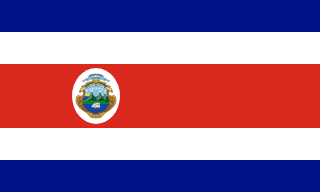
- description: five horizontal bands of blue (top), white, red (double-width), white, and blue, with the coat of arms in a white elliptical disk placed toward the left side of the red band
meaning: the blue is said to stand for the sky, opportunity, and perseverance; the white for peace, happiness, and wisdom; and the red for the blood shed for freedom, as well as Costa Ricans' generosity and vibrancy
history: Costa Rica retained the earlier blue-white-blue flag of Central America until 1848 when, in response to revolutions in Europe, it was decided to incorporate the French colors by adding a central red stripe
note: somewhat resembles the flag of North Korea; similar to the flag of Thailand, but with the blue and red colors reversed - National symbol(s)
- yiguirro (clay-colored thrush)
- National color(s)
- blue, white, red
- National coat of arms
- the Costa Rican coat of arms highlights the country’s natural beauty and history; three volcanoes, each topped with a white cloud, are surrounded with water, symbolizing the seaports of the Pacific and Atlantic Oceans; the rising sun in the background stands for the birth of a new nation, and the seven white stars for the country's provinces; the two merchant ships carrying Costa Rica’s flag are a reminder of the maritime trade that shaped the country's history
- National anthem(s)
- title: "Himno Nacional de Costa Rica" (National Anthem of Costa Rica)
lyrics/music: Jose Maria ZELEDON Brenes/Manuel Maria GUTIERREZ
history: adopted 1949; the music was originally written for a welcome ceremony in 1852 for the US and UK diplomatic missions; the lyrics were added in 1900 - National heritage
- total World Heritage Sites: 4 (1 cultural, 3 natural)
selected World Heritage Site locales: Guanacaste Conservation Area (n); Cocos Island National Park (n); Precolumbian Stone Spheres (c); La Amistad International Park (n)