- Country name
- conventional long form: Republic of Cuba
conventional short form: Cuba
local long form: República de Cuba
local short form: Cuba
etymology: the origin of the name is disputed; it could be derived from a local Taino word, either cubao, meaning "where fertile land is abundant," or coabana, meaning "great place" - Government type
- communist state
- Capital
- name: Havana
geographic coordinates: 23 07 N, 82 21 W
time difference: UTC-5 (same time as Washington, DC, during Standard Time)
daylight saving time: +1hr, begins second Sunday in March; ends first Sunday in November; note - Cuba has been known to alter the schedule of DST on short notice in an attempt to conserve electricity for lighting
etymology:
Spanish soldier Diego VELAZQUEZ named the city San Cristobal de la Habana, or Saint Christopher of the Habana; "Habana" may have been the name of a local ethnic group, but the meaning of the word is unknown - Administrative divisions
- 15 provinces (provincias, singular - provincia) and 1 special municipality* (municipio especial); Artemisa, Camaguey, Ciego de Avila, Cienfuegos, Granma, Guantanamo, Holguin, Isla de la Juventud*, La Habana (Havana), Las Tunas, Matanzas, Mayabeque, Pinar del Río, Sancti Spiritus, Santiago de Cuba, Villa Clara
- Legal system
- civil law system based on Spanish civil code
- Constitution
- history: several previous; latest drafted 14 July 2018, approved by the National Assembly 22 December 2018, approved by referendum 24 February 2019
amendment process:
proposed by the National Assembly of People’s Power; passage requires approval of at least two-thirds majority of the National Assembly membership; amendments to constitutional articles on the authorities of the National Assembly, Council of State, or any rights and duties in the constitution also require approval in a referendum; constitutional articles on the Cuban political, social, and economic system cannot be amended - International law organization participation
- has not submitted an ICJ jurisdiction declaration; non-party state to the ICCt
- Citizenship
- citizenship by birth: yes
citizenship by descent only: yes
dual citizenship recognized: no
residency requirement for naturalization: unknown - Suffrage
- 16 years of age; universal
- Executive branch
- chief of state: President Miguel DIAZ-CANEL Bermudez (since 19 April 2018)
head of government: Prime Minister Manuel MARRERO Cruz (since 21 December 2019)
cabinet: Council of Ministers proposed by the president and appointed by the National Assembly
election/appointment process: president and vice president indirectly elected by the National Assembly for a 5-year term (eligible for a second term)
most recent election date: 19 April 2023
election results:
2023: Miguel DIAZ-CANEL Bermudez (PCC) reelected president; percent of National Assembly vote - 97.7%; Salvador Antonio VALDES Mesa (PCC) reelected vice president; percent of National Assembly vote - 93.4%
2018: Miguel DIAZ-CANEL Bermudez (PCC) elected president; percent of National Assembly vote - 98.8%; Salvador Antonio VALDES Mesa (PCC) elected vice president; percent of National Assembly vote - 98.1%
expected date of next election: 2028 - Legislative branch
- legislature name: National Assembly of the People's Power (Asamblea nacional del Poder popular)
legislative structure: unicameral
number of seats: 470 (all directly elected)
electoral system: other systems
scope of elections: full renewal
term in office: 5 years
most recent election date: 3/26/2023
percentage of women in chamber: 55.7%
expected date of next election: March 2028
note: the National Candidature Commission submits a slate of approved candidates; to be elected, candidates must receive more than 50% of valid votes, otherwise the seat remains vacant or the Council of State can declare another election - Judicial branch
- highest court(s):
People's Supreme Court (consists of court president, vice president, 41 professional justices, and NA lay judges); organization includes the State Council, criminal, civil, administrative, labor, crimes against the state, and military courts)
judge selection and term of office:
professional judges elected by the National Assembly are not subject to a specific term; lay judges nominated by workplace collectives and neighborhood associations and elected by municipal or provincial assemblies; lay judges appointed for 5-year terms and serve up to 30 days per year
subordinate courts: People's Provincial Courts; People's Regional Courts; People's Courts - Political parties
- Cuban Communist Party or PCC
- Diplomatic representation in the US
- chief of mission: Ambassador (vacant); Chargé d'Affaires Lianys TORRES RIVERA (since 14 January 2021)
chancery: 2630 16th Street NW, Washington, DC 20009
telephone: [1] (202) 797-8515
FAX: [1] (202) 797-8521
email address and website:
recepcion@usadc.embacuba.cu
https://misiones.cubaminrex.cu/en/usa/embassy-cuba-usa - Diplomatic representation from the US
- chief of mission: Ambassador (vacant); Chargé d'Affaires Mike HAMMER (since 14 November 2024)
embassy: Calzada between L & M Streets, Vedado, Havana
mailing address: 3200 Havana Place, Washington DC 20521-3200
telephone: [53] (7) 839-4100
FAX: [53] (7) 839-4247
email address and website:
acshavana@state.gov
https://cu.usembassy.gov/ - International organization participation
- ACP, ACS, ALBA, AOSIS, CABEI, CELAC, EAEU (observer), FAO, G-77, IAEA, ICAO, ICC (national committees), ICRM, IFAD, IFRCS, IHO, ILO, IMO, IMSO, Interpol, IOC, IOM (observer), IPU, ISO, ITSO, ITU, LAES, LAIA, NAM, OAS (excluded from formal participation since 1962), OPANAL, OPCW, PCA, Petrocaribe, PIF (partner), UN, UNCTAD, UNESCO, UNHRC, UNIDO, Union Latina, UNOOSA, UNWTO, UPU, WCO, WFTU (NGOs), WHO, WIPO, WMO, WTO
- Independence
- 20 May 1902 (from US administration); 10 December 1898 (from Spain); not acknowledged by the Cuban Government as days of independence
- National holiday
- Triumph of the Revolution (Liberation Day), 1 January (1959)
- Flag
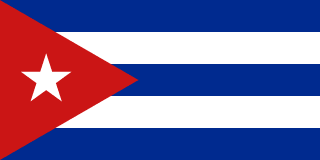
- description: five equal horizontal bands of blue (top, center, and bottom) alternating with white; a red equilateral triangle based on the left side has a five-pointed white star in the center
meaning: the blue bands stand for the islands' three former departments: Central, Occidental, and Oriental; the white bands for the purity of the independence ideal; the triangle for liberty, equality, and fraternity; the red color for the blood shed in the independence struggle; the white star, called "La Estrella Solitaria" (the Lone Star), lights the way to freedom and was inspired by the state flag of Texas
note: design similar to the Puerto Rican flag, with the colors of the bands and triangle reversed - National symbol(s)
- royal palm
- National color(s)
- red, white, blue
- National anthem(s)
- title: "La Bayamesa" (The Bayamo Song)
lyrics/music: Pedro FIGUEREDO
history:
adopted 1940; Pedro FIGUEREDO first performed it in 1868 during the Ten Years War against the Spanish; a leading figure in the uprising, FIGUEREDO was captured in 1870 and executed by a firing squad; just before being shot, he is said to have shouted, "Morir por la Patria es vivir" (To die for the country is to live), a line from the anthem - National heritage
- total World Heritage Sites: 9 (7 cultural, 2 natural)
selected World Heritage Site locales:
Old Havana (c); Trinidad and the Valley de los Ingenios (c); San Pedro de la Roca Castle (c); Desembarco del Granma National Park (n); Viñales Valley (c); Archaeological Landscape of the First Coffee Plantations (c); Alejandro de Humboldt National Park (n); Historic Cienfuegos (c); Historic Camagüey (c)