- Country name
- conventional long form: Federal Republic of Germany
conventional short form: Germany
local long form: Bundesrepublik Deutschland
local short form: Deutschland
former: German Reich
etymology:
the origin of the name is unclear; it may come from Celtic words meaning "neighboring people," or it may derive from Germanic words meaning either "spear man" or "head man;" the native designation "Deutsch" comes from the Old High German "diutisc" meaning "national" - Government type
- federal parliamentary republic
- Capital
- name: Berlin
geographic coordinates: 52 31 N, 13 24 E
time difference: UTC+1 (6 hours ahead of Washington, DC, during Standard Time)
daylight saving time: +1hr, begins last Sunday in March; ends last Sunday in October
etymology: the origin of the name is unclear but may be related to the Old Slavic (Polabian) word berl or birl, meaning "swamp" and referring to the original settlement site by the Spree River - Administrative divisions
- 16 states (Laender, singular - Land); Baden-Wuerttemberg, Bayern (Bavaria), Berlin, Brandenburg, Bremen, Hamburg, Hessen (Hesse), Mecklenburg-Vorpommern (Mecklenburg-Western Pomerania), Niedersachsen (Lower Saxony), Nordrhein-Westfalen (North Rhine-Westphalia), Rheinland-Pfalz (Rhineland-Palatinate), Saarland, Sachsen (Saxony), Sachsen-Anhalt (Saxony-Anhalt), Schleswig-Holstein, Thueringen (Thuringia)
note: Bayern, Sachsen, and Thueringen refer to themselves as free states (Freistaaten, singular - Freistaat), while Bremen calls itself a Free Hanseatic City (Freie Hansestadt) and Hamburg considers itself a Free and Hanseatic City (Freie und Hansestadt) - Legal system
- civil law system
- Constitution
- history: previous 1919 (Weimar Constitution); latest drafted 10-23 August 1948, approved 12 May 1949, promulgated 23 May 1949, entered into force 24 May 1949
amendment process:
proposed by Parliament; passage and enactment into law require two-thirds majority vote by both the Bundesrat (upper house) and the Bundestag (lower house) of Parliament; articles including those on basic human rights and freedoms cannot be amended - International law organization participation
- accepts compulsory ICJ jurisdiction with reservations; accepts ICCt jurisdiction
- Citizenship
- citizenship by birth: no
citizenship by descent only: at least one parent must be a German citizen or a resident alien who has lived in Germany at least 8 years
dual citizenship recognized: yes, but requires prior permission from government
residency requirement for naturalization: 8 years - Suffrage
- 18 years of age; universal; age 16 for some state and municipal elections
- Executive branch
- chief of state: President Frank-Walter STEINMEIER (since 19 March 2017)
head of government: Chancellor Friedrich MERZ (since 6 May 2025)
cabinet: Cabinet or Bundesminister (Federal Ministers) recommended by the chancellor, appointed by the president
election/appointment process:
president indirectly elected by a Federal Convention consisting of all members of the Federal Parliament (Bundestag) and an equivalent number of delegates indirectly elected by the state parliaments; president serves a 5-year term (eligible for a second term); following the most recent Federal Parliament election, the party or coalition with the most representatives usually elects the chancellor, who is appointed by the president to serve a renewable 4-year term
most recent election date:
president: 13 February 2022
chancellor: 6 May 2025
election results:
2025: Friedrich MERZ (CDU) elected chancellor in second round; Federal Parliament vote - 325 to 289
2022: Frank-Walter STEINMEIER reelected president; Federal Convention vote count - Frank-Walter STEINMEIER (SPD) 1,045, Max OTTE (CDU) 140, Gerhard TRABERT (The Left) 96, Stefanie GEBAUER (Free Voters) 58, abstentions 86
expected date of next election: president: February 2027 - Legislative branch
- legislative structure: bicameral
note: due to Germany's recognition of the concepts of "overhang" (when a party's share of the nationwide votes would entitle it to fewer seats than the number of individual constituency seats won in an election under Germany's mixed member proportional system) and "leveling" (whereby additional seats are elected to supplement the members directly elected by each constituency in order to ensure that each party's share of the total seats is roughly proportional to the party's overall shares of votes at the national level), the 20th Bundestag is the largest to date - Legislative branch - lower chamber
- chamber name: German Bundestag (Deutscher Bundestag)
number of seats: 630 (all directly elected)
electoral system: mixed system
scope of elections: full renewal
term in office: 4 years
most recent election date: 2/23/2025
parties elected and seats per party:
Christian Democratic Union (CDU) (164); Alternative for Germany (AfD) (152); Social Democratic Party (SPD) (120); Green Party (85); Left Party (Die Linke) (64); Christian Social Union of Bavaria (CSU) (44); Other (1)
percentage of women in chamber: 32.4%
expected date of next election: February 2029
note 1: total seats can vary each electoral term; currently includes 4 seats for independent members; approximately one-half of members directly elected in multi-seat constituencies by proportional representation vote and approximately one-half directly elected in single-seat constituencies by simple majority vote; members' terms vary depending on the states they represent
note 2: the 20th Bundestag is the largest to date, due to Germany's recognition of "overhang" (when a party's share of the nationwide votes would entitle it to fewer seats than the number of individual constituency seats won in an election) and "leveling" (when additional seats are elected to supplement the members directly elected in order to ensure that each party's share of the total seats is roughly proportional to its overall share of votes at the national level) - Legislative branch - upper chamber
- chamber name: Federal Council (Bundesrat)
number of seats: 69 (all appointed)
parties elected and seats per party: SPD 23; CDU 17; Green Party 15; Left Party 4; CSU 3; FW 3; FDP 2; other 2
percentage of women in chamber: 34.8% - Judicial branch
- highest court(s):
Federal Court of Justice (court consists of 127 judges, including the court president, vice presidents, presiding judges, other judges; organized into 25 Senates subdivided into 12 civil panels, 5 criminal panels, and 8 special panels); Federal Constitutional Court or Bundesverfassungsgericht (consists of 2 Senates each subdivided into 3 chambers, each with a chairman and 8 members)
judge selection and term of office:
Federal Court of Justice judges selected by the Judges Election Committee, which consists of the Secretaries of Justice from each of the 16 federated states and 16 members appointed by the Federal Parliament; judges appointed by the president; judges serve until mandatory retirement at age 65; half of Federal Constitutional Court judges are elected by the House of Representatives and half by the Senate; judges appointed for 12-year terms with mandatory retirement at age 68
subordinate courts:
Federal Administrative Court; Federal Finance Court; Federal Labor Court; Federal Social Court; each of the 16 federated states or Land has its own constitutional court and a hierarchy of ordinary (civil, criminal, family) and specialized (administrative, finance, labor, social) courts; two English-speaking commercial courts opened in 2020 in the state of Baden-Wuerttemberg -- the Stuttgart Commercial Court and the Mannheim Commercial Court - Political parties
- Alliance '90/Greens
Alternative for Germany or AfD
Christian Democratic Union or CDU
Christian Social Union or CSU
Free Democratic Party or FDP
Free Voters or FW
The Left or Die Linke
Social Democratic Party or SPD - Diplomatic representation in the US
- chief of mission: Ambassador Jens HANEFELD (since 5 September 2025)
chancery: 4645 Reservoir Road NW, Washington, DC 20007
telephone: [1] (202) 298-4000
FAX: [1] (202) 298-4261
email address and website:
info@washington.diplo.de
https://www.germany.info/us-en
consulate(s) general: Atlanta, Boston, Chicago, Houston, Los Angeles, Miami, New York, San Francisco - Diplomatic representation from the US
- chief of mission: Ambassador (vacant); Chargé d’Affaires Alan MELTZER (since July 2024)
embassy:
Pariser Platz 2, 10117 Berlin
Clayallee 170, 14191 Berlin (administrative services)
mailing address: 5090 Berlin Place, Washington DC 20521-5090
telephone: [49] (30) 8305-0
FAX: [49] (30) 8305-1215
email address and website:
BerlinPCO@state.gov
https://de.usembassy.gov/
consulate(s) general: Dusseldorf, Frankfurt am Main, Hamburg, Leipzig, Munich - International organization participation
- ADB (nonregional member), AfDB (nonregional member), Arctic Council (observer), Australia Group, BIS, BSEC (observer), CBSS, CD, CDB, CE, CERN, EAPC, EBRD, ECB, EIB, EITI (implementing country), EMU, ESA, EU, FAO, FATF, G-5, G-7, G-8, G-10, G-20, IADB, IAEA, IBRD, ICAO, ICC (national committees), ICCt, ICRM, IDA, IEA, IFAD, IFC, IFRCS, IGAD (partners), IHO, ILO, IMF, IMO, IMSO, Interpol, IOC, IOM, IPU, ISO, ITSO, ITU, ITUC (NGOs), MIGA, MINURSO, NATO, NEA, NSG, OAS (observer), OECD, OPCW, OSCE, Pacific Alliance (observer), Paris Club, PCA, Schengen Convention, SELEC (observer), SICA (observer), UN, UNAMID, UNCTAD, UNESCO, UNHCR, UNHRC, UNIDO, UNIFIL, UNMISS, UNOOSA, UNRWA, UNSOM, UNWTO, UPU, Wassenaar Arrangement, WCO, WHO, WIPO, WMO, WTO, ZC
- Independence
- 18 January 1871 (establishment of the German Empire); divided into four zones of occupation (UK, US, USSR, and France) in 1945 after World War II; Federal Republic of Germany (FRG or West Germany) proclaimed on 23 May 1949 and included the former UK, US, and French zones; German Democratic Republic (GDR or East Germany) proclaimed on 7 October 1949 and included the former USSR zone; West Germany and East Germany unified on 3 October 1990, with all four powers formally relinquishing rights on 15 March 1991; notable earlier dates: 10 August 843 (Eastern Francia established from the division of the Carolingian Empire); 2 February 962 (crowning of OTTO I, recognized as the first Holy Roman Emperor)
- National holiday
- German Unity Day, 3 October (1990)
- Flag
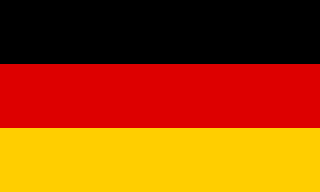
- description: three equal horizontal bands of black (top), red, and gold
history: the colors can be traced back to the medieval banner of the Holy Roman Emperor -- a black eagle with red claws and beak on a gold field - National symbol(s)
- eagle
- National color(s)
- black, red, yellow
- National coat of arms
- Germany’s coat of arms is the world’s oldest, said to date back to 1200, and uses the country’s national colors; it features the oldest European national symbol, an eagle known as the Bundesadler (Federal Eagle); the coat of arms has varied over time for military or political reasons, but the eagle has always been part of the design; the Federal Republic of Germany adopted this version in 1950
- National anthem(s)
- title: “Lied der Deutschen”(Song of the Germans)
lyrics/music: August Heinrich HOFFMANN VON FALLERSLEBEN/Franz Joseph HAYDN
history:
first adopted 1922; the anthem, also known as "Deutschlandlied" (Song of Germany), was originally adopted for its connection to the March 1848 liberal revolution; the Nazis later appropriated the first verse -- specifically the phrase "Deutschland, Deutschland ueber alles" (Germany, Germany above all) -- to promote nationalism, and the anthem was banned after 1945; in 1952, West Germany adopted the third verse as its national anthem; in 1990, it became the national anthem for the reunited Germany - National heritage
- total World Heritage Sites: 56 (54 cultural, 2 natural)
selected World Heritage Site locales:
Museumsinsel (Museum Island), Berlin (c); Palaces and Parks of Potsdam and Berlin (c); Speyer Cathedral (c); Aachen Cathedral (c); Bauhaus and its Sites in Weimar, Dessau, and Bernau (c); Caves and Ice Age Art in the Swabian Jura (c); Roman Monuments, Cathedral of St. Peter, and Church of Our Lady in Trier (c); Hanseatic City of Lübeck (c); Old Town of Regensburg with Stadtamhof (c); Würzburg Residence with the Court Gardens and Residence Square (c); Pilgrimage Church of Wies (c); Castles of Augustusburg and Falkenlust at Brühl (c); St Mary's Cathedral and St Michael's Church at Hildesheim (c); Abbey and Altenmünster of Lorsch (c); Maulbronn Monastery Complex (c); Collegiate Church, Castle and Old Town of Quedlinburg (c); Cologne Cathedral (c); Castle Church in Wittenberg (c); Classical Weimar (c); Wartburg Castle (c); Garden Kingdom of Dessau-Wörlitz (c); Monastic Island of Reichenau (c); Berlin Modernism Housing Estates (c); Prehistoric Pile Dwellings around the Alps (c); Moravian Church Settlements (c); Speicherstadt and Kontorhaus District with Chilehaus (c); The Architectural Work of Le Corbusier, an Outstanding Contribution to the Modern Movement (c); Archaeological Border complex of Hedeby and the Danevirke (c); Naumburg Cathedral (c); Mathildenhöhe Darmstadt (c); ShUM Sites of Speyer, Worms and Mainz (c); The Great Spa Towns of Europe (c); Jewish-Medieval Heritage of Erfurt (c); Schwerin Residence Ensemble (c); The Palaces of King Ludwig II of Bavaria: Neuschwanstein, Linderhof, Schachen and Herrenchiemsee (c); The Palaces of King Ludwig II of Bavaria: Neuschwanstein, Linderhof, Schachen and Herrenchiemsee (c)