- Country name
- conventional long form: Arab Republic of Egypt
conventional short form: Egypt
local long form: Jumhuriyat Misr al-Arabiyah
local short form: Misr
former: United Arab Republic (short-lived unification with Syria)
etymology:
the English name Egypt derives from the ancient Greek name for the country, "Aguptos," and the ancient Roman name, "Aegyptus," with the Greek form coming from the words aia gupos, or "land of the vulture;" the Arabic name for the country, Misr, can be traced to the Assyrian word misir, meaning "fort" - Government type
- presidential republic
- Capital
- name: Cairo
geographic coordinates: 30 03 N, 31 15 E
time difference: UTC+2 (7 hours ahead of Washington, DC, during Standard Time)
daylight saving time: +1hr, begins last Friday in April; ends last Friday in October
etymology:
the ancient Egyptian name of the original city was Khere-ohe or Kheri-aha; the modern city's name may also derive from the Arabic al-qahir, meaning "the victorious;" this is an Arabic name for the planet Mars, which was in the ascendant on the day in 969 A.D. when construction on the new part of the city began - Administrative divisions
- 27 governorates (muhafazat, singular - muhafazat); Ad Daqahliyah, Al Bahr al Ahmar (Red Sea), Al Buhayrah, Al Fayyum, Al Gharbiyah, Al Iskandariyah (Alexandria), Al Isma'iliyah (Ismailia), Al Jizah (Giza), Al Minufiyah, Al Minya, Al Qahirah (Cairo), Al Qalyubiyah, Al Uqsur (Luxor), Al Wadi al Jadid (New Valley), As Suways (Suez), Ash Sharqiyah, Aswan, Asyut, Bani Suwayf, Bur Sa'id (Port Said), Dumyat (Damietta), Janub Sina' (South Sinai), Kafr ash Shaykh, Matruh, Qina, Shamal Sina' (North Sinai), Suhaj
- Legal system
- mixed system based on Napoleonic civil and penal law, Islamic religious law, and vestiges of colonial-era laws; Supreme Constitutional Court reviews laws
- Constitution
- history: several previous; latest approved by a constitutional committee in December 2013, approved by referendum held on 14-15 January 2014, ratified by interim president on 19 January 2014
amendment process:
proposed by the president of the republic or by one fifth of the House of Representatives members; a decision to accept the proposal requires majority vote by House members; passage of amendment requires a two-thirds majority vote by House members and passage by majority vote in a referendum; articles of reelection of the president and principles of freedom are not amendable unless the amendment "brings more guarantees" - International law organization participation
- accepts compulsory ICJ jurisdiction with reservations; non-party state to the ICCt
- Citizenship
- citizenship by birth: no
citizenship by descent only: if the father was born in Egypt
dual citizenship recognized: only with prior permission from the government
residency requirement for naturalization: 10 years - Suffrage
- 18 years of age; universal and compulsory
- Executive branch
- chief of state: President Abdel Fattah EL-SISI (since 8 June 2014)
head of government: Prime Minister Mostafa MADBOULY (since 7 June 2018)
cabinet: Cabinet ministers nominated by the executive branch and approved by the House of Representatives
election/appointment process:
president elected by absolute-majority popular vote in 2 rounds, if needed, for a 6-year term (eligible for 3 consecutive terms); prime minister appointed by the president, approved by the House of Representatives
most recent election date: 10-12 December 2023
election results:
2023: Abdel Fattah EL-SISI reelected president in first round; percent of valid votes cast - Abdel Fattah EL-SISI (independent) 89.6%, Hazam OMAR (Republican People’s Party) 4.5%, Farid ZAHRAN (Egyptian Social Democratic Party 4%, Abdel-Samad YAMAMA 1.9%
2018: Abdelfattah ELSISI reelected president in first round; percent of valid votes cast - Abdelfattah ELSISI (independent) 97.1%, Moussa Mostafa MOUSSA (El Ghad Party) 2.9%; note - more than 7% of ballots cast were deemed invalid
expected date of next election: 2029 - Legislative branch
- legislative structure: bicameral
- Legislative branch - lower chamber
- chamber name: House of Representatives (Majlis Al-Nuwab)
number of seats: 596 (568 directly elected; 28 appointed)
electoral system: mixed system
scope of elections: full renewal
term in office: 5 years
most recent election date: 10/24/2020 to 12/8/2020
parties elected and seats per party: Future of the Nation (Mostakbal Watan) (317); Republican People's party (El Shaab el Gomhory) (49); Independents (117); Other (109)
percentage of women in chamber: 27.7%
expected date of next election: November 2025 - Legislative branch - upper chamber
- chamber name: Senate (Majlis Al-Shiyoukh)
number of seats: 300 (200 directly elected; 100 appointed)
electoral system: mixed system
scope of elections: full renewal
term in office: 5 years
most recent election date: 8/4/2025 to 8/28/2025
parties elected and seats per party: Future of the Nation (Mostakbal Watan) (148); Republican People's party (17); Independents (88); Other (47)
percentage of women in chamber: 10.7%
expected date of next election: July 2030 - Judicial branch
- highest court(s):
Supreme Constitutional Court (SCC) (consists of the court president and 10 justices); the SCC serves as the final court of arbitration on the constitutionality of laws and conflicts between lower courts regarding jurisdiction and rulings; Court of Cassation (CC) (consists of the court president and 550 judges organized in circuits with cases heard by panels of 5 judges); the CC is the highest appeals body for civil and criminal cases, also known as "ordinary justices"; Supreme Administrative Court (SAC) (consists of the court president and NA judges and organized in circuits with cases heard by panels of 5 judges); the SAC is the highest court of the State Council
judge selection and term of office:
under the 2014 constitution, all judges and justices selected and appointed by the Supreme Judiciary Council and approved as a formality by the president of the Republic; judges appointed for life; under the 2019 amendments, the president has the power to appoint heads of judiciary authorities and courts, the prosecutor general, and the head of the Supreme Constitutional Court
subordinate courts: Courts of Appeal; Courts of First Instance; courts of limited jurisdiction; Family Court (established in 2004) - Political parties
- Al-Nour
Arab Democratic Nasserist Party
Congress Party
Conservative Party
Democratic Peace Party
Egyptian National Movement Party
Egyptian Social Democratic Party
El Ghad Party
El Serh El Masry el Hor
Eradet Geel Party
Free Egyptians Party
Freedom Party
Justice Party
Homeland’s Protector Party
Modern Egypt Party
My Homeland Egypt Party
Nation's Future Party (Mostaqbal Watan)
National Progressive Unionist (Tagammu) Party
Reform and Development Party
Republican People’s Party
Revolutionary Guards Party
Wafd Party - Diplomatic representation in the US
- chief of mission: Ambassador Motaz Mounir ZAHRAN (since 17 September 2020)
chancery: 3521 International Court NW, Washington, DC 20008
telephone: [1] (202) 895-5400
FAX: (202) 244-4319
email address and website:
embassy@egyptembassy.net
https://www.egyptembassy.net/
consulate(s) general: Chicago, Houston, Los Angeles, New York - Diplomatic representation from the US
- chief of mission: Ambassador Herro MUSTAFA GARG (since 15 November 2023)
embassy: 5 Tawfik Diab St., Garden City, Cairo
mailing address: 7700 Cairo Place, Washington DC 20512-7700
telephone: [20-2] 2797-3300
FAX: [20-2] 2797-3200
email address and website:
ConsularCairoACS@state.gov
https://eg.usembassy.gov/
consulate(s) general: Alexandria - International organization participation
- ABEDA, AfDB, AFESD, AMF, AU, BRICS, BSEC (observer), CAEU, CD, CICA, COMESA, D-8, EBRD, FAO, G-15, G-24, G-77, IAEA, IBRD, ICAO, ICC (national committees), ICRM, IDA, IDB, IFAD, IFC, IFRCS, IHO, ILO, IMF, IMO, IMSO, Interpol, IOC, IOM, IPU, ISO, ITSO, ITU, LAS, LCBC (observer), MIGA, MINURSO, MONUSCO, NAM, OAPEC, OAS (observer), OIC, OIF, OSCE (partner), PCA, UN, UNAMID, UNCTAD, UNESCO, UNHCR, UNIDO, UNISFA, UNMISS, UNOCI, UNOOSA, UNRWA, UNWTO, UPU, WCO, WFTU (NGOs), WHO, WIPO, WMO, WTO
- Independence
- 28 February 1922 (from UK protectorate status; the military-led revolution that began on 23 July 1952 led to a republic being declared on 18 June 1953 and all British troops withdrawn on 18 June 1956)
note: the Two Lands of Upper (southern) and Lower (northern) Egypt were first united politically around 3200 B.C. - National holiday
- Revolution Day, 23 July (1952)
- Flag
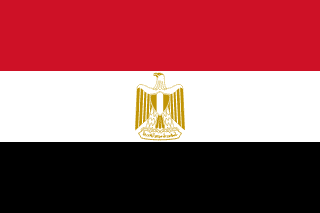
- description: three equal horizontal bands of red (top), white, and black; centered in the white band is the national emblem, a gold Eagle of Saladin; it faces the left side, with a shield on its chest, above a scroll with the country's name in Arabic
meaning: the band colors derive from the Arab Liberation flag and represent oppression (black) overcome through bloody struggle (red), to be replaced by a bright future (white)
note: similar to the flags of Syria (two green stars in the white band), Iraq (an Arabic inscription centered in the white band), and Yemen (plain white band) - National symbol(s)
- golden eagle, white lotus
- National color(s)
- red, white, black
- National coat of arms
- adopted in 1984, the coat of arms features the national symbol, the Eagle of Saladin; the eagle holds a golden scroll with the name of the country, “Gumhuriyet Miṣr al-ʿArabiyyah” (Arab Republic of Egypt), in Arabic script; the shield on the eagle’s chest shows the national colors of red, white, and black
- National anthem(s)
- title: "Bilady, Bilady, Bilady" (My Homeland, My Homeland, My Homeland)
lyrics/music: Younis-al QADI/Sayed DARWISH
history:
adopted 1979; the current anthem was written after the 1979 peace treaty with Israel; the composer is considered the father of modern Egyptian music; of the three verses, only the first verse is sung, preceded and followed by the chorus - National heritage
- total World Heritage Sites: 7 (6 cultural, 1 natural)
selected World Heritage Site locales: Memphis and its Necropolis (c); Ancient Thebes with its Necropolis (c); Nubian Monuments (c); Saint Catherine Area (c); Abu Mena (c); Historic Cairo (c); Wadi Al-Hitan (Whale Valley) (n)