- Country name
- conventional long form: Kingdom of Spain
conventional short form: Spain
local long form: Reino de España
local short form: España
etymology:
derivation of the name España is uncertain; the Basque words ezpain or espan ("edge," as in a river bank) are possible sources, or the Punic word span, meaning "rabbit;" some academics tie it to the god Hesperus from Greco-Roman mythology - Government type
- parliamentary constitutional monarchy
- Capital
- name: Madrid
geographic coordinates: 40 24 N, 3 41 W
time difference: UTC+1 (6 hours ahead of Washington, DC, during Standard Time)
daylight saving time: +1hr, begins last Sunday in March; ends last Sunday in October
time zone note: Spain has two time zones, including the Canary Islands (UTC 0)
etymology:
the meaning and origin of the name is unclear; the city grew from a small Moorish fort that was called Majerit in the first recorded mention in A.D. 932; some trace the modern-day name back to the Roman era, with the Latin word materia (materials) as a possible source - Administrative divisions
- 17 autonomous communities (comunidades autonomas, singular - comunidad autonoma) and 2 autonomous cities* (ciudades autonomas, singular - ciudad autonoma); Andalucia; Aragon; Asturias; Canarias (Canary Islands); Cantabria; Castilla-La Mancha; Castilla-Leon; Cataluña (Castilian), Catalunya (Catalan), Catalonha (Aranese) [Catalonia]; Ceuta*; Comunidad Valenciana (Castilian), Comunitat Valenciana (Valencian) [Valencian Community]; Extremadura; Galicia; Illes Baleares (Balearic Islands); La Rioja; Madrid; Melilla*; Murcia; Navarra (Castilian), Nafarroa (Basque) [Navarre]; Pais Vasco (Castilian), Euskadi (Basque) [Basque Country]
note: Spain administers the autonomous cities of Ceuta and Melilla and the three small islands of Islas Chafarinas, Peñón de Alhucemas, and Peñón de Velez de la Gomera, which are all located along the coast of Morocco; they are collectively referred to as Places of Sovereignty (Plazas de Soberania) - Legal system
- civil law system with regional variations
- Constitution
- history: several previous; latest approved by the General Courts 31 October 1978, passed by referendum 6 December 1978, signed by the king 27 December 1978, effective 29 December 1978
amendment process:
proposed by the government, by the General Courts (the Congress or the Senate), or by the self-governing communities submitted through the government; passage requires three-fifths majority vote by both houses and passage by referendum if requested by one tenth of the members of either house; proposals disapproved by both houses are submitted to a joint committee, which submits an agreed upon text for another vote; passage requires two-thirds majority vote in Congress and simple majority vote in the Senate - International law organization participation
- accepts compulsory ICJ jurisdiction with reservations; accepts ICCt jurisdiction
- Citizenship
- citizenship by birth: no
citizenship by descent only: at least one parent must be a citizen of Spain
dual citizenship recognized: only with select Latin American countries
residency requirement for naturalization: 10 years for persons with no ties to Spain - Suffrage
- 18 years of age; universal
- Executive branch
- chief of state: King FELIPE VI (since 19 June 2014)
head of government: President of the Government of Spain (prime minister-equivalent) Pedro SANCHEZ PEREZ-CASTEJON (since 2 June 2018)
cabinet: Council of Ministers designated by the president
election/appointment process:
the monarchy is hereditary; following legislative elections, the monarch usually proposes as president the leader of the majority party or coalition, who is then indirectly elected by the Congress of Deputies; vice president and Council of Ministers appointed by the president
most recent election date: 23 July 2023
election results: Congress of Deputies vote - 179 to 171 (16 November 2023)
expected date of next election: 31 July 2027
note: there is also a Council of State that is the supreme consultative organ of the government, but its recommendations are non-binding - Legislative branch
- legislature name: The Cortes (Las Cortes Generales)
legislative structure: bicameral - Legislative branch - lower chamber
- chamber name: Congress of Deputies (Congreso de los Diputados)
number of seats: 350 (all directly elected)
electoral system: proportional representation
scope of elections: full renewal
term in office: 4 years
most recent election date: 7/23/2023
parties elected and seats per party: People's Party (PP) (136); Spanish Socialist Workers' Party (PSOE) (122); Vox (33); SUMAR (31); Other (28)
percentage of women in chamber: 44.3%
expected date of next election: July 2027 - Legislative branch - upper chamber
- chamber name: Senate (Senado)
number of seats: 265 (208 directly elected; 57 indirectly elected)
electoral system: mixed system
scope of elections: full renewal
term in office: 4 years
most recent election date: 7/23/2023
parties elected and seats per party: People's Party (PP) (120); Spanish Socialist Workers' Party (PSOE) (72); Other (16)
percentage of women in chamber: 42.5%
expected date of next election: July 2027 - Judicial branch
- highest court(s):
Supreme Court or Tribunal Supremo (consists of the court president and organized into the Civil Room, with a president and 9 judges; the Penal Room, with a president and 14 judges; the Administrative Room, with a president and 32 judges; the Social Room, with a president and 12 judges; and the Military Room, with a president and 7 judges); Constitutional Court or Tribunal Constitucional de Espana (consists of 12 judges)
judge selection and term of office:
Supreme Court judges appointed by the monarch from candidates proposed by the General Council of the Judiciary Power, a 20-member governing board chaired by the monarch; judges can serve until age 70; Constitutional Court judges nominated by the National Assembly, executive branch, and the General Council of the Judiciary, and appointed by the monarch for 9-year terms
subordinate courts: National High Court; High Courts of Justice (in each of the autonomous communities); provincial courts; courts of first instance - Political parties
- Asturias Forum or FAC
Basque Country Unite (Euskal Herria Bildu) or EH Bildu (coalition of 4 Basque pro-independence parties)
Basque Nationalist Party or PNV or EAJ
Canarian Coalition or CC (coalition of 5 parties)
Ciudadanos Party (Citizens Party) or Cs
Compromis - Compromise Coalition
Navarrese People's Union or UPN
Together for Catalonia or Junts
People's Party or PP
Republican Left of Catalonia or ERC
Spanish Socialist Workers Party or PSOE
Teruel Existe or TE
Unidas (Unite) or Sumar (electoral coalition formed in March 2022) (formerly Unidas Podemos or UP)
Vox or VOX - Diplomatic representation in the US
- chief of mission: Ambassador Ángeles MORENO Bau (since 27 February 2024)
chancery: 2375 Pennsylvania Avenue NW, Washington, DC 20037
telephone: [1] (202) 452-0100
FAX: [1] (202) 833-5670
email address and website:
emb.washington@maec.es
https://www.exteriores.gob.es/Embajadas/washington/en/Paginas/index.aspx
consulate(s) general: Boston, Chicago, Houston, Los Angeles, Miami, New York, San Francisco, San Juan (Puerto Rico) - Diplomatic representation from the US
- chief of mission: Ambassador (vacant); Chargé d’Affaires Rian Harker HARRIS (since 15 July 2024); note - also accredited to Andorra
embassy: Calle de Serrano, 75, 28006 Madrid
mailing address: 8500 Madrid Place, Washington DC 20521-8500
telephone: [34] (91) 587-2200
FAX: [34] (91) 587-2303
email address and website:
askACS@state.gov
https://es.usembassy.gov/
consulate(s) general: Barcelona - International organization participation
- ADB (nonregional member), AfDB (nonregional member), Arctic Council (observer), Australia Group, BCIE, BIS, CABEI, CAN (observer), CBSS (observer), CD, CE, CERN, EAPC, EBRD, ECB, EIB, EITI (implementing country), EMU, ESA, EU, FAO, FATF, IADB, IAEA, IBRD, ICAO, ICC (national committees), ICCt, ICRM, IDA, IEA, IFAD, IFC, IFRCS, IHO, ILO, IMF, IMO, IMSO, Interpol, IOC, IOM, IPU, ISO, ITSO, ITU, ITUC (NGOs), LAIA (observer), MIGA, NATO, NEA, NSG, OAS (observer), OECD, OPCW, OSCE, Pacific Alliance (observer), Paris Club, PCA, PIF (partner), Schengen Convention, SELEC (observer), SICA (observer), UN, UNCTAD, UNESCO, UNHCR, UNIDO, UNIFIL, Union Latina, UNOCI, UNOOSA, UNRWA, UNWTO, UPU, Wassenaar Arrangement, WCO, WHO, WIPO, WMO, WTO, ZC
- Independence
- 1492
note: the Iberian peninsula was home to a variety of independent kingdoms prior to the Muslim occupation that began in the early 8th century A.D. and lasted nearly seven centuries; the small Christian redoubts of the north began the reconquest almost immediately, culminating in the seizure of Granada in 1492; this completed the unification of several kingdoms and is traditionally considered the forging of present-day Spain - National holiday
- National Day (Hispanic Day), 12 October (1492)
note: commemorates the arrival of explorer Christopher COLUMBUS in the Americas - Flag
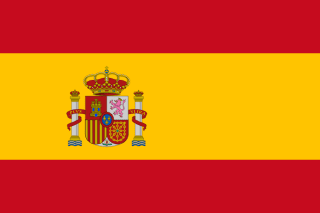
- description: three horizontal bands of red (top), yellow (double-width), and red, with the national coat of arms on the left side of the yellow band; the coat of arms shows the emblems of the area's former kingdoms (clockwise from upper left: Castile, Leon, Navarre, and Aragon), which also used red and yellow as their colors; the stylized pomegranate at the bottom of the shield represents Granada; the two columns represent the Pillars of Hercules, which are promontories (Gibraltar and Ceuta) on the Strait of Gibraltar; a red scroll bears the imperial motto of "Plus Ultra" (further beyond), referring to Spanish lands outside Europe
- National symbol(s)
- Pillars of Hercules
- National color(s)
- red, yellow
- National anthem(s)
- title: "Himno Nacional Espanol" (National Anthem of Spain)
lyrics/music: no lyrics/unknown
history:
adopted 1942;officially in use between 1770 and 1931, restored in 1939; the Spanish anthem was the first to be officially adopted; it first appeared in a 1761 military bugle-call book and was replaced by "Himno de Riego" in the years between 1931 and 1939; the long version of the anthem is used for the king, and the short version is used for the prince, prime minister, and occasions such as sporting events - National heritage
- total World Heritage Sites: 50 (44 cultural, 4 natural, 2 mixed)
selected World Heritage Site locales:
Cave of Altamira and Paleolithic Cave Art of Northern Spain (c); Works of Antoni Gaudí (c); Santiago de Compostela (Old Town) (c); Historic City of Toledo (c); Archaeological Ensemble of Mérida (c); Tower of Hercules (c); Doñana National Park (n); Pyrénées - Mont Perdu (m); Alhambra, Generalife, and Albayzín in Granada (c); Old City of Salamanca (c); Teide National Park (n); Historic Walled Town of Cuenca (c); Old Town of Segovia and its Aqueduct (c); Historic Cordoba (c); Royal Site of Saint Lorenzo de El Escorial (c); Cathedral, Alcázar, and Archivo de Indias in Seville