- Country name
- conventional long form: Federal Democratic Republic of Ethiopia
conventional short form: Ethiopia
local long form: YeItyop'iya Federalawi Demokrasiyawi Ripeblik
local short form: Ityop'iya
former: Abyssinia, Italian East Africa
abbreviation: FDRE
etymology: the country name derives from the ancient Greek word used to describe the inhabitants, aithiops, meaning "burnt appearance" - Government type
- federal parliamentary republic
- Capital
- name: Addis Ababa
geographic coordinates: 9 02 N, 38 42 E
time difference: UTC+3 (8 hours ahead of Washington, DC, during Standard Time)
etymology: the name in Amharic means "new flower;" Empress TAITU gave the name to the new capital city in 1887 - Administrative divisions
- 12 ethnically based regional states (kililoch, singular - kilil) and 2 chartered cities* (astedader akabibiwach, singular - astedader akabibi); Adis Abeba* (Addis Ababa), Afar, Amara (Amhara), Binshangul Gumuz, Dire Dawa*, Gambela Hizboch (Gambela), Hareri Hizb (Harari), Oromia, Sidama, Sumale, Tigray, YeDebub Biheroch Bihereseboch na Hizboch (Southern Nations, Nationalities and Peoples), YeDebub M'irab Ityop'iya Hizboch (Southwest Ethiopia Peoples), Southern Ethiopia Peoples
- Legal system
- civil law system
- Constitution
- history: several previous; latest drafted June 1994, adopted 8 December 1994, entered into force 21 August 1995
amendment process:
proposals submitted for discussion require two-thirds majority approval in either house of Parliament or majority approval of one-third of the State Councils; passage of amendments other than constitutional articles on fundamental rights and freedoms and the initiation and amendment of the constitution requires two-thirds majority vote in a joint session of Parliament and majority vote by two thirds of the State Councils; passage of amendments affecting rights and freedoms and amendment procedures requires two-thirds majority vote in each house of Parliament and majority vote by all the State Councils - International law organization participation
- has not submitted an ICJ jurisdiction declaration; non-party state to the ICCt
- Citizenship
- citizenship by birth: no
citizenship by descent only: at least one parent must be a citizen of Ethiopia
dual citizenship recognized: no
residency requirement for naturalization: 4 years - Suffrage
- 18 years of age; universal
- Executive branch
- chief of state: President TAYE Atske Selassie (since 7 October 2024)
head of government: Prime Minister ABIY Ahmed Ali (since April 2018)
cabinet: Council of Ministers selected by the prime minister and approved by the House of People's Representatives
election/appointment process: president indirectly elected by both chambers of Parliament for a 6-year term (eligible for a second term); prime minister designated by the majority party following legislative elections
most recent election date: 21 June 2021 and 30 September 2021 (scheduled 29 August 2020 election was postponed due to the COVID-19 pandemic)
election results: 2021: SAHLE-WORK Zewde reelected president during joint session of Parliament, vote - 659 (unanimous); ABIY confirmed Prime Minister by House of Peoples' Representatives (4 October 2021) - Legislative branch
- legislative structure: bicameral
note: the House of Federation is responsible for interpreting the constitution and federal-regional issues, and the House of People's Representatives is responsible for passing legislation - Legislative branch - lower chamber
- chamber name: House of Peoples' Representatives (Yehizb Tewokayoch Mekir Bete)
number of seats: 547 (all directly elected)
electoral system: plurality/majority
scope of elections: full renewal
term in office: 5 years
most recent election date: 6/21/2021 to 9/30/2021
parties elected and seats per party: Prosperity Party (448); Other (22)
percentage of women in chamber: 41.9%
expected date of next election: June 2026
note: only 470 of the 547 seats in the House of People's Representatives were filled during the 2021 elections due to security issues in the Tigray State and other areas - Legislative branch - upper chamber
- chamber name: House of the Federation (Yefedereshein Mekir Bete)
number of seats: 153 (all indirectly elected)
scope of elections: full renewal
term in office: 5 years
most recent election date: 10/4/2021
percentage of women in chamber: 29.7%
expected date of next election: October 2026 - Judicial branch
- highest court(s): Federal Supreme Court (consists of 11 judges)
judge selection and term of office:
president and vice president of Federal Supreme Court recommended by the prime minister and appointed by the House of People's Representatives; other Supreme Court judges nominated by the Federal Judicial Administrative Council (a 10-member body chaired by the president of the Federal Supreme Court) and appointed by the House of People's Representatives; judges serve until retirement at age 60
subordinate courts: federal high courts and federal courts of first instance; state court systems (mirror structure of federal system); sharia courts and customary and traditional courts
note: the House of Federation has jurisdiction for all constitutional issues - Political parties
- Ethiopian Citizens for Social Justice and Democracy or EZEMA
Gedeo People's Democratic Party
Independent
Kucha People Democratic Party
National Movement of Amhara or NAMA
Prosperity Party or PP - Diplomatic representation in the US
- chief of mission: Ambassador BINALF Andualem Ashenef (since 25 February 2025)
chancery: 3506 International Drive NW, Washington, DC 20008
telephone: [1] (202) 364-1200
FAX: [1] (202) 587-0195
email address and website:
ethiopia@ethiopianembassy.org
https://ethiopianembassy.org/
consulate(s) general: Los Angeles, St. Paul (MN) - Diplomatic representation from the US
- chief of mission: Ambassador Ervin MASSINGA (since 4 October 2023)
embassy: Entoto Street, P.O. Box 1014, Addis Ababa
mailing address: 2030 Addis Ababa Place, Washington DC 20521-2030
telephone: [251] 111-30-60-00
FAX: [251] 111-24-24-01
email address and website:
AddisACS@state.gov
https://et.usembassy.gov/ - International organization participation
- ACP, AfDB, ATMIS, AU, BRICS, COMESA, EITI, FAO, G-24, G-77, IAEA, IBRD, ICAO, ICRM, IDA, IFAD, IFC, IFRCS, IGAD, ILO, IMF, IMO, Interpol, IOC, IOM, IPU, ISO, ITSO, ITU, ITUC (NGOs), MIGA, NAM, OPCW, PCA, UN, UNCTAD, UNESCO, UNHCR, UNIDO, UNMISS, UNOOSA, UNWTO, UPU, WCO, WFTU (NGOs), WHO, WIPO, WMO, WTO (accession candidate)
- Independence
- oldest independent country in Africa and one of the oldest in the world, at least 2,000 years; may be traced to the Aksumite Kingdom, which appeared in the first century B.C.
- National holiday
- Derg Downfall Day (defeat of MENGISTU regime), 28 May (1991)
- Flag
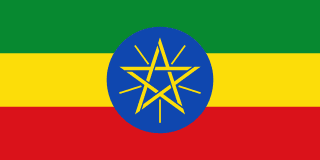
- description: three equal horizontal bands of green (top), yellow, and red, with a light blue disk centered on the three bands; on the disk is a yellow pentagram with single yellow rays emanating from the angles between the points
meaning: green stands for hope and the land's fertility, yellow for justice and harmony, and red for sacrifice and heroism; the blue of the disk symbolizes peace, and the pentagram represents the Ethiopian people's unity and equality
history: the emblem in the center of the current flag was added in 1996
note: Ethiopia is the oldest independent country in Africa, and newly independent African countries often adopted the Ethiopian flag's colors, which were later known as the Pan-African movement's colors - National symbol(s)
- Abyssinian lion (traditional), yellow pentagram with five rays of light on a blue field (promoted by government)
- National color(s)
- green, yellow, red
- National coat of arms
- adopted in 1996, the coat of arms features the national symbol, a pentagram; the blue circle symbolizes peace, and the pentagram represents the unity and equality of the Ethiopian people
- National anthem(s)
- title: "Whedefit Gesgeshi Woud Enat Ethiopia" (March Forward, Dear Mother Ethiopia)
lyrics/music: DEREJE Melaku Mengesha/SOLOMON Lulu
history: adopted 1992 - National heritage
- total World Heritage Sites: 12 (10 cultural, 2 natural)
selected World Heritage Site locales:
Rock-Hewn Churches, Lalibela (c); Simien National Park (n); Fasil Ghebbi, Gondar Region (c); Aksum (c); Lower Valley of the Awash (c); Lower Valley of the Omo (c); Tiya (c); Harar Jugol, the Fortified Historic Town (c); Konso Cultural Landscape (c); Gedeo Cultural Landscape (c); Bale Mountains National Park (n); Melka Kunture and Balchit: Archaeological and Palaeontological Sites in the Highland Area of Ethiopia (c)