- Country name
- conventional long form: Republic of Guinea-Bissau
conventional short form: Guinea-Bissau
local long form: Republica da Guine-Bissau
local short form: Guine-Bissau
former: Portuguese Guinea
etymology:
the country is partly named after the Guinea region of West Africa that lies along the Gulf of Guinea; the name itself is derived from the Tuareg word aginaw, meaning "black people;" Bissau, the name of the capital city, distinguishes the country from neighboring Guinea and is derived from the local Bijuga people - Government type
- semi-presidential republic
- Capital
- name: Bissau
geographic coordinates: 11 51 N, 15 35 W
time difference: UTC 0 (5 hours ahead of Washington, DC, during Standard Time)
etymology: the name is derived from the local Bijuga people and is used to distinguish the country from neighboring Guinea - Administrative divisions
- 9 regions (regioes, singular - regiao); Bafata, Biombo, Bissau, Bolama/Bijagos, Cacheu, Gabu, Oio, Quinara, Tombali
- Legal system
- mixed system of civil law, which incorporated Portuguese law at independence; influenced by Economic Community of West African States (ECOWAS), West African Economic and Monetary Union (UEMOA), African Francophone Public Law, and customary law
- Constitution
- history: promulgated 16 May 1984
amendment process:
proposed by the National People’s Assembly if supported by at least one third of its members, by the Council of State (a presidential consultant body), or by the government; passage requires approval by at least two-thirds majority vote of the Assembly; constitutional articles on the republican and secular form of government and national sovereignty cannot be amended - International law organization participation
- accepts compulsory ICJ jurisdiction; non-party state to the ICCt
- Citizenship
- citizenship by birth: yes
citizenship by descent only: yes
dual citizenship recognized: no
residency requirement for naturalization: 5 years - Suffrage
- 18 years of age; universal
- Executive branch
- chief of state: Interim President Gen. Horta Nta Na MAN (since 27 November 2025)
head of government: Interim Prime Minister Ilídio Vieira TE (since 28 November 2025)
cabinet: Cabinet nominated by the prime minister, appointed by the president
election/appointment process:
president directly elected by absolute-majority popular vote in 2 rounds, if needed, for up to 2 consecutive 5-year terms; prime minister appointed by the president after consultation with party leaders in the National People's Assembly
most recent election date: 23 November 2025
election results:
2025: Umaro Sissoco EMBALO (Madem G15) and Fernando DIAS da Costa (PRS) both claimed victory in first round; a coup prevented the release of election results after ballots were destroyed
2019: Umaro Sissoco EMBALO elected president in second round; percent of vote in first round - Domingos Simoes PEREIRA (PAIGC) 40.1%, Umaro Sissoco EMBALO (Madem G15) 27.7%, Nuno Gomez NABIAM (APU-PDGB) 13.2%, Jose Mario VAZ (independent) 12.4%, other 6.6%; percent of vote in second round - Umaro Sissoco EMBALO 53.6%, Domingos Simoes PEREIRA 46.5% (2019)
expected date of next election: 2025
note: elections were held on 23 November 2025; a military coup on 26 November suspended the election process, arrested the sitting president, swore in a transitional president, and appointed a cabinet for one year - Legislative branch
- legislature name: People's National Assembly (Assembleia Nacional Popular)
legislative structure: unicameral
number of seats: 102 (all directly elected)
electoral system: proportional representation
scope of elections: full renewal
term in office: 4 years
most recent election date: 11/23/2025
parties elected and seats per party: Inclusive Alliance Platform/Terra Coalition (54); Movement for Democratic Alternation (MADEM G.15) (29); Party for Social Renewal (PRS) (12); Bissau-Guinean Workers’ Party (6); Other (1)
percentage of women in chamber: 9.8%
expected date of next election: November 2029 - Judicial branch
- highest court(s): Supreme Court or Supremo Tribunal de Justica (consists of 9 judges and organized into Civil, Criminal, and Social and Administrative Disputes Chambers)
judge selection and term of office: judges nominated by the Higher Council of the Magistrate, a major government organ responsible for judge appointments, dismissals, and judiciary discipline; judges appointed by the president for life
subordinate courts: Appeals Court; regional (first instance) courts; military court
note: the Supreme Court has both appellate and constitutional jurisdiction - Political parties
- African Party for the Independence of Guinea and Cabo Verde or PAIGC
Democratic Convergence Party or PCD
Movement for Democratic Alternation Group of 15 or MADEM-G15
National People’s Assembly – Democratic Party of Guinea Bissau or APU-PDGB
New Democracy Party or PND
Party for Social Renewal or PRS
Republican Party for Independence and Development or PRID
Union for Change or UM - Diplomatic representation in the US
- chief of mission: Ambassador Maria Da Conceição NOBRE CABRAL (since 18 September 2024)
chancery:
918 16th Street, NW (Mezzanine Suite)
Washington DC 20006
telephone: [1] (202) 872-4222
FAX: [1] (202) 872-4226 - Diplomatic representation from the US
- chief of mission: Ambassador Michael RAYNOR (since 20 April 2022)
mailing address: 2080 Bissau Place, Washington DC 20521-2080
email address and website:
dakarACS@state.gov
https://gw.usmission.gov/ - International organization participation
- ACP, AfDB, AOSIS, AU, CPLP, ECOWAS, FAO, FZ, G-77, IBRD, ICAO, ICRM, IDA, IDB, IFAD, IFC, IFRCS, ILO, IMF, IMO, Interpol, IOC, IOM, IPU, ITSO, ITU, ITUC (NGOs), MIGA, MINUSMA, NAM, OIC, OIF, OPCW, UN, UNCTAD, UNESCO, UNIDO, UNWTO, UPU, WADB (regional), WAEMU, WCO, WFTU (NGOs), WHO, WIPO, WMO, WTO
- Independence
- 24 September 1973 (declared); 10 September 1974 (from Portugal)
- National holiday
- Independence Day, 24 September (1973)
- Flag
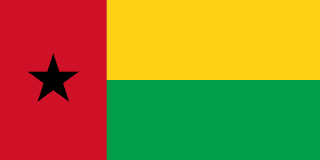
- description: two equal horizontal bands of yellow (top) and green, with a vertical red band on the left side; a five-pointed black star is centered in the red band
meaning: yellow stands for the sun, green for hope, red for blood shed during the struggle for independence; the black star stands for African unity
history: uses the colors of the Pan-African movement; the Ghanaian flag heavily influenced the design - National symbol(s)
- black star
- National color(s)
- red, yellow, green, black
- National anthem(s)
- title: "Esta e a Nossa Patria Bem Amada" (This is Our Beloved Country)
lyrics/music: Amilcar Lopes CABRAL/XIAO He
history:
adopted 1974; a delegation from Portuguese Guinea visited China in 1963 and heard music by XIAO He; Amilcar Lopes CABRAL, the leader of Guinea-Bissau's independence movement, asked the composer to create a piece that would inspire his people to fight for independence - National heritage
- total World Heritage Sites: 1 (natural)
selected World Heritage Site locales: Coastal and Marine Ecosystems of the Bijagós Archipelago – Omatí Minhô (n)