- Country name
- conventional long form: Hellenic Republic
conventional short form: Greece
local long form: Elliniki Dimokratia
local short form: Ellas or Ellada
former: Hellenic State, Kingdom of Greece
etymology:
the English name derives from the Roman (Latin) designation Graecia, meaning "Land of the Greeks"; the Greeks call their country Ellas or Ellada, which is probably derived from Hellas, the name of the mythical son of Deucalian - Government type
- parliamentary republic
- Capital
- name: Athens
geographic coordinates: 37 59 N, 23 44 E
time difference: UTC+2 (7 hours ahead of Washington, DC, during Standard Time)
daylight saving time: +1hr, begins last Sunday in March; ends last Sunday in October
etymology: the origin of the name is uncertain; according to tradition, the city is named after Athena, the Greek goddess of wisdom, but the name is probably pre-Hellenic - Administrative divisions
- 13 regions (perifereies, singular - perifereia) and 1 autonomous monastic state* (aftonomi monastiki politeia); Agion Oros* (Mount Athos), Anatoliki Makedonia kai Thraki (East Macedonia and Thrace), Attiki (Attica), Dytiki Ellada (West Greece), Dytiki Makedonia (West Macedonia), Ionia Nisia (Ionian Islands), Ipeiros (Epirus), Kentriki Makedonia (Central Macedonia), Kriti (Crete), Notio Aigaio (South Aegean), Peloponnisos (Peloponnese), Sterea Ellada (Central Greece), Thessalia (Thessaly), Voreio Aigaio (North Aegean)
- Legal system
- civil legal system based on Roman law
- Constitution
- history: many previous; latest entered into force 11 June 1975
amendment process:
proposed by at least 50 members of Parliament and agreed by three-fifths majority vote in two separate ballots at least 30 days apart; passage requires absolute majority vote by the next elected Parliament; entry into force finalized through a "special parliamentary resolution"; articles on human rights and freedoms and the form of government cannot be amended - International law organization participation
- accepts compulsory ICJ jurisdiction with reservations; accepts ICCt jurisdiction
- Citizenship
- citizenship by birth: no
citizenship by descent only: at least one parent must be a citizen of Greece
dual citizenship recognized: yes
residency requirement for naturalization: 10 years - Suffrage
- 17 years of age; universal and compulsory
- Executive branch
- chief of state: President Konstantinos TASOULAS (since 13 March 2025)
head of government: Prime Minister Kyriakos MITSOTAKIS (since 26 June 2023)
cabinet: Cabinet appointed by the president on the recommendation of the prime minister
election/appointment process: president elected by Hellenic Parliament for a 5-year term (eligible for a second term); president appoints as prime minister the leader of the majority party or coalition in the Hellenic Parliament
most recent election date: 12 February 2025
election results:
2025: Konstantinos TASOULAS (ND) elected president by Parliament - 160 of 300 votes
2020: Katerina SAKELLAROPOULOU (independent) elected president by Parliament - 261 of 300 votes
expected date of next election: 2030 - Legislative branch
- legislature name: Hellenic Parliament (Vouli Ton Ellinon)
legislative structure: unicameral
number of seats: 300 (all directly elected)
electoral system: proportional representation
scope of elections: full renewal
term in office: 4 years
most recent election date: 6/25/2023
parties elected and seats per party: New Democracy (ND) (158); Coalition of the Radical Left (SYRIZA) (47); Panhellenic Socialist Movement - Movement for Change (PASOK-KINAL) (32); Communist Party (KKE) (21); Other (42)
percentage of women in chamber: 22.9%
expected date of next election: June 2027
note: only parties surpassing a 3% vote threshold are entitled to parliamentary seats; parties need 10 seats to become formal parliamentary groups but can retain that status if the party participated in the last election and received the minimum 3% threshold - Judicial branch
- highest court(s):
Supreme Civil and Criminal Court or Areios Pagos (consists of 56 judges, including the court presidents); Council of State (supreme administrative court) consists of the president, 7 vice presidents, 42 privy councilors, 48 associate councilors and 50 reporting judges, organized into six 5- and 7-member chambers; Court of Audit (government audit and enforcement) consists of the president, 5 vice presidents, 20 councilors, and 90 associate and reporting judges
judge selection and term of office:
Supreme Court judges appointed by presidential decree on the advice of the Supreme Judicial Council (SJC), which includes the president of the Supreme Court, other judges, and the prosecutor of the Supreme Court; judges appointed for life after a 2-year probationary period; Council of State president appointed by the Greek Cabinet to serve a 4-year term; other judge appointments and tenure NA; Court of Audit president appointed by decree of the president of the republic on the advice of the SJC; court president serves a 4-year term or until age 67; tenure of vice presidents, councilors, and judges NA
subordinate courts: Courts of Appeal and Courts of First Instance (district courts) - Political parties
- Coalition of the Radical Left-Progressive Alliance or SYRIZA-PS
Communist Party of Greece or KKE
Course of Freedom
Democratic Patriotic Movement-Victory or NIKI
Greek Solution
New Democracy or ND
PASOK - Movement for Change or PASOK-KINAL
Spartans - Diplomatic representation in the US
- chief of mission: Ambassador Ekaterini NASSIKA (since 27 February 2024)
chancery: 2217 Massachusetts Avenue NW, Washington, DC 20008
telephone: [1] (202) 939-1300
FAX: [1] (202) 939-1324
email address and website:
gremb.was@mfa.gr
https://www.mfa.gr/usa/en/the-embassy/
consulate(s) general: Boston, Chicago, Los Angeles, New York, Tampa (FL), San Francisco
consulate(s): Atlanta, Houston - Diplomatic representation from the US
- chief of mission: Ambassador Kimberly Ann GUILFOYLE (since 4 November 2025)
embassy: 91 Vasillisis Sophias Avenue, 10160 Athens
mailing address: 7100 Athens Place, Washington DC 20521-7100
telephone: [30] (210) 721-2951
FAX: [30] (210) 724-5313
email address and website:
athensamericancitizenservices@state.gov
https://gr.usembassy.gov/
consulate(s) general: Thessaloniki - International organization participation
- Australia Group, BIS, BSEC, CD, CE, CERN, EAPC, EBRD, ECB, EIB, EMU, ESA, EU, FAO, FATF, IAEA, IBRD, ICAO, ICC (national committees), ICCt, ICRM, IDA, IEA, IFAD, IFC, IFRCS, IGAD (partners), IHO, ILO, IMF, IMO, IMSO, Interpol, IOC, IOM, IPU, ISO, ITSO, ITU, ITUC (NGOs), MIGA, NATO, NEA, NSG, OAS (observer), OECD, OIF, OPCW, OSCE, PCA, Schengen Convention, SELEC, UN, UNCTAD, UNESCO, UNHCR, UNIDO, UNIFIL, UNOOSA, UNWTO, UPU, Wassenaar Arrangement, WCO, WFTU (NGOs), WHO, WIPO, WMO, WTO, ZC
- Independence
- 3 February 1830 (from the Ottoman Empire)
note: the national revolt against the Ottomans began on 25 March 1821; the London Protocol recognizing Greek independence was signed on 3 February 1830 by Great Britain, France, and Russia - National holiday
- Independence Day, 25 March (1821)
- Flag
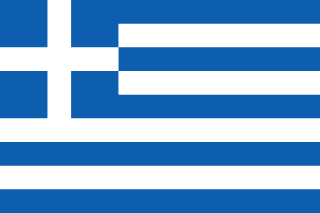
- description: nine equal horizontal stripes of blue alternating with white; a blue square with a white cross is in the upper-left corner
meaning: the cross symbolizes Greek Orthodoxy, the established religion; there is no set meaning for the stripes and colors
note: Greek legislation states that the flag colors are cyan and white, but cyan can mean "blue" in Greek, so the exact shade of blue has never been set and has varied from a light to a dark blue over time; the blue is now usually an azure - National symbol(s)
- Greek cross (white cross on a blue field)
- National color(s)
- blue, white
- National coat of arms
- the coat of arms was designed by Greek artist Kostas Grammatopoulos and has been in use since 1975; depicted in the national colors of blue and white; the white cross represents the country’s primary religion, Greek Orthodoxy, and the laurel branches symbolize victory
- National anthem(s)
- title: "Ymnos eis tin Eleftherian" (Hymn to Freedom)
lyrics/music: Dionysios SOLOMOS/Nikolaos MANTZAROS
history:
adopted 1864; the anthem is based on a 158-stanza poem by the same name, which was inspired by the Greek Revolution of 1821 against the Ottomans (only the first two stanzas are used); Cyprus also uses "Hymn to Freedom" as its anthem - National heritage
- total World Heritage Sites: 20 (18 cultural, 2 mixed)
selected World Heritage Site locales:
Acropolis, Athens (c); Archaeological site of Delphi (c); Meteora (m); Medieval City of Rhodes (c); Archaeological site of Olympia (c); Archaeological site of Mycenae and Tiryns (c); Old Town of Corfu (c); Mount Athos (m); Delos (c); Archaeological Site of Philippi (c); Minoan Palatial Centres (c)