- Country name
- conventional long form: Republic of Croatia
conventional short form: Croatia
local long form: Republika Hrvatska
local short form: Hrvatska
former: People's Republic of Croatia, Socialist Republic of Croatia
etymology: name probably derives from the Croats, a Slavic tribe who migrated to the Balkans in the 7th century A.D., but that name may be related to the Russian word khrebet, meaning "mountain chain" - Government type
- parliamentary republic
- Capital
- name: Zagreb
geographic coordinates: 45 48 N, 16 00 E
time difference: UTC+1 (6 hours ahead of Washington, DC, during Standard Time)
daylight saving time: +1hr, begins last Sunday in March; ends last Sunday in October
etymology: the city's name means "beyond the bank (or ditch)"; za in Old Croat means "beyond," and greb means "bank" or "ditch," relating to the city's original site above the Sava River - Administrative divisions
- 20 counties (zupanije, singular - zupanija) and 1 city* (grad - singular) with special county status; Bjelovarsko-Bilogorska (Bjelovar-Bilogora), Brodsko-Posavska (Brod-Posavina), Dubrovacko-Neretvanska (Dubrovnik-Neretva), Istarska (Istria), Karlovacka (Karlovac), Koprivnicko-Krizevacka (Koprivnica-Krizevci), Krapinsko-Zagorska (Krapina-Zagorje), Licko-Senjska (Lika-Senj), Medimurska (Medimurje), Osjecko-Baranjska (Osijek-Baranja), Pozesko-Slavonska (Pozega-Slavonia), Primorsko-Goranska (Primorje-Gorski Kotar), Sibensko-Kninska (Sibenik-Knin), Sisacko-Moslavacka (Sisak-Moslavina), Splitsko-Dalmatinska (Split-Dalmatia), Varazdinska (Varazdin), Viroviticko-Podravska (Virovitica-Podravina), Vukovarsko-Srijemska (Vukovar-Syrmia), Zadarska (Zadar), Zagreb*, Zagrebacka (Zagreb county)
- Legal system
- civil law system influenced by legal heritage of Austria-Hungary
- Constitution
- history: several previous; latest adopted 22 December 1990
amendment process:
proposed by at least one fifth of the Assembly membership, by the president of the republic, by the Government of Croatia, or through petition by at least 10% of the total electorate; proceedings to amend require majority vote by the Assembly; passage requires two-thirds majority vote by the Assembly; passage by petition requires a majority vote in a referendum and promulgation by the Assembly - International law organization participation
- has not submitted an ICJ jurisdiction declaration; accepts ICCt jurisdiction
- Citizenship
- citizenship by birth: no
citizenship by descent only: at least one parent must be a citizen of Croatia
dual citizenship recognized: yes
residency requirement for naturalization: 5 years - Suffrage
- 18 years of age; universal
- Executive branch
- chief of state: President Zoran MILANOVIC (since 18 February 2020)
head of government: Prime Minister Andrej PLENKOVIC (since 19 October 2016)
cabinet: Council of Ministers named by the prime minister and approved by the Assembly
election/appointment process:
president directly elected by absolute-majority popular vote in 2 rounds, if needed, for a 5-year term (eligible for a second term); the leader of the majority party or majority coalition is usually appointed prime minister by the president and approved by the Assembly
most recent election date: December 2024 (first round) and January 2025 (second round)
election results:
2025: Zoran MILANOVIC elected president in second round; percent of vote in second round - Zoran MILANOVIC (SDP) 74.6%, Dragan PRIMORAC (independent) 25.3%
2019: Zoran MILANOVIC elected president in second round; percent of vote in second round - Zoran MILANOVIC (SDP) 52.7%, Kolinda GRABAR-KITAROVIC (HDZ) 47.3%
expected date of next election: 2029 - Legislative branch
- legislature name: Croatian Parliament (Hrvatski Sabor)
legislative structure: unicameral
number of seats: 151 (all directly elected)
electoral system: proportional representation
scope of elections: full renewal
term in office: 4 years
most recent election date: 4/17/2024
parties elected and seats per party: Croatian Democratic Union (HDZ) (55); Social Democratic Party of Croatia (SDP) (37); Homeland Movement (DP) (11); We Can! – Political Platform (Možemo!) (10); Bridge (Most) (7); Other (20)
percentage of women in chamber: 33.1%
expected date of next election: April 2028
note: of the 151 seats, 140 members come from 10 multi-seat constituencies, with 3 members in a constituency for Croatian diaspora; voters belonging to recognized minorities elect an additional 8 members from a nationwide constituency: the Serb minority elects 3 members, the Hungarian and Italian minorities elect 1 each, the Czech and Slovak minorities elect 1 jointly, and all other minorities elect 2 - Judicial branch
- highest court(s): Supreme Court (consists of the court president and vice president, 25 civil department justices, and 16 criminal department justices)
judge selection and term of office:
president of Supreme Court nominated by the president of Croatia and elected by the Sabor for a 4-year term; other Supreme Court justices appointed by the National Judicial Council; all judges serve until age 70
subordinate courts: Administrative Court; county, municipal, and specialized courts
note: an 11-member Constitutional Court has jurisdiction limited to constitutional issues, but it is outside the judicial system - Political parties
- Bosniaks Together
The Bridge or MOST (formerly the Bridge of Independent Lists)
Croatia Romani Union Kali Sara (SRRH)
Croatian Democratic Union or HDZ
Democratic Union of Hungarians in Croatia (DZMH)
Focus or Fokus
Homeland Movement or DP (also known as Miroslav Škoro Homeland Movement or DPMS)
Independent Democratic Serb Party or SDSS
Independent Platform of the North (NPS)
Istrian Democratic Assembly or IDS
Social Democratic Party of Croatia or SDP
We Can! or Mozemo! - Diplomatic representation in the US
- chief of mission: Ambassador Pjer ŠIMUNOVIĆ (since 8 September 2017)
chancery: 2343 Massachusetts Avenue NW, Washington, DC 20008
telephone: [1] (202) 588-5899
FAX: [1] (202) 588-8937
email address and website:
washington@mvep.hr
https://mvep.gov.hr/embassy-114969/114969
consulate(s) general: Chicago, Los Angeles, New York, Seattle (WA)
consulate(s): Anchorage (AL), Houston, Kansas City (MO),Minneapolis/St. Paul (MN), New Orleans, Pittsburgh (PA) - Diplomatic representation from the US
- chief of mission: Ambassador Nicole McGRAW (since 21 October 2025)
embassy: Ulica Thomasa Jeffersona 2, 10010 Zagreb
mailing address: 5080 Zagreb Place, Washington DC 20521-5080
telephone: [385] (1) 661-2200
FAX: [385] (1) 665-8933
email address and website:
ZagrebACS@state.gov
https://hr.usembassy.gov/ - International organization participation
- AIIB, Australia Group, BIS, BSEC (observer), CD, CE, CEI, EAPC, EBRD, ECB, EMU, EU, FAO, G-11, IADB, IAEA, IBRD, ICAO, ICC (national committees), ICCt, ICRM, IDA, IFAD, IFC, IFRCS, IHO, ILO, IMF, IMO, IMSO, Interpol, IOC, IOM, IPU, ISO, ITSO, ITU, ITUC (NGOs), MIGA, MINURSO, NAM (observer), NATO, NSG, OAS (observer), OIF (observer), OPCW, OSCE, PCA, Schengen Convention, SELEC, UN, UNCTAD, UNESCO, UNFICYP, UNHCR, UNIDO, UNIFIL, UNMIL, UNMOGIP, UNWTO, UPU, Wassenaar Arrangement, WCO, WHO, WIPO, WMO, WTO, ZC
- Independence
- 25 June 1991 (from Yugoslavia); notable earlier dates: ca. 925 (Kingdom of Croatia established), 1 December 1918 (Kingdom of Serbs, Croats, and Slovenes established, later became Yugoslavia)
note: 25 June 1991 was the day the Croatian parliament voted for independence; the legislature adopted a decision on 8 October 1991 to sever constitutional relations with Yugoslavia - National holiday
- Statehood Day (National Day), 30 May (1990)
note: marks the day in 1990 that the first modern multi-party Croatian parliament convened - Flag
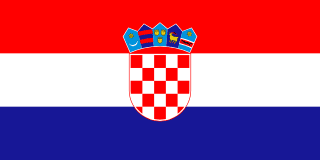
- description: three equal horizontal bands of red (top), white, and blue -- the pan-Slav colors -- with the Croatian coat of arms in the center, which consists of a main shield (a checkerboard of 13 red and 12 silver fields) with five smaller shields that form a crown over the main shield
meaning: the small shields represent the five historic regions (from left to right): Croatia, Dubrovnik, Dalmatia, Istria, and Slavonia
history: Russia's 19th-century flag inspired the pan-Slav colors - National symbol(s)
- red-and-white checkerboard
- National color(s)
- red, white, blue
- National anthem(s)
- title: "Lijepa nasa domovino" (Our Beautiful Homeland)
lyrics/music: Antun MIHANOVIC/Josip RUNJANIN
history: adopted in 1972 while still part of Yugoslavia; the lyrics were written in 1835, and it served as an unofficial anthem beginning in 1891 - National heritage
- total World Heritage Sites: 10 (8 cultural, 2 natural)
selected World Heritage Site locales:
Plitvice Lakes National Park (n); Historic Split (c); Old City of Dubrovnik (c); Euphrasian Basilica; Historic Trogir (c); Šibenik Cathedral (c); Stari Grad Plain (c); Zadar and Fort St. Nikola Venetian Defense Works (c); Primeval Beech Forests (n); Stećci Medieval Tombstones Graveyards (c)