- Country name
- conventional long form: none
conventional short form: Ireland
local long form: none
local short form: Eire
etymology: the Irish name Eire evolved from the Gaelic name Eriu, which is possibly derived from the Old Celtic iveriu, meaning "good land;" the English name, Ireland, is a direct translation - Government type
- parliamentary republic
- Capital
- name: Dublin
geographic coordinates: 53 19 N, 6 14 W
time difference: UTC 0 (5 hours ahead of Washington, DC, during Standard Time)
daylight saving time: +1hr, begins last Sunday in March; ends last Sunday in October
etymology: derived from the Irish words dubh (black or dark) and linn (pool), referring to the color of the Liffey River - Administrative divisions
- 28 counties and 3 cities*; Carlow, Cavan, Clare, Cork, Cork*, Donegal, Dublin*, Dun Laoghaire-Rathdown, Fingal, Galway, Galway*, Kerry, Kildare, Kilkenny, Laois, Leitrim, Limerick, Longford, Louth, Mayo, Meath, Monaghan, Offaly, Roscommon, Sligo, South Dublin, Tipperary, Waterford, Westmeath, Wexford, Wicklow
- Legal system
- common law system based on the English model but substantially modified by customary law; Supreme Court reviews legislative acts
- Constitution
- history: previous 1922; latest drafted 14 June 1937, adopted by plebiscite 1 July 1937, effective 29 December 1937
amendment process: proposed as bills by Parliament; passage requires majority vote by both the Senate and House of Representatives, majority vote in a referendum, and presidential signature - International law organization participation
- accepts compulsory ICJ jurisdiction with reservations; accepts ICCt jurisdiction
- Citizenship
- citizenship by birth: no, unless a parent of a child born in Ireland has been legally resident in Ireland for at least three of the four years prior to the birth of the child
citizenship by descent only: yes
dual citizenship recognized: yes
residency requirement for naturalization: 4 of the previous 8 years - Suffrage
- 18 years of age; universal
- Executive branch
- chief of state: President Catherine CONNOLLY (since 11 November 2025)
head of government: Taoiseach (Prime Minister) Michael MARTIN (since 23 January 2025)
cabinet: Cabinet nominated by the prime minister, appointed by the president, approved by the Dali Eireann (lower house of Parliament)
election/appointment process:
president directly elected by majority popular vote for a 7-year term (eligible for a second term); taoiseach (prime minister) nominated by the House of Representatives (Dail Eireann), appointed by the president
most recent election date: 26 October 2018
election results:
2025: Michael MARTIN is elected taoiseach by parliament, 95 votes to 76, and is appointed taoiseach by the president
2024: Simon HARRIS is elected taoiseach by parliament, 88 votes to 69, and is appointed taoiseach by the president
2018: Michael D. HIGGINS reelected president in first round; percent of vote in first round - Michael D. HIGGINS (independent) 55.8%, Peter CASEY (independent) 23.3%, Sean GALLAGHER (independent) 6.4%, Liadh NI RIADA (Sinn Fein) 6.4%, Joan FREEMAN (independent) 6%, Gavin DUFFY (independent) 2.2%
expected date of next election: no later than November 2025 - Legislative branch
- legislature name: Parliament (Oireachtas)
legislative structure: bicameral - Legislative branch - lower chamber
- chamber name: House of Representatives (Dáil Éireann)
number of seats: 174 (all directly elected)
electoral system: proportional representation
scope of elections: full renewal
term in office: 5 years
most recent election date: 1/29/2025 to 1/30/2025
parties elected and seats per party: Fianna Fáil (48); Sinn Féin (39); Fine Gael (38); Social Democratic Party (11); Labour Party (11); Independents (16); Other (11)
percentage of women in chamber: 25.3%
expected date of next election: November 2029 - Legislative branch - upper chamber
- chamber name: Senate (Seanad Éireann - Senate)
number of seats: 60 (49 indirectly elected; 11 appointed)
scope of elections: full renewal
term in office: 5 years
most recent election date: 11/29/2024
parties elected and seats per party: Fianna Fail (19); Fine Gael (18); Sinn Fein (6); Independents (12); other (5)
percentage of women in chamber: 45%
expected date of next election: January 2030 - Judicial branch
- highest court(s):
Supreme Court of Ireland (consists of the chief justice, 9 judges, 2 ex-officio members -- the presidents of the High Court and Court of Appeal -- and organized in 3-, 5-, or 7-judge panels, depending on the importance or complexity of an issue of law)
judge selection and term of office: judges nominated by the prime minister and Cabinet and appointed by the president; chief justice serves in the position for 7 years; judges can serve until age 70
subordinate courts: High Court, Court of Appeal; circuit and district courts; criminal courts - Political parties
- Aontu
Solidarity-People Before Profit or PBP-S
Fianna Fail
Fine Gael
Green Party
Human Dignity Alliance
Independent Ireland
Labor (Labour) Party
100% Redress
Right to Change or RTC
Sinn Fein
Social Democrats
Socialist Party
The Workers' Party - Diplomatic representation in the US
- chief of mission: Ambassador Geraldine BYRNE NASON (since 16 September 2022)
chancery: 2234 Massachusetts Avenue NW, Washington, DC 20008
telephone: [1] (202) 462-3939
FAX: [1] (202) 232-5993
email address and website: https://www.ireland.ie/en/usa/washington/
consulate(s) general: Atlanta, Austin (TX), Boston, Chicago, Los Angeles, Miami, New York, San Francisco - Diplomatic representation from the US
- chief of mission: Ambassador Edward S. WALSH (since 1 July 2025)
embassy: 42 Elgin Road, Ballsbridge, Dublin 4
mailing address: 5290 Dublin Place, Washington DC 20521-5290
telephone: [353] (1) 668-8777
FAX: [353] (1) 688-8056
email address and website:
ACSDublin@state.gov
https://ie.usembassy.gov/ - International organization participation
- ADB (nonregional member), Australia Group, BIS, CD, CE, EAPC, EBRD, ECB, EIB, EMU, ESA, EU, FAO, FATF, IAEA, IBRD, ICAO, ICC (national committees), ICCt, ICRM, IDA, IEA, IFAD, IFC, IFRCS, IGAD (partners), IHO, ILO, IMF, IMO, Interpol, IOC, IOM, IPU, ISO, ITSO, ITU, ITUC (NGOs), MIGA, MINURSO, MONUSCO, NEA, NSG, OAS (observer), OECD, OPCW, OSCE, Paris Club, PCA, PFP, UN, UNCTAD, UNDOF, UNESCO, UNHCR, UNIDO, UNIFIL, UNOCI, UNRWA, UNTSO, UPU, Wassenaar Arrangement, WCO, WHO, WIPO, WMO, WTO, ZC
- Independence
- 6 December 1921 (from the UK); 6 December 1922 (Irish Free State established); 18 April 1949 (Republic of Ireland Act enabled)
- National holiday
- Saint Patrick's Day, 17 March
note: marks the traditional death date of Saint Patrick, patron saint of Ireland, during the latter half of the fifth century A.D. (most commonly cited years are c. 461 and c. 493); Saint Patrick's feast day was celebrated as early as the ninth century, but it only became an official public holiday in 1903 - Flag
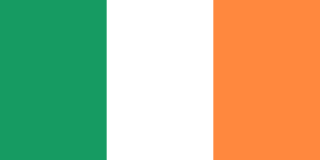
- description: three equal vertical bands of green (left side), white, and orange
meaning: the flag colors have no official meaning, but a common interpretation is that the green stands for the Irish nationalist tradition, orange for the Orange tradition (minority supporters of William of Orange), and white for peace or a lasting truce between the green and the orange
note: similar to the flag of Cote d'Ivoire, which is shorter and has the colors reversed; also similar to the flag of Italy, which is shorter and has red instead of orange - National symbol(s)
- harp, shamrock (trefoil)
- National color(s)
- blue, green
- National coat of arms
- the coat of arms features a gold harp on a blue shield and dates back to the 13th century, although it only became official in 1945; the harp, a national symbol that Ireland adopted after gaining independence from the United Kingdom in 1921, represents the country’s history, culture, and national identity
- National anthem(s)
- title: "Amhran na bhFiann" (The Soldier's Song)
lyrics/music: Peadar KEARNEY [English], Liam O RINN [Irish]/Patrick HEENEY and Peadar KEARNEY
history: adopted 1926; the song "Ireland's Call" is often used as the anthem at athletic events if citizens of Ireland and Northern Ireland are competing as a unified team - National heritage
- total World Heritage Sites: 2 (both cultural)
selected World Heritage Site locales: Brú na Bóinne - Archaeological Ensemble of the Bend of the Boyne; Sceilg Mhichíl