- Country name
- conventional long form: Islamic Republic of Iran
conventional short form: Iran
local long form: Jomhuri-ye Eslami-ye Iran
local short form: Iran
former: Persia
etymology:
the name derives from the Sanskrit word arya, referring to people living in a mountainous land, from the root word ar-, or "mountain;" the former name, Persia, was originally "Pars" (or the Arabic-influenced variant "Fars") from the Old Persian parsi, meaning "pure" - Government type
- theocratic republic
- Capital
- name: Tehran
geographic coordinates: 35 42 N, 51 25 E
time difference: UTC+3.5 (8.5 hours ahead of Washington, DC)
daylight saving time: does not observe daylight savings time
etymology: the name probably means "flat" or "lower," referring to its location in the foothills of the Elburz Mountains - Administrative divisions
- 31 provinces (ostanha, singular - ostan); Alborz, Ardabil, Azarbayjan-e Gharbi (West Azerbaijan), Azarbayjan-e Sharqi (East Azerbaijan), Bushehr, Chahar Mahal va Bakhtiari, Esfahan, Fars, Gilan, Golestan, Hamadan, Hormozgan, Ilam, Kerman, Kermanshah, Khorasan-e Jonubi (South Khorasan), Khorasan-e Razavi (Razavi Khorasan), Khorasan-e Shomali (North Khorasan), Khuzestan, Kohgiluyeh va Bowyer Ahmad, Kordestan, Lorestan, Markazi, Mazandaran, Qazvin, Qom, Semnan, Sistan va Baluchestan, Tehran, Yazd, Zanjan
- Legal system
- religious system based on secular and Islamic law
- Constitution
- history: previous 1906; latest adopted 24 October 1979, effective 3 December 1979
amendment process:
proposed by the supreme leader – after consultation with the Exigency Council – and submitted as an edict to the "Council for Revision of the Constitution," a body consisting of various executive, legislative, judicial, and academic leaders and members; passage requires absolute majority vote in a referendum and approval of the supreme leader; articles including Iran’s political system, its religious basis, and its form of government cannot be amended - International law organization participation
- has not submitted an ICJ jurisdiction declaration; non-party state to the ICCt
- Citizenship
- citizenship by birth: no
citizenship by descent only: the father must be a citizen of Iran
dual citizenship recognized: no
residency requirement for naturalization: 5 years - Suffrage
- 18 years of age; universal
- Executive branch
- chief of state: Supreme Leader Ali Hoseini-KHAMENEI (since 4 June 1989)
head of government: President Masoud PEZESHKIAN (since 30 July 2024)
cabinet: Council of Ministers selected by the president with legislative approval; the supreme leader has some control over appointments to several ministries
election/appointment process:
supreme leader appointed for life by Assembly of Experts; president directly elected by absolute-majority popular vote in 2 rounds, if needed, for a 4-year term (eligible for a second term and an additional nonconsecutive term)
most recent election date: 28 June 2024, with runoff held on 5 July 2024
election results:
2024: first round results - Masoud PEZESHKIAN (independent) 44.4%, Saeed JALILI (Front of Islamic Revolution Stability) 40.4%, Mohammad Baqer QAKIBAF (Progress and Justice Population of Islamic Iran) 14.3%, other 0.9%; second round results - Masoud PEZESHKIAN elected; Masoud PEZESHKIAN 54.8%, Saeed JALILI 45.2%
2021: Ebrahim RAISI elected president; percent of vote - Ebrahim RAISI (independent) 72.4%, Mohsen REZAI (RFII) 13.8%, Abbdolnaser HEMATI (ECP) 9.8%, Amir-Hosein Qazizadeh-HASHEMI (Islamic Law Party) 4%
note: presidential election held early due to the death of President Ebrahim RAISI in a helicopter accident in May 2024 - Legislative branch
- legislature name: Islamic Parliament of Iran (Majles Shoraye Eslami)
legislative structure: unicameral
number of seats: 290 (all directly elected)
electoral system: plurality/majority
scope of elections: full renewal
term in office: 4 years
most recent election date: 3/1/2024 to 5/10/2024
percentage of women in chamber: 4.9%
expected date of next election: February 2028
note: all candidates to the Majles must be approved by the Council of Guardians, a 12-member group of which 6 are appointed by the supreme leader and 6 are jurists nominated by the judiciary and elected by the Majles - Judicial branch
- highest court(s): Supreme Court (consists of the chief justice and organized into 42 two-bench branches, each with a justice and a judge)
judge selection and term of office:
Supreme Court president appointed by the head of the High Judicial Council (HJC), a 5-member body to include the Supreme Court chief justice, the prosecutor general, and 3 clergy, in consultation with judges of the Supreme Court; president appointed for a single, renewable 5-year term; other judges appointed by the HJC; judge tenure NA
subordinate courts: Penal Courts I and II; Islamic Revolutionary Courts; Courts of Peace; Special Clerical Court (functions outside the judicial system and handles cases involving clerics); military courts - Political parties
- Combatant Clergy Association (an active political group)
Executives of Construction Party
Front of Islamic Revolutionary Stability
Islamic Coalition Party
Progress and Justice Population of Islamic Iran
Militant Clerics Society (Majma-e Ruhaniyoun-e Mobarez) or MRM
Moderation and Development Party
National Trust Party (Hezb-e E'temad-eMelli) or HEM
Progress and Justice Society
Union of Islamic Iran People's Party (Hezb-e Ettehad-e Iran-e Eslami) - Diplomatic representation in the US
- none
note: Iran has an Interests Section in the Pakistani Embassy; address: Iranian Interests Section, Embassy of Pakistan, 1250 23rd Street NW, Washington, DC 20037; telephone: [1] (202) 965-4990; FAX [1] (202) 965-1073; email: requests@daftar.org; info@daftarwashington.com; website: https://daftar.org/ - Diplomatic representation from the US
- embassy:
none; the US Interests Section is located in the Embassy of Switzerland; US Foreign Interests Section, Embassy of Switzerland, Pasdaran, Shahid Mousavi Street (Golestan 5th), Corner of Paydarfard Street, No. 55, Tehran - International organization participation
- BRICS, CICA, CP, D-8, ECO, FAO, G-15, G-24, G-77, IAEA, IBRD, ICAO, ICC (national committees), ICRM, IDA, IDB, IFAD, IFC, IFRCS, IHO, ILO, IMF, IMO, IMSO, Interpol, IOC, IOM, IPU, ISO, ITSO, ITU, MIGA, NAM, OIC, OPCW, OPEC, PCA, SAARC (observer), SCO (observer), UN, UNAMID, UNCTAD, UNESCO, UNHCR, UNIDO, UNITAR, UNOOSA, UNWTO, UPU, WCO, WFTU (NGOs), WHO, WIPO, WMO, WTO (observer)
- Independence
- 1 April 1979 (Islamic Republic of Iran proclaimed); notable earlier dates: ca. 550 B.C. (Achaemenid or Persian Empire established); A.D. 1501 (Iran reunified under the Safavid dynasty); 1794 (beginning of Qajar dynasty); 12 December 1925 (modern Iran established under the PAHLAVI dynasty)
- National holiday
- Republic Day, 1 April (1979)
- Flag
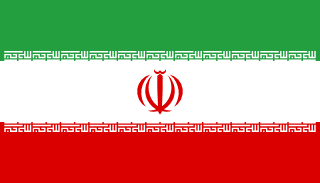
- description: three equal horizontal bands of green (top), white, and red; centered in the white band is the red national emblem, a stylization of the word Allah in the shape of a tulip (a symbol of martyrdom); ALLAH AKBAR (God is Great) in white Arabic script is repeated 11 times along the bottom edge of the green band and 11 times along the top edge of the red band
meaning: green is the color of Islam and also represents growth, white stands for honesty and peace, and red for bravery and martyrdom - National symbol(s)
- lion
- National color(s)
- green, white, red
- National anthem(s)
- title: "Soroud-e Melli-ye Jomhouri-ye Eslami-ye Iran" (National Anthem of the Islamic Republic of Iran)
lyrics/music: multiple authors/Hassan RIAHI
history: adopted 1990
note: a recording of the current Iranian national anthem is unavailable because the US Navy Band does not record anthems for countries from which the US does not anticipate official visits; the US does not have diplomatic relations with Iran - National heritage
- total World Heritage Sites: 29 (27 cultural, 2 natural)
selected World Heritage Site locales:
Persepolis (c); Tchogha Zanbil (c); Bam and its Cultural Landscape (c); Golestan Palace (c); Shushtar Historical Hydraulic System (c); Pasargadae (c); Hyrcanian Forests (n); Tabriz Historic Bazaar Complex (c); Meidan Emam, Esfahan (c); Bisotun (c); Takht-e Soleyman (c); Soltaniyeh(c); Bisotun (c); Armenian Monastic Ensembles of Iran(c); Sheikh Safi al-din Khānegāh and Shrine Ensemble in Ardabil (c); The Persian Garden (c); Gonbad-e Qābus (c); Masjed-e Jāmé of Isfahan (c); Shahr-i Sokhta (c); Cultural Landscape of Maymand (c); Susa (c); Lut Desert (n);The Persian Qanat (c); Historic City of Yazd (c); Sassanid Archaeological Landscape of Fars Region (c); Cultural Landscape of Hawraman/Uramanat (c); Trans-Iranian Railway (c); The Persian Caravanserai (c); Hegmataneh (c); Prehistoric Sites of the Khorramabad Valley (c)