- Country name
- conventional long form: none
conventional short form: Japan
local long form: Nihon-koku/Nippon-koku
local short form: Nihon/Nippon
etymology:
the English word for Japan comes from the Chinese name for the country, Cipangu; both Nihon and Nippon come from the Japanese words nichi, or "sun," and hon, or "origin," which is frequently translated as "Land of the Rising Sun" - Government type
- parliamentary constitutional monarchy
- Capital
- name: Tokyo
geographic coordinates: 35 41 N, 139 45 E
time difference: UTC+9 (14 hours ahead of Washington, DC, during Standard Time)
etymology:
originally known as Edo, meaning "estuary" because of its location on a bay; the name was changed to Tokyo, meaning "eastern capital," in 1868, as a contrast to Kyoto, the previous capital to the west - Administrative divisions
- 47 prefectures; Aichi, Akita, Aomori, Chiba, Ehime, Fukui, Fukuoka, Fukushima, Gifu, Gunma, Hiroshima, Hokkaido, Hyogo, Ibaraki, Ishikawa, Iwate, Kagawa, Kagoshima, Kanagawa, Kochi, Kumamoto, Kyoto, Mie, Miyagi, Miyazaki, Nagano, Nagasaki, Nara, Niigata, Oita, Okayama, Okinawa, Osaka, Saga, Saitama, Shiga, Shimane, Shizuoka, Tochigi, Tokushima, Tokyo, Tottori, Toyama, Wakayama, Yamagata, Yamaguchi, Yamanashi
- Legal system
- civil law system based on German model; also reflects Anglo-American influence and Japanese traditions; Supreme Court reviews legislative acts
- Constitution
- history: previous 1890; latest approved 6 October 1946, adopted 3 November 1946, effective 3 May 1947
amendment process: proposed by the Diet; passage requires approval by at least two-thirds majority of both houses of the Diet and approval by majority in a referendum - International law organization participation
- accepts compulsory ICJ jurisdiction with reservations; accepts ICCt jurisdiction
- Citizenship
- citizenship by birth: no
citizenship by descent only: at least one parent must be a citizen of Japan
dual citizenship recognized: no
residency requirement for naturalization: 5 years - Suffrage
- 18 years of age; universal
- Executive branch
- chief of state: Emperor NARUHITO (since 1 May 2019)
head of government: Prime Minister Sanae TAKAICHI (since 21 October 2025)
cabinet: Cabinet appointed by the prime minister
election/appointment process: the monarchy is hereditary; the leader of the majority party or majority coalition in the House of Representatives usually becomes prime minister
election results:
2025: Sanae TAKAICHI (LDP) elected prime minister on 21 October 2025; upper house vote - 125 of 171 votes (runoff); lower house vote - 237 of 386 votes
2024: Shigeru ISHIBA (LDP) elected prime minister on 27 September 2024; upper house vote - 143 of 242 votes; lower house vote - 291 of 461 votes
note: Shigeru ISHIBA resigned as prime minister on 7 September 2025; the party vote on the new prime minister is expected in early October 2025 - Legislative branch
- legislature name: National Diet (Kokkai)
legislative structure: bicameral - Legislative branch - lower chamber
- chamber name: House of Representatives (Shugiin)
number of seats: 465 (all directly elected)
electoral system: mixed system
scope of elections: full renewal
term in office: 4 years
most recent election date: 7/20/2025
parties elected and seats per party: Liberal Democratic Party (LDP) (191); Constitutional Democratic Party of Japan (148); Nippon Ishin (Japan Innovation Party) (38); Democratic Party for the People (28); Komeito (24); Other (36)
percentage of women in chamber: 15.7%
expected date of next election: October 2028 - Legislative branch - upper chamber
- chamber name: House of Councillors (Sangiin)
number of seats: 248 (all directly elected)
electoral system: mixed system
scope of elections: partial renewal
term in office: 6 years
most recent election date: 10/27/2024
parties elected and seats per party:
Liberal Democratic Party (LDP) (39); Constitutional Democratic Party of Japan (22); Democratic Party for the People (17); Sanseito (14); Komeito (8); Nippon Ishin (Japan Innovation Party) (7); Independents (8); Other (10)
percentage of women in chamber: 29.4%
expected date of next election: June 2028 - Judicial branch
- highest court(s): Supreme Court or Saiko saibansho (consists of the chief justice and 14 associate justices)
judge selection and term of office:
Supreme Court chief justice designated by the Cabinet and appointed by the monarch; associate justices appointed by the Cabinet and confirmed by the monarch; all justices are reviewed in a popular referendum during the first general election of the House of Representatives after each judge's appointment and every 10 years afterward
subordinate courts: 8 High Courts (Koto-saiban-sho), each with a Family Court (Katei-saiban-sho); 50 District Courts (Chiho saibansho), with 203 additional branches; 438 Summary Courts (Kani saibansho)
note: the Supreme Court has jurisdiction in constitutional issues - Political parties
- Conservative Party of Japan or CPJ
Constitutional Democratic Party of Japan or CDP
Democratic Party for the People or DPFP or DPP
Japan Communist Party or JCP
Japan Innovation Party or Nippon Ishin no kai or Ishin
Komeito or Komei
Liberal Democratic Party or LDP
Okinawa Social Mass Party or Okinawa Whirlwind or OW
Party to Protect the People from NHK or NHK
Reiwa Shinsengumi
Sanseito Party
Social Democratic Party or SDP - Diplomatic representation in the US
- chief of mission: Ambassador YAMADA Shigeo (since 27 February 2024)
chancery: 2520 Massachusetts Avenue NW, Washington, DC 20008
telephone: [1] (202) 238-6700
FAX: [1] (202) 328-2187
email address and website:
emb-consulate.dc@ws.mofa.go.jp
https://www.us.emb-japan.go.jp/itprtop_en/index.html
consulate(s) general: Chicago
consulate(s):
Anchorage (AK), Atlanta, Boston, Denver (CO), Detroit (MI), Hagatna (Guam), Honolulu, Houston, Los Angeles, Miami, Nashville (TN), New York, Portland (OR), San Francisco, Saipan (Northern Mariana Islands), Seattle (WA) - Diplomatic representation from the US
- chief of mission: Ambassador George GLASS (since 17 July 2025)
embassy: 1-10-5 Akasaka, Minato-ku, Tokyo 107-8420
mailing address: 9800 Tokyo Place, Washington DC 20521-9800
telephone: [81] (03) 3224-5000
FAX: [81] (03) 3224-5856
email address and website:
TokyoACS@state.gov
https://jp.usembassy.gov/
consulate(s) general: Naha (Okinawa), Osaka-Kobe, Sapporo
consulate(s): Fukuoka, Nagoya - International organization participation
- ADB, AfDB (nonregional member), APEC, Arctic Council (observer), ARF, ASEAN (dialogue partner), Australia Group, BIS, CD, CE (observer), CERN (observer), CICA (observer), CP, CPLP (associate), EAS, EBRD, EITI (implementing country), FAO, FATF, G-5, G-7, G-8, G-10, G-20, IADB, IAEA, IBRD, ICAO, ICC (national committees), ICCt, ICRM, IDA, IEA, IFAD, IFC, IFRCS, IGAD (partners), IHO, ILO, IMF, IMO, IMSO, Interpol, IOC, IOM, IPU, ISO, ITSO, ITU, ITUC (NGOs), LAIA (observer), MIGA, NEA, NSG, OAS (observer), OECD, OPCW, OSCE (partner), Pacific Alliance (observer), Paris Club, PCA, PIF (partner), Quad, SAARC (observer), SELEC (observer), SICA (observer), UN, UNCTAD, UNESCO, UNHCR, UNHRC, UNIDO, UNMISS, UNOOSA, UNRWA, UNWTO, UPU, Wassenaar Arrangement, WCO, WFTU (NGOs), WHO, WIPO, WMO, WTO, ZC
- Independence
- 3 May 1947 (current constitution adopted as amendment to Meiji Constitution); notable earlier dates: 11 February 660 B.C. (mythological date of Emperor JIMMU founding the nation); 29 November 1890 (Meiji Constitution provides for constitutional monarchy)
- National holiday
- Birthday of Emperor NARUHITO, 23 February (1960)
note: celebrates the birthday of the current emperor - Flag
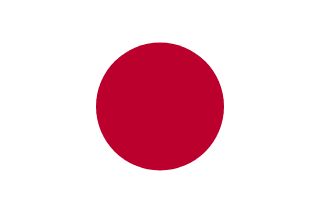
- description: white with a large red disk that symbolizes the sun without rays, in the center
history: the current flag was adopted in 1854, but a sun flag has been in use in Japan since at least 1184; the sun has long been a national symbol: according to tradition, the sun goddess Amaterasu founded the country in the 7th century B.C. - National symbol(s)
- red sun disc, chrysanthemum
- National color(s)
- red, white
- National coat of arms
- the Kikumon is the Japanese emperor's family coat of arms and dates from 1183; the Imperial chrysanthemum emblem (菊の御紋, kikunogomon) is a yellow or orange chrysanthemum with black or red outlines and background; a central disc is surrounded by a front set of 16 petals; a rear set of 16 petals are half-staggered in relation to the front set and are visible at the edges of the flower
- National anthem(s)
- title: "Kimigayo" (“His Majesty’s Reign)
lyrics/music: unknown/Hiromori HAYASHI
history:
adopted 1999; unofficial national anthem since 1883; oldest anthem lyrics in the world, dating to the 10th century or earlier; some oppose the anthem because of its association with militarism and worship of the emperor - National heritage
- total World Heritage Sites: 26 (21 cultural, 5 natural)
selected World Heritage Site locales:
Buddhist Monuments in the Horyu-ji Area (c); Historic Monuments of Ancient Nara (c); Himeji-jo (c); Shiretoko (n); Mozu-Furuichi Kofun Group: Mounded Tombs of Ancient Japan (c); Jomon Prehistoric Sites in Northern Japan (c); Yakushima (n); Historic Monuments of Ancient Kyoto (Kyoto, Uji and Otsu Cities) (c); Hiroshima Peace Memorial (Genbaku Dome) (c); Shirakami-Sanchi (n); Historic Villages of Shirakawa-go and Gokayama (c); Itsukushima Shinto Shrine (c); Historic Monuments of Ancient Nara (c); Shrines and Temples of Nikko (c); Gusuku Sites and Related Properties of the Kingdom of Ryukyu (c); Sacred Sites and Pilgrimage Routes in the Kii Mountain Range (c); Hiraizumi – Temples, Gardens and Archaeological Sites Representing the Buddhist Pure Land (c); Ogasawara Islands (n); Sacred Island of Okinoshima and Associated Sites in the Munakata Region (c); Hidden Christian Sites in the Nagasaki Region (c); Amami-Oshima Island, Tokunoshima Island, Northern part of Okinawa Island, and Iriomote Island (n); Jomon Prehistoric Sites in Northern Japan (c)