- Country name
- conventional long form: Republic of Korea
conventional short form: South Korea
local long form: Taehan-min'guk
local short form: Han'guk
abbreviation: ROK
etymology:
derived from the Chinese name for Goryeo, which was the Korean dynasty that united the peninsula in the 10th century A.D.; the South Korean name "Han'guk" derives from the long form, "Taehan-min'guk," which is itself a derivation from "Daehan-je'guk," which means "the Great Han Empire" - Government type
- presidential republic
- Capital
- name: Seoul
geographic coordinates: 37 33 N, 126 59 E
time difference: UTC+9 (14 hours ahead of Washington, DC, during Standard Time)
etymology: the name originates from the Korean word meaning "capital city;" it was the capital of the unified Korea from 1392 to 1910
note: Sejong, located some 120 km (75 mi) south of Seoul, serves as an administrative capital for segments of the South Korean government - Administrative divisions
- 9 provinces (do, singular and plural), 6 metropolitan cities (gwangyeoksi, singular and plural), 1 special city (teugbyeolsi), and 1 special self-governing city (teukbyeoljachisi)
provinces: Chungcheongbuk-do (North Chungcheong), Chungcheongnam-do (South Chungcheong), Gangwon-do, Gyeongsangbuk-do (North Gyeongsang), Gyeonggi-do, Gyeongsangnam-do (South Gyeongsang), Jeju-do (Jeju), Jeollabuk-do (North Jeolla), Jeollanam-do (South Jeolla)
metropolitan cities: Busan (Pusan), Daegu (Taegu), Daejeon (Taejon), Gwangju (Kwangju), Incheon (Inch'on), Ulsan
special city: Seoul
special self-governing city: Sejong - Legal system
- mixed system combining European civil law, Anglo-American law, and Chinese classical thought
- Constitution
- history: several previous; latest passed by National Assembly 12 October 1987, approved in referendum 28 October 1987, effective 25 February 1988
amendment process:
proposed by the president or by majority support of the National Assembly membership; passage requires at least two-thirds majority vote by the Assembly membership, approval in a referendum by more than one half of the votes by more than one half of eligible voters, and promulgation by the president - International law organization participation
- has not submitted an ICJ jurisdiction declaration; accepts ICCt jurisdiction
- Citizenship
- citizenship by birth: no
citizenship by descent only: at least one parent must be a citizen of South Korea
dual citizenship recognized: no
residency requirement for naturalization: 5 years - Suffrage
- 18 years of age; universal
- Executive branch
- chief of state: President LEE Jae-myung (since 4 June 2025)
head of government: Prime Minister KIM Min-seok (since 3 July 2025)
cabinet: State Council appointed by the president on the prime minister's recommendation
election/appointment process: president directly elected by simple-majority popular vote for a single 5-year term; prime minister appointed by president with consent of the National Assembly
most recent election date: 3 June 2025 (special snap election in the wake of the impeachment of former President YOON Suk-yeol)
election results:
2025: LEE Jae-myung elected president; LEE Jae-myung (DPK) 49.4%, KIM Moon-soo (PPP) 41.2%, LEE Jun-seok (New Reform Party) 8.3%
2022: YOON Suk-yeol elected president; YOON Suk-yeol (PPP) 48.6%, LEE Jae-myung (DPK) 47.8%; other 3.6%
expected date of next election: 2030
note: the president is both chief of state and head of government; the prime minister serves as the principal executive assistant to the president, similar to the role of a vice president - Legislative branch
- legislature name: National Assembly (Kuk Hoe)
legislative structure: unicameral
number of seats: 300 (all directly elected)
electoral system: mixed system
scope of elections: full renewal
term in office: 4 years
most recent election date: 4/10/2024
parties elected and seats per party: Democratic Party of Korea (161); People Power Party (90); People Future Party (18); Other (31)
percentage of women in chamber: 20.3%
expected date of next election: April 2028 - Judicial branch
- highest court(s): Supreme Court (consists of a chief justice and 13 justices); Constitutional Court (consists of a court head and 8 justices)
judge selection and term of office:
Supreme Court chief justice appointed by the president with the consent of the National Assembly; other justices appointed by the president on the recommendation of the chief justice and consent of the National Assembly; position of the chief justice is a 6-year nonrenewable term; other justices serve 6-year renewable terms; Constitutional Court justices appointed - 3 by the president, 3 by the National Assembly, and 3 by the Supreme Court chief justice; court head serves until retirement at age 70, while other justices serve 6-year renewable terms with mandatory retirement at age 65
subordinate courts: High Courts; District Courts; Branch Courts (organized under the District Courts); specialized courts for family and administrative issues - Political parties
- Basic Income Party
Democratic Party of Korea or DPK
New Future Party
New Reform Party
Open Democratic Party or ODP
People Power Party or PPP
Progressive Party or Jinbo Party
Rebuilding Korea Party
Social Democratic Party
note: the Democratic Alliance coalition consists of the DPK and the smaller Basic Income, Jinbo, Open Democratic, and Social Democratic parties, as well as two independents; for the 2024 election, the Basic Income Party, the ODP, and the Social Democratic Party formed the New Progressive Alliance - Diplomatic representation in the US
- chief of mission: Ambassador KANG Kyung-wha (since 16 December 2025)
chancery: 2450 Massachusetts Avenue NW, Washington, DC 20008
telephone: [1] (202) 939-5600
FAX: [1] (202) 797-0595
email address and website:
generalusa@mofa.go.kr
https://overseas.mofa.go.kr/us-en/index.do
consulate(s) general: Anchorage (AK), Atlanta, Boston, Chicago, Dallas, Hagatna (Guam), Honolulu, Houston, Los Angeles, New York, San Francisco, Seattle, Philadelphia - Diplomatic representation from the US
- chief of mission: Ambassador (vacant); Chargé d'Affaires James “Jim” HELLER (since 7 January 2026)
embassy: 188 Sejong-daero, Jongno-gu, Seoul
mailing address: 9600 Seoul Place, Washington, DC 20521-9600
telephone: [82] (2) 397-4114
FAX: [82] (2) 397-4101
email address and website:
seoulinfoACS@state.gov
https://kr.usembassy.gov/
consulate(s): Busan - International organization participation
- ADB, AfDB (nonregional member), APEC, Arctic Council (observer), ARF, ASEAN (dialogue partner), Australia Group, BIS, CABEI, CD, CICA, CP, EAS, EBRD, FAO, FATF, G-20, IADB, IAEA, IBRD, ICAO, ICC (national committees), ICCt, ICRM, IDA, IEA, IFAD, IFC, IFRCS, IHO, ILO, IMF, IMO, IMSO, Interpol, IOC, IOM, IPU, ISO, ITSO, ITU, ITUC (NGOs), LAIA (observer), MIGA, MINURSO, MINUSTAH, NEA, NSG, OAS (observer), OECD, OPCW, OSCE (partner), Pacific Alliance (observer), Paris Club (associate), PCA, PIF (partner), SAARC (observer), SICA (observer), UN, UNAMID, UNCTAD, UNESCO, UNHCR, UNHRC, UNIDO, UNIFIL, UNISFA, UNMIL, UNMISS, UNMOGIP, UNOCI, UNOOSA, UNWTO, UPU, Wassenaar Arrangement, WCO, WHO, WIPO, WMO, WTO, ZC
- Independence
- 15 August 1945 (from Japan)
- National holiday
- Liberation Day, 15 August (1945)
- Flag
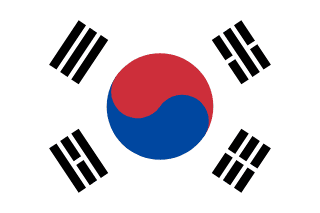
- description: white with a red-and-blue yin-yang symbol in the center; a black trigram (kwae) from the ancient I Ching (Book of Changes) is in each corner of the white field
meaning: the flag is called Taegukki; white is a traditional Korean color and represents peace and purity; blue stands for the negative cosmic forces of the yin, and red for the opposite positive forces of the yang; each trigram represents one of the universal elements, which together express the principle of movement and harmony - National symbol(s)
- taegeuk (yin-yang symbol), Rose of Sharon (Hibiscus syriacus), Siberian tiger
- National color(s)
- red, white, blue, black
- National anthem(s)
- title: "Aegukga" (Patriotic Song)
lyrics/music: YUN Ch'i-Ho or AN Ch'ang-Ho/AHN Eaktay
history: adopted 1948, well-known by 1910; North Korea's and South Korea's anthems have the same name and a similar melody, but different lyrics - National heritage
- total World Heritage Sites: 17 (15 cultural, 2 natural)
selected World Heritage Site locales:
Jeju Volcanic Island and Lava Tubes (n); Changdeokgung Palace Complex (c); Jongmyo Shrine (c); Seokguram Grotto and Bulguksa Temple (c); Hwaseong Fortress (c); Gochang, Hwasun, and Ganghwa Dolmen Sites (c); Gyeongju Historic Areas (c); Namhansanseong (c); Baekje Historic Areas (c); Sansa, Buddhist Mountain Monasteries in Korea (c); Royal Tombs of the Joseon Dynasty (c); Petroglyphs along the Bangucheon Stream (c)