- Country name
- conventional long form: Democratic Socialist Republic of Sri Lanka
conventional short form: Sri Lanka
local long form: Shri Lanka Prajatantrika Samajavadi Janarajaya (Sinhala)/ Ilankai Jananayaka Choshalichak Kutiyarachu (Tamil)
local short form: Shri Lanka (Sinhala)/ Ilankai (Tamil)
former: Serendib, Ceylon
etymology:
the name is composed of the Sanskrit words shri (happiness or holiness) and lanka (island); the former name Serendib was an Arabic derivation of the Sanskrit word simhaladvipa, or "island of the place of lions;" the former name Ceylon came from the Sanskrit simha, or "lion" - Government type
- presidential republic
- Capital
- name: Colombo (commercial capital); Sri Jayewardenepura Kotte (legislative capital)
geographic coordinates: 6 55 N, 79 50 E
time difference: UTC+5.5 (10.5 hours ahead of Washington, DC, during Standard Time)
etymology:
the origin of Colombo's name is unclear; it may derive from the Sinhalese words kola (leaves) and amba (mango), referring to local mango trees, or from the name Kelantotta, referring to a ferry that crossed the Kelani River; the name was corrupted to Kolambu by Arab traders, and 16th-century Portuguese settlers then called it Colombo, possibly referring to explorer Christopher COLUMBUS; the legislative capital's name, Sri Jayewardenepura Kotte, is composed of the Sanskrit honorific sri, the name of Sri Lankan President J.R. JAYEWARDENE, and the Hindi word pura (town) - Administrative divisions
- 9 provinces; Central, Eastern, North Central, Northern, North Western, Sabaragamuwa, Southern, Uva, Western
- Legal system
- mixed system of Roman-Dutch civil law, English common law, Jaffna Tamil customary law, and Muslim personal law
- Constitution
- history: several previous; latest adopted 16 August 1978, certified 31 August 1978
amendment process:
proposed by Parliament; passage requires at least two-thirds majority vote of its total membership, certification by the president of the republic or the Parliament speaker, and in some cases approval in a referendum by absolute majority of valid votes - International law organization participation
- has not submitted an ICJ jurisdiction declaration; non-party state to the ICCt
- Citizenship
- citizenship by birth: no
citizenship by descent only: at least one parent must be a citizen of Sri Lanka
dual citizenship recognized: no, except in cases where the government rules it is to the benefit of Sri Lanka
residency requirement for naturalization: 7 years - Suffrage
- 18 years of age; universal
- Executive branch
- chief of state: President Anura Kumara DISSANAYAKE (since 23 September 2024)
head of government: President Anura Kumara DISSANAYAKE (since 23 September 2024)
cabinet: Cabinet appointed by the president in consultation with the prime minister
election/appointment process: president directly elected by preferential majority popular vote for a 5-year term (eligible for a second term); prime minister appointed by the president
most recent election date: 21 September 2024
election results: 2024: Anura Kumara DISSANAYAKE elected president; percent of vote after reallocation - Anura Kumara DISSANAYAKE (JVP) 55.9%, Sajith PREMADASA (SJB) 44.1%
expected date of next election: 2029
note: the president is both chief of state and head of government - Legislative branch
- legislature name: Parliament
legislative structure: unicameral
number of seats: 225 (196 directly elected; 29 indirectly elected)
electoral system: proportional representation
scope of elections: full renewal
term in office: 5 years
most recent election date: 11/14/2024
parties elected and seats per party: National People's Power (Jathika Jana Balawegaya, NPP) (159); Samagi Jana Balawegaya (SJB) (40); Other (26)
percentage of women in chamber: 9.8%
expected date of next election: November 2029 - Judicial branch
- highest court(s): Supreme Court of the Republic (consists of the chief justice and 9 justices); has exclusive jurisdiction to review legislation
judge selection and term of office:
chief justice nominated by the Constitutional Council (CC), a 9-member high-level advisory body, and appointed by the president; other justices nominated by the CC and appointed by the president on the advice of the chief justice; all justices can serve until age 65
subordinate courts: Court of Appeals; High Courts; Magistrates' Courts; municipal and primary courts - Political parties
- Crusaders for Democracy or CFD
Eelam People's Democratic Party or EPDP
Eelam People's Revolutionary Liberation Front or EPRLF
Illankai Tamil Arasu Kachchi or ITAK
Janatha Vimukthi Peramuna or JVP
Jathika Hela Urumaya or JHU
National People's Power or NPP (also known as Jathika Jana Balawegaya or JJB)
People's Liberation Organisation of Tamil Eelam or PLOTE
Samagi Jana Balawegaya or SJB
Sri Lanka Freedom Party or SLFP
Sri Lanka Muslim Congress or SLMC
Sri Lanka People's Freedom Alliance or SLPFA (includes SLPFP, SLPP, and several smaller parties)
Sri Lanka Podujana Peramuna (Sri Lanka's People's Front) or SLPP
Tamil Eelam Liberation Organization or TELO
Tamil National Alliance or TNA (includes ITAK, PLOTE, TELO)
Tamil National People's Front or TNPF
Tamil People's National Alliance or TPNA
United National Front for Good Governance or UNFGG (coalition includes JHU, UNP)
United National Party or UNP - Diplomatic representation in the US
- chief of mission: Ambassador Mahinda SAMARASINGHE (since 13 January 2022)
chancery: 3025 Whitehaven Street NW, Washington, DC 20008
telephone: [1] (202) 483-4025
FAX: [1] 202-232-2329
email address and website:
slemb.washington@mfa.gov.lk
https://slembassyusa.org/
consulate(s) general: Los Angeles
consulate(s): New York - Diplomatic representation from the US
- chief of mission: Ambassador Julie J. CHUNG (since 17 February 2022)
embassy: 210 Galle Road, Colombo 03
mailing address: 6100 Colombo Place, Washington DC 20521-6100
telephone: [94] (11) 249-8500
FAX: [94] (11) 243-7345
email address and website:
colomboacs@state.gov
https://lk.usembassy.gov/ - International organization participation
- ABEDA, ADB, ARF, BIMSTEC, C, CD, CICA (observer), CP, FAO, G-11, G-15, G-24, G-77, IAEA, IBRD, ICAO, ICC (national committees), ICRM, IDA, IFAD, IFC, IFRCS, IHO, ILO, IMF, IMO, IMSO, Interpol, IOC, IOM, IPU, ISO, ITSO, ITU, ITUC (NGOs), MIGA, MINURSO, MINUSTAH, MONUSCO, NAM, OAS (observer), OPCW, PCA, SAARC, SACEP, SCO (dialogue member), UN, UNCTAD, UNESCO, UNIDO, UNIFIL, UNISFA, UNMISS, UNOOSA, UNWTO, UPU, WCO, WFTU (NGOs), WHO, WIPO, WMO, WTO
- Independence
- 4 February 1948 (from the UK)
- National holiday
- Independence Day (National Day), 4 February (1948)
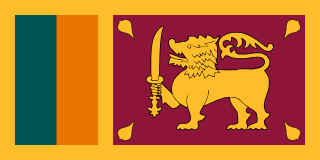
- Flag
- description: yellow with two panels; the smaller panel on the left has two equal vertical bands of green (left side) and orange; the larger panel has a yellow lion holding a sword on a maroon field, with a yellow bo leaf in each corner
meaning: the sword stands for national sovereignty; the lion for Sinhalese ethnicity, the strength of the nation, and bravery; the four bo leaves for Buddhism and the four virtues of kindness, friendliness, happiness, and equanimity; orange stands for Tamils, green for Moors, and maroon for the Sinhalese majority; yellow represents other ethnic groups
note: the banner is sometimes referred to as the Lion Flag - National symbol(s)
- lion, water lily
- National color(s)
- maroon, yellow
- National anthem(s)
- title: "Sri Lanka Matha" (Mother Sri Lanka)
lyrics/music: Ananda SAMARKONE (Sinhala),M. NALLATHAMBY (Tamil)/Ananda SAMARKONE
history: adopted 1951 - National heritage
- total World Heritage Sites: 8 (6 cultural, 2 natural)
selected World Heritage Site locales:
Ancient City of Polonnaruwa (c); Ancient City of Sigiriya (c); Sacred City of Anuradhapura (c); Old Town of Galle and its Fortifications (c); Sacred City of Kandy (c); Sinharaja Forest Reserve (n); Rangiri Dambulla Cave Temple (c); Central Highlands of Sri Lanka (n)