- Country name
- conventional long form: none
conventional short form: Mongolia
local long form: none
local short form: Mongol Uls
former: Outer Mongolia, Mongolian People's Republic
etymology: name comes from the Mongol people, whose name derives from the Mongol root word mengu or mongu, meaning "brave" or "unconquered;" the Mongolian name Mongol Uls translates as "Mongol State" - Government type
- semi-presidential republic
- Capital
- name: Ulaanbaatar
geographic coordinates: 47 55 N, 106 55 E
time difference: UTC+8 (13 hours ahead of Washington, DC, during Standard Time)
daylight saving time: +1hr, begins last Saturday in March; ends last Saturday in September
time zone note: Mongolia has two time zones - Ulaanbaatar Time (8 hours in advance of UTC) and Hovd Time (7 hours in advance of UTC)
etymology: the name means "red hero" in Mongolian and honors national hero Damdin SUKHBAATAR, leader of the partisan army that, with Soviet help, liberated Mongolia from Chinese occupation in the early 1920s - Administrative divisions
- 21 provinces (aymguud, singular - aymag) and 1 municipality* (hot); Arhangay, Bayanhongor, Bayan-Olgiy, Bulgan, Darhan-Uul, Dornod, Dornogovi, Dundgovi, Dzavhan (Zavkhan), Govi-Altay, Govisumber, Hentiy, Hovd, Hovsgol, Omnogovi, Orhon, Ovorhangay, Selenge, Suhbaatar, Tov, Ulaanbaatar*, Uvs
- Legal system
- civil law system influenced by Soviet and Romano-Germanic systems; constitution ambiguous on judicial review of legislative acts
- Constitution
- history: several previous; latest adopted 13 January 1992, effective 12 February 1992
amendment process:
proposed by the State Great Hural, by the president of the republic, by the government, or by petition submitted to the State Great Hural by the Constitutional Court; conducting referenda on proposed amendments requires at least two-thirds majority vote of the State Great Hural; passage of amendments by the State Great Hural requires at least three-quarters majority vote; passage by referendum requires majority participation of qualified voters and a majority of votes - International law organization participation
- has not submitted an ICJ jurisdiction declaration; accepts ICCt jurisdiction
- Citizenship
- citizenship by birth: no
citizenship by descent only: both parents must be citizens of Mongolia; one parent if born within Mongolia
dual citizenship recognized: no
residency requirement for naturalization: 5 years - Suffrage
- 18 years of age; universal
- Executive branch
- chief of state: President Ukhnaagiin KHURELSUKH (since 25 June 2021)
head of government: Prime Minister Gombojavyn ZANDANSHATAR (since 13 June 2025)
cabinet: Cabinet directly appointed by the prime minister
election/appointment process:
presidential candidates nominated by political parties represented in the State Great Hural and directly elected by simple-majority popular vote for one 6-year term; following legislative elections, the State Great Hural usually elects the leader of the majority party or majority coalition as prime minister
most recent election date: 9 June 2021
election results:
2021: Ukhnaagiin KHURELSUKH elected president in first round; percent of vote - Ukhnaagiin KHURELSUKH (MPP) 68%, Dangaasuren ENKHBAT (RPEC) 20.1%, Sodnomzundui ERDENE (DP) 6%
2017: Khaltmaa BATTULGA elected president in second round; percent of vote in first round - Khaltmaa BATTULGA (DP) 38.1%, Miyegombo ENKHBOLD (MPP) 30.3%, Sainkhuu GANBAATAR (MPRP) 30.2%, invalid 1.4%; percent of vote in second round - Khaltmaa BATTULGA 55.2%, Miyegombo ENKHBOLD 44.8%
expected date of next election: 2027 - Legislative branch
- legislature name: State Great Hural (Ulsiin Ih Hural)
legislative structure: unicameral
number of seats: 126 (all directly elected)
electoral system: mixed system
scope of elections: full renewal
term in office: 4 years
most recent election date: 6/28/2024
parties elected and seats per party: Mongolian People's Party (MPP) (68); Democratic Party (DP) (42); HUN Party (8); Other (8)
percentage of women in chamber: 25.4%
expected date of next election: June 2028 - Judicial branch
- highest court(s): Supreme Court (consists of the Chief Justice and 24 judges organized into civil, criminal, and administrative chambers); Constitutional Court or Tsets (consists of the chairman and 8 members)
judge selection and term of office:
Supreme Court chief justice and judges appointed by the president on recommendation of the General Council of Courts -- a 14-member body of judges and judicial officials -- to the State Great Hural; appointment is for life; chairman of the Constitutional Court elected from among its members; members appointed from nominations by the State Great Hural - 3 each by the president, the State Great Hural, and the Supreme Court; appointment is 6 years; chairmanship limited to a single renewable 3-year term
subordinate courts: aimag (provincial) and capital city appellate courts; soum, inter-soum, and district courts; Administrative Cases Courts - Political parties
- Democratic Party or DP
Mongolian People's Party or MPP
National Coalition (consists of Mongolian Green Party or MGP and the Mongolian National Democratic Party or MNDP)
National Labor Party or HUN
Civil Will-Green Party or CWGP - Diplomatic representation in the US
- chief of mission: Ambassador BATBAYAR Ulziidelger (since 1 December 2021)
chancery: 2833 M Street NW, Washington, DC 20007
telephone: [1] (202) 333-7117
FAX: [1] (202) 298-9227
email address and website:
washington@mfa.gov.mn
http://mongolianembassy.us/
consulate(s) general: New York, San Francisco - Diplomatic representation from the US
- chief of mission: Ambassador Richard L. BUANGAN (since November 2022)
embassy: Denver Street #3, 11th Micro-District, Ulaanbaatar 14190
mailing address: 4410 Ulaanbaatar Place, Washington DC 20521-4410
telephone: [976] 7007-6001
FAX: [976] 7007-6174
email address and website:
UlaanbaatarACS@state.gov
https://mn.usembassy.gov/ - International organization participation
- ADB, ARF, CD, CICA, CP, EBRD, EITI (compliant country), FAO, G-77, IAEA, IBRD, ICAO, ICC (NGOs), ICCt, ICRM, IDA, IFAD, IFC, IFRCS, ILO, IMF, IMO, IMSO, Interpol, IOC, IOM, IPU, ISO, ITSO, ITU, ITUC, MIGA, MINURSO, MONUSCO, NAM, OPCW, OSCE, SCO (observer), UN, UNAMID, UNCTAD, UNESCO, UNIDO, UNISFA, UNMISS, UNOOSA, UNWTO, UPU, WCO, WHO, WIPO, WMO, WTO
- Independence
- 29 December 1911 (independence declared from China; in actuality, autonomy attained); 11 July 1921 (from China)
- National holiday
- Naadam (games) holiday, 11-15 July; Constitution Day, 26 November (1924)
note: the first holiday commemorates independence from China in the 1921 Revolution, and the second marks the date that the Mongolian People's Republic was created under a new constitution - Flag
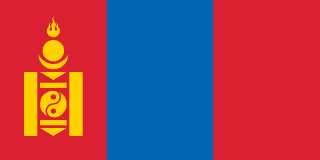
- description: three equal vertical bands of red (left side), blue, and red; centered on the left-side red band is the national emblem in yellow, the soyombo, which is an abstract representation of fire, sun, moon, earth, water, and the yin-yang symbol
meaning: blue stands for the sky, and red for progress and prosperity - National symbol(s)
- Soyombo character (from the Soyombo writing system)
- National color(s)
- red, blue, yellow
- National anthem(s)
- title: "Mongol ulsyn toriin duulal" (National Anthem of Mongolia)
lyrics/music: Tsendiin DAMDINSUREN/Bilegiin DAMDINSUREN and Luvsanjamts MURJORJ
history: music adopted 1950, lyrics adopted 2006; lyrics altered on numerous occasions - National heritage
- total World Heritage Sites: 6 (4 cultural, 2 natural)
selected World Heritage Site locales:
Uvs Nuur Basin (n); Orkhon Valley Cultural Landscape (c); Petroglyphic Complexes of the Mongolian Altai (c); Great Burkhan Khaldun Mountain and surrounding sacred landscape (c); Landscapes of Dauria (n); Deer Stone Monuments and Related Bronze Age Sites (c)