- Country name
- conventional long form: Republic of Namibia
conventional short form: Namibia
local long form: Republic of Namibia
local short form: Namibia
former: German South-West Africa (Deutsch-Suedwestafrika), South-West Africa
etymology: named for the coastal Namib Desert; the word namib comes from the local Nama language and means "an area where there is nothing" - Government type
- presidential republic
- Capital
- name: Windhoek
geographic coordinates: 22 34 S, 17 05 E
time difference: UTC+2 (7 hours ahead of Washington, DC, during Standard Time)
etymology:
the name is an Afrikaans word meaning "windy corner;" a local Khoikhoin chief first used the name in the 19th century and may have derived it from the name of his childhood South African village of Winterhoek - Administrative divisions
- 14 regions; Erongo, Hardap, //Karas, Kavango East, Kavango West, Khomas, Kunene, Ohangwena, Omaheke, Omusati, Oshana, Oshikoto, Otjozondjupa, Zambezi
note: the Karas region was renamed //Karas in 2013 to include the alveolar lateral click of the Khoekhoegowab language - Legal system
- mixed system of uncodified civil law based on Roman-Dutch law and customary law
- Constitution
- history: adopted 9 February 1990, entered into force 21 March 1990
amendment process:
passage requires majority vote of the National Assembly membership and of the National Council of Parliament and assent of the president of the republic; if the National Council fails to pass an amendment, the president can call for a referendum; passage by referendum requires two-thirds majority of votes cast; amendments that detract from or repeal constitutional articles on fundamental rights and freedoms cannot be amended, and the requisite majorities needed by Parliament to amend the constitution cannot be changed - International law organization participation
- has not submitted an ICJ jurisdiction declaration; accepts ICCt jurisdiction
- Citizenship
- citizenship by birth: no
citizenship by descent only: at least one parent must be a citizen of Namibia
dual citizenship recognized: no
residency requirement for naturalization: 5 years - Suffrage
- 18 years of age; universal
- Executive branch
- chief of state: President Netumbo NANDI-NDAITWAH (since 21 March 2025)
head of government: President Netumbo NANDI-NDAITWAH (since 21 March 2025)
cabinet: Cabinet appointed by the president from among members of the National Assembly
election/appointment process: president directly elected by absolute-majority popular vote in 2 rounds, if needed, for a 5-year term (eligible for a second term)
most recent election date: 27 November 2024
election results:
2024: Netumbo NANDI-NDAITWAH elected president in the first round; percent of vote -Netumbo NANDI-NDAITWAH (SWAPO) 57%, Panduleni ITULA (IPC) 26%, McHenry VENAANI (PDM) 5.10%, Bernadus SWARTBOOI (LPM) 4.72%, Job AMUPANDA (AR) 1.80%, Hendrik GAOBEAB (UDF) 1.16%; other 3.31%
2019: Hage GEINGOB reelected president in the first round; percent of vote - Hage GEINGOB (SWAPO) 56.3%, Panduleni ITULA (independent) 29.4%, McHenry VENAANI (PDM) 5.3%, other .9%
expected date of next election: November 2029
note: the president is both chief of state and head of government - Legislative branch
- legislature name: Parliament
legislative structure: bicameral - Legislative branch - lower chamber
- chamber name: National Assembly
number of seats: 104 (96 directly elected; 8 appointed)
electoral system: proportional representation
scope of elections: full renewal
term in office: 5 years
most recent election date: 11/27/2024 to 11/30/2024
parties elected and seats per party: SWAPO Party (51); Independent Patriots of Change (IPC) (20); Affirmative Repositioning (AR) (6); Landless People's Movement (LPM) (5); Popular Democratic Movement (PDM) (5); Other (9)
percentage of women in chamber: 42.3%
expected date of next election: November 2029 - Legislative branch - upper chamber
- chamber name: National Council
number of seats: 42 (all indirectly elected)
electoral system: proportional representation
term in office: 5 years
most recent election date: 12/15/2020
percentage of women in chamber: 14.3%
expected date of next election: December 2025
note: the Council primarily reviews legislation passed and referred by the National Assembly - Judicial branch
- highest court(s): Supreme Court (consists of the chief justice and at least 3 judges in quorum sessions)
judge selection and term of office: judges appointed by the president of Namibia on the recommendation of the Judicial Service Commission; judges serve until age 65, but terms can be extended by the president until age 70
subordinate courts: High Court; Electoral Court, Labor Court; regional and district magistrates' courts; community courts - Political parties
- All People's Party or APP
Christian Democratic Voice or CDV
Landless People's Movement or LPM
National Unity Democratic Organization or NUDO
Namibian Economic Freedom Fighters or NEFF
Popular Democratic Movement or PDM (formerly Democratic Turnhalle Alliance or DTA)
Rally for Democracy and Progress or RDP
Republican Party or RP
South West Africa National Union or SWANU
South West Africa People's Organization or SWAPO
United Democratic Front or UDF
United People's Movement or UPM - Diplomatic representation in the US
- chief of mission: Ambassador Wilbard HELLAO (since 16 December 2025)
chancery: 1605 New Hampshire Avenue NW, Washington, DC 20009
telephone: [1] (202) 986-0540
FAX: [1] (202) 986-0443
email address and website:
info@namibiaembassyusa.org
https://namibiaembassyusa.org/ - Diplomatic representation from the US
- chief of mission: Ambassador John GIORDANO (since 29 October 2025)
embassy: 38 Metje Street, Klein Windhoek, Windhoek
mailing address: 2540 Windhoek Place, Washington DC 20521-2540
telephone: [264] (61) 202-5000
FAX: [264] (61) 202-5219
email address and website:
ConsularWindhoek@state.gov
https://na.usembassy.gov/ - International organization participation
- ACP, AfDB, AU, C, CD, CPLP (associate observer), FAO, G-77, IAEA, IBRD, ICAO, ICCt, ICRM, IDA, IFAD, IFC, IFRCS, ILO, IMF, IMO, Interpol, IOC, IOM, IPU, ISO, ITSO, ITU, ITUC (NGOs), MIGA, NAM, OPCW, SACU, SADC, UN, UNAMID, UNCTAD, UNESCO, UNHCR, UNHRC, UNIDO, UNISFA, UNMIL, UNMISS, UNOCI, UNWTO, UPU, WCO, WHO, WIPO, WMO, WTO
- Independence
- 21 March 1990 (from South African mandate)
- National holiday
- Independence Day, 21 March (1990)
- Flag
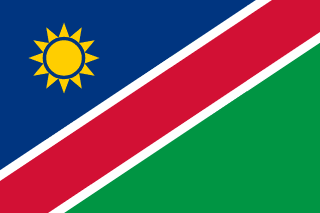
- description: a wide red stripe edged with narrow white stripes divides the flag diagonally from lower-left corner to upper-right corner; the upper triangle is blue and has a golden-yellow, 12-ray sunburst, and the lower triangle is green
meaning: red stands for the heroism of the people and their determination to build a future of equal opportunity; white stands for peace, unity, tranquility, and harmony; blue stands for the sky and the Atlantic Ocean, the sun for power and existence, and green for vegetation and agricultural resources - National symbol(s)
- oryx (antelope)
- National color(s)
- blue, red, green, white, yellow
- National anthem(s)
- title: "Namibia, Land of the Brave"
lyrics/music: Axali DOESEB
history: adopted 1991 - National heritage
- total World Heritage Sites: 2 (1 cultural, 1 natural)
selected World Heritage Site locales: Twyfelfontein or /Ui-//aes (c); Namib Sand Sea (n)