- Country name
- conventional long form: none
conventional short form: Nepal
local long form: none
local short form: Nepal
etymology: the name probably comes from the Sanskrit term nepala, from the words for "fly down" and "house," which would refer to the villages at the base of the mountains - Government type
- federal parliamentary republic
- Capital
- name: Kathmandu
geographic coordinates: 27 43 N, 85 19 E
time difference: UTC+5.75 (10.75 hours ahead of Washington, DC, during Standard Time)
etymology: the name comes from the Nepalese words kath (wooden) and mandu (temple), referring to the local temples that are often still built from wood - Administrative divisions
- 7 provinces (pradesh, singular - pradesh); Bagmati, Gandaki, Karnali, Koshi, Lumbini, Madhesh, Sudurpashchim
- Legal system
- English common law and Hindu legal concepts
- Constitution
- history: several previous; latest approved by the Second Constituent Assembly 16 September 2015, signed by the president and effective 20 September 2015
amendment process:
proposed as a bill by either house of the Federal Parliament; bills affecting a state border or powers delegated to a state must be submitted to the affected state assembly; passage of such bills requires a majority vote of that state assembly membership; bills not requiring state assembly consent require at least two-thirds majority vote by the membership of both houses of the Federal Parliament; parts of the constitution on the sovereignty, territorial integrity, independence, and sovereignty vested in the people cannot be amended - International law organization participation
- has not submitted an ICJ jurisdiction declaration; non-party state to the ICCt
- Citizenship
- citizenship by birth: yes
citizenship by descent only: yes
dual citizenship recognized: no
residency requirement for naturalization: 15 years - Suffrage
- 18 years of age; universal
- Executive branch
- chief of state: President Ram Chandra POUDEL (since 13 March 2023)
head of government: Prime Minister Sushila KARKI (since 12 September 2025)
cabinet: Council of Ministers appointed by the prime minister; cabinet positions shared among Nepali Congress, Communist Party of Nepal-Maoist Centre, and various coalition partners
election/appointment process: president indirectly elected by an electoral college of the Federal Parliament and the state assemblies for a 5-year term (eligible for a second term)
most recent election date: 9 March 2023
election results: 2023: Ram Chandra POUDEL elected president; electoral college vote - Ram Chandra POUDEL (NC) 33,802, Subash Chandra NEMBANG (CPN-UML) 15,518
expected date of next election: 5 March 2026
note: KARKI was sworn in as interim prime minister on 12 September 2025 after Khadga Prasad Sharma OLI resigned on 9 September following violent protests; KARKI will serve until elections are held in March 2026 - Legislative branch
- legislature name: Federal Parliament (Sanghiya Sansad)
legislative structure: bicameral
note: violent student-led protests in early September 2025 led to the resignation of the Prime Minister; the President dissolved Parliament on 12 September 2015 following the swearing in of an interim prime minister and set elections for 5 March 2026; the major political parties have demanded reinstatement of the Parliament - Legislative branch - lower chamber
- chamber name: House of Representatives (Pratinidhi Sabha)
number of seats: 275 (all directly elected)
electoral system: mixed system
scope of elections: full renewal
term in office: 5 years
most recent election date: 11/20/2022
parties elected and seats per party:
Nepali Congress (NC) (89); Communist Party of Nepal (Unified Marxist-Leninist, UML) (78); Communist Party of Nepal-Maoist Centre (CPN-MC) (32); Rastriya Swatantra Party (20); Rastriya Prajatantra Party Nepal (RPP) (14); People's Socialist Party, Nepal (12); Communist Party of Nepal (Unified Socialist) (10); Janamat Party (6); Democratic Socialist Party, Nepal (4); People's Freedom Party (3); Nepal Workers Peasants Party (1); Rastriya Janamorcha (1); Independents (5)
percentage of women in chamber: 0%
expected date of next election: 5 March 2026
note: Parliament was dissolved by the President on 12 September following violent protests, the resignation of the Prime Minister, and the appointment of an interim prime minister with new elections set for March 2026 - Legislative branch - upper chamber
- chamber name: National Assembly (Rastriya Sabha)
number of seats: 59 (56 indirectly elected; 3 appointed)
scope of elections: partial renewal
term in office: 6 years
most recent election date: 1/25/2024
percentage of women in chamber: 37.3%
expected date of next election: January 2026 - Judicial branch
- highest court(s): Supreme Court (consists of the chief justice and up to 20 judges)
judge selection and term of office:
Supreme Court chief justice appointed by the president on the recommendation of the Constitutional Council, a 5-member, high-level advisory body headed by the prime minister; other judges appointed by the president on the recommendation of the Judicial Council, a 5-member advisory body headed by the chief justice; the chief justice serves a 6-year term; judges serve until age 65
subordinate courts: High Court; district courts - Political parties
- Communist Party of Nepal (Maoist Centre) or CPN-MC
Communist Party of Nepal (Unified Marxist-Leninist) or CPN-UML
Communist Party of Nepal (Unified Socialist) or CPN-US
Janamat Party
Janata Samajbaadi Party or JSP
Loktantrik Samajwadi Party or LSP
Naya Shakti Party, Nepal
Nepali Congress or NC
Nepal Mazdoor Kisan Party (Nepal Workers' and Peasants' Party) or NWPP
Rastriya Janamorcha (National People's Front)
Rastriya Prajatantra Party (National Democratic Party) or RPP
Rastriya Swatantra Party or RSP - Diplomatic representation in the US
- chief of mission: Ambassador (vacant); Chargé d'Affaires Sharad Raj ARAN (since November 2025)
chancery: 2730 34th Place NW, Washington, DC 20007
telephone: [1] (202) 667-4550
FAX: [1] (202) 667-5534
email address and website:
info@nepalembassyusa.org
https://us.nepalembassy.gov.np/
consulate(s) general: New York - Diplomatic representation from the US
- chief of mission: Ambassador Dean R. THOMPSON (since October 2022)
embassy: Maharajgunj, Kathmandu
mailing address: 6190 Kathmandu Place, Washington DC 20521-6190
telephone: [977] (1) 423-4000
FAX: [977] (1) 400-7272
email address and website:
usembktm@state.gov
https://np.usembassy.gov/ - International organization participation
- ADB, BIMSTEC, CD, CP, FAO, G-77, IAEA, IBRD, ICAO, ICC (NGOs), ICRM, IDA, IFAD, IFC, IFRCS, ILO, IMF, IMO, Interpol, IOC, IOM, IPU, ISO, ITSO, ITU, ITUC (NGOs), MIGA, MINURSO, MINUSTAH, MONUSCO, NAM, OPCW, SAARC, SACEP, UN, UNAMID, UNCTAD, UNDOF, UNESCO, UNIDO, UNIFIL, UNISFA, UNMIL, UNMISS, UNOCI, UNSOM, UNTSO, UNWTO, UPU, WCO, WFTU (NGOs), WHO, WIPO, WMO, WTO
- Independence
- 1768 (unified by Prithvi Narayan SHAH)
- National holiday
- Constitution Day, 20 September (2015)
note: replaces the previous Republic Day on 28 May as the official national day in Nepal; the Gregorian date fluctuates based on Nepal’s Hindu calendar - Flag
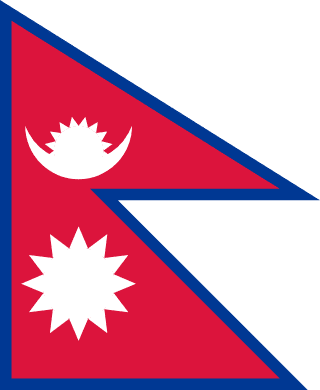
- description: crimson red with a blue border, in the shape of two overlapping right triangles; the smaller upper triangle has a stylized white moon, and the larger lower triangle has a 12-pointed white sun
meaning: red stands for the rhododendron (the national flower) and victory and bravery, and the blue border for peace and harmony; the two triangles are a combination of two pennants that originally symbolized the Himalaya Mountains, but today they refer to Hinduism and Buddhism, the country's two main religions; the moon stands for the serenity of the people, as well as Himalayan shade and cool weather, and the sun for the heat and higher temperatures in the rest of the country
note: Nepal is the only country with a flag that is not rectangular or square - National symbol(s)
- rhododendron blossom
- National color(s)
- red
- National anthem(s)
- title: "Sayaun Thunga Phool Ka" (Hundreds of Flowers)
lyrics/music: Pradeep Kumar RAI/Ambar GURUNG
history: adopted 2007 - National heritage
- total World Heritage Sites: 4 (2 cultural, 2 natural)
selected World Heritage Site locales: Kathmandu Valley (c); Sagarmatha National Park (n); Chitwan National Park (n); Lumbini, Buddha Birthplace (c)