- Country name
- conventional long form: Islamic Republic of Pakistan
conventional short form: Pakistan
local long form: Jamhuryat Islami Pakistan
local short form: Pakistan
former: West Pakistan
etymology:
the name is said to have been proposed in the early 1930s by Muslim students at Cambridge University, created from the initials of Punjab, Afghanistan, and Kashmir; the word pak also means "pure" in Persian or Pashto, and the Persian suffix -stan means "place of" or "country," so Pakistan literally means "Land of the Pure" - Government type
- federal parliamentary republic
- Capital
- name: Islamabad
geographic coordinates: 33 41 N, 73 03 E
time difference: UTC+5 (10 hours ahead of Washington, DC, during Standard Time)
etymology: the name means "city of Islam" and derives from the Arabic islam, referring to the Islamic faith, and the Persian suffix -abad, meaning "inhabited place" or "city" - Administrative divisions
- 4 provinces, 2 Pakistan-administered areas*, and 1 capital territory**; Azad Kashmir*, Balochistan, Gilgit-Baltistan*, Islamabad Capital Territory**, Khyber Pakhtunkhwa, Punjab, Sindh
- Legal system
- common law system with Islamic law influence
- Constitution
- history: several previous; latest endorsed 12 April 1973, passed 19 April 1973, entered into force 14 August 1973 (suspended and restored several times)
amendment process: proposed by the Senate or by the National Assembly; passage requires at least two-thirds majority vote of both houses - International law organization participation
- accepts compulsory ICJ jurisdiction with reservations; non-party state to the ICCt
- Citizenship
- citizenship by birth: yes
citizenship by descent only: at least one parent must be a citizen of Pakistan
dual citizenship recognized: yes, but limited to select countries
residency requirement for naturalization: 4 out of the previous 7 years and including the 12 months preceding application - Suffrage
- 18 years of age; universal
note: women and non-Muslims have joint electorates and reserved parliamentary seats - Executive branch
- chief of state: President Asif Ali ZARDARI (since 10 March 2024)
head of government: Prime Minister Muhammad Shehbaz SHARIF (since 3 March 2024)
cabinet: Cabinet appointed by the president on the advice of the prime minister
election/appointment process:
president indirectly elected for a 5-year term (limited to 2 consecutive terms) by the Electoral College, which consists of members of the Senate, National Assembly, and provincial assemblies; prime minister elected for a 5-year term by the National Assembly
most recent election date: 9 March 2024
election results:
2024: Asif Ali ZARDARI elected president; National Assembly vote - Asif Ali ZARDARI (PPP) 411 votes, Mehmood Khan ACHAKZALI (PMAP) 181 votes; Shehbaz SHARIF elected prime minister; National Assembly vote - Shehbaz SHARIF (PML-N) 201, Omar AYUB (PTI) 92
expected date of next election: 2029 - Legislative branch
- legislature name: Parliament (Majlis-E-Shoora)
legislative structure: bicameral - Legislative branch - lower chamber
- chamber name: National Assembly
number of seats: 336 (all directly elected)
electoral system: plurality/majority
scope of elections: full renewal
term in office: 5 years
most recent election date: 2/8/2024
parties elected and seats per party: Pakistan Muslim League-Nawaz (PML-N) (75); Pakistan People's Party Parliamentarians (PPPP) (54); Muttahida Quami Movement Pakistan (MQMP) (17); Independents (101); Other (16)
percentage of women in chamber: 17%
expected date of next election: February 2029 - Legislative branch - upper chamber
- chamber name: Senate
number of seats: 96 (all indirectly elected)
scope of elections: partial renewal
term in office: 6 years
most recent election date: 4/2/2024
percentage of women in chamber: 18.8%
expected date of next election: March 2027 - Judicial branch
- highest court(s): Supreme Court of Pakistan (consists of the chief justice and 16 judges)
judge selection and term of office:
justices nominated by an 8-member parliamentary committee on the recommendation of the Judicial Commission, a 9-member body of judges and other judicial professionals, and appointed by the president; justices can serve until age 65
subordinate courts: High Courts; Federal Shariat Court; provincial and district civil and criminal courts; specialized courts for issues, such as taxation, banking, and customs - Political parties
- Awami National Party or ANP
Awami Muslim League or AML
Balochistan Awami Party or BAP
Balochistan National Party-Awami or BNP-A
Balochistan National Party-Mengal or BNP-M
Grand Democratic Alliance or GDA (alliance of several parties)
Hazara Democratic Party or HDP
Istehkam-e-Pakistan Party
Jamaat-e-Islami or JI
Jamhoori Wattan Party or JWP
Jamiat Ulema-e-Islam-Fazl or JUI-F
Majlis Wahdat-e-Muslimeen Pakistan or MWM
Muttahida Majlis-e-Amal or MMA (alliance of several parties)
Muttahida Qaumi Movement-Pakistan or MQM-P
National Party or NP
Pakistan Muslim League or PML-Z
Pakistan Muslim League-Functional or PML-F
Pakistan Muslim League-Nawaz or PML-N
Pakistan Muslim League-Quaid-e-Azam or PML-Q
Pakistan Peoples Party or PPP
Pakistan Rah-e-Haq Party or PRHP
Pakistan Tehrik-e Insaaf or PTI (Pakistan Movement for Justice)
Pashtoonkhwa Milli Awami Party or PMAP or PKMAP
Tehreek-e-Labbaik Pakistan or TLP - Diplomatic representation in the US
- chief of mission: Ambassador Rizwan Saeed SHEIKH (since 18 September 2024)
chancery: 3517 International Court NW, Washington, DC 20008
telephone: [1] (202) 243-6500
FAX: [1] (202) 686-1534
email address and website:
consularsection@embassyofpakistanusa.org
https://embassyofpakistanusa.org/
consulate(s) general: Chicago, Houston, Los Angeles, New York - Diplomatic representation from the US
- chief of mission: Ambassador (vacant); Chargé d’Affaires Natalie A. BAKER (since January 2025)
embassy: Diplomatic Enclave, Ramna 5, Islamabad
mailing address: 8100 Islamabad Place, Washington, DC 20521-8100
telephone: [92] 051-201-4000
FAX: [92] 51-2338071
email address and website:
ACSIslamabad@state.gov
https://pk.usembassy.gov/
consulate(s) general: Karachi, Lahore, Peshawar - International organization participation
- ADB, AIIB, ARF, ASEAN (sectoral dialogue partner), C, CERN (associate member), CICA, CP, D-8, ECO, FAO, G-11, G-24, G-77, IAEA, IBRD, ICAO, ICC (national committees), ICRM, IDA, IDB, IFAD, IFC, IFRCS, IHO, ILO, IMF, IMO, IMSO, Interpol, IOC, IOM, IPU, ISO, ITSO, ITU, ITUC (NGOs), MIGA, MINURCAT, MINURSO, MINUSCA, MONUSCO, NAM, OAS (observer), OIC, OPCW, PCA, SAARC, SACEP, SCO, UN, UNAMID, UNCTAD, UNESCO, UNFICYP, UNHCR, UNIDO, UNISFA, UNISFA, UNMISS, UNOOSA, UNSOS, UNWTO, UPU, WCO, WFTU (NGOs), WHO, WIPO, WMO, WTO
- Independence
- 14 August 1947 (from British India)
- National holiday
- Pakistan Day, 23 March, also referred to as Pakistan Resolution Day (1940) or Republic Day (1956)
note: commemorates the adoption of the Lahore Resolution on 23 March 1940, which called for the creation of independent Muslim states, and also the adoption of Pakistan's first constitution on 23 March 1956, during the transition to the Islamic Republic of Pakistan - Flag
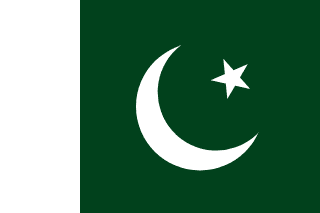
- description: green with a vertical white band on the left side; a large white crescent and star are centered in the green field
meaning: the crescent, star, and color green are all traditional Islamic symbols; the white band symbolizes the role of religious minorities - National symbol(s)
- five-pointed star between the horns of a waxing crescent moon, jasmine
- National color(s)
- green, white
- National anthem(s)
- title: "Qaumi Tarana" (National Anthem)
lyrics/music: Abu-Al-Asar Hafeez JULLANDHURI/Ahmed Ghulamali CHAGLA
history: adopted 1954; also known as "Pak sarzamin shad bad" (Blessed Be the Sacred Land) - National heritage
- total World Heritage Sites: 6 (all cultural)
selected World Heritage Site locales: Archaeological Ruins at Moenjodaro; Buddhist Ruins of Takht-i-Bahi; Taxila; Fort and Shalamar Gardens in Lahore; Historical Monuments at Makli, Thatta; Rohtas Fort