- Country name
- conventional long form: Republic of the Philippines
conventional short form: Philippines
local long form: Republika ng Pilipinas
local short form: Pilipinas
etymology: named in honor of King PHILLIP II of Spain by Spanish explorer Ruy LOPEZ de VILLALOBOS, who visited the islands in 1543 - Government type
- presidential republic
- Capital
- name: Manila
geographic coordinates: 14 36 N, 120 58 E
time difference: UTC+8 (13 hours ahead of Washington, DC, during Standard Time)
etymology: derives from the Tagalog word may, meaning "there is," and nila, the local name for a shrub in the indigo family - Administrative divisions
- 81 provinces and 38 chartered cities
provinces: Abra, Agusan del Norte, Agusan del Sur, Aklan, Albay, Antique, Apayao, Aurora, Basilan, Bataan, Batanes, Batangas, Biliran, Benguet, Bohol, Bukidnon, Bulacan, Cagayan, Camarines Norte, Camarines Sur, Camiguin, Capiz, Catanduanes, Cavite, Cebu, Cotabato, Davao del Norte, Davao del Sur, Davao de Oro, Davao Occidental, Davao Oriental, Dinagat Islands, Eastern Samar, Guimaras, Ifugao, Ilocos Norte, Ilocos Sur, Iloilo, Isabela, Kalinga, Laguna, Lanao del Norte, Lanao del Sur, La Union, Leyte, Maguindanao, Marinduque, Masbate, Mindoro Occidental, Mindoro Oriental, Misamis Occidental, Misamis Oriental, Mountain, Negros Occidental, Negros Oriental, Northern Samar, Nueva Ecija, Nueva Vizcaya, Palawan, Pampanga, Pangasinan, Quezon, Quirino, Rizal, Romblon, Samar, Sarangani, Siquijor, Sorsogon, South Cotabato, Southern Leyte, Sultan Kudarat, Sulu, Surigao del Norte, Surigao del Sur, Tarlac, Tawi-Tawi, Zambales, Zamboanga del Norte, Zamboanga del Sur, Zamboanga Sibugay
chartered cities: Angeles, Bacolod, Baguio, Butuan, Cagayan de Oro, Caloocan, Cebu, Cotabato, Dagupan, Davao, General Santos, Iligan, Iloilo, Lapu-Lapu, Las Pinas, Lucena, Makati, Malabon, Mandaluyong, Mandaue, Manila, Marikina, Muntinlupa, Naga, Navotas, Olongapo, Ormoc, Paranaque, Pasay, Pasig, Puerto Princesa, Quezon, San Juan, Santiago, Tacloban, Taguig, Valenzuela, Zamboanga - Legal system
- mixed system of civil, common, Islamic (sharia), and customary law
- Constitution
- history: several previous; latest ratified 2 February 1987, effective 11 February 1987
amendment process:
proposed by Congress if supported by three fourths of the membership, by a constitutional convention called by Congress, or by public petition; passage by either of the three proposal methods requires a majority vote in a national referendum - International law organization participation
- accepts compulsory ICJ jurisdiction with reservations; withdrew from the ICCt in March 2019
- Citizenship
- citizenship by birth: no
citizenship by descent only: at least one parent must be a citizen of the Philippines
dual citizenship recognized: no
residency requirement for naturalization: 10 years - Suffrage
- 18 years of age; universal
- Executive branch
- chief of state: President Ferdinand "BongBong" MARCOS, Jr. (since 30 June 2022)
head of government: President Ferdinand "BongBong" MARCOS, Jr. (since 30 June 2022)
cabinet:
Cabinet appointed by the president with the consent of the Commission of Appointments, an independent body of 25 Congressional members that includes the Senate president (ex officio chairman) and is appointed by the president
election/appointment process: president and vice president directly elected on separate ballots by simple-majority popular vote for a single 6-year term
most recent election date: 9 May 2022
election results:
2022: Ferdinand MARCOS, Jr. elected president; percent of vote - Ferdinand MARCOS, Jr. (PFP) 58.7%, Leni ROBREDO (independent) 27.9%, Manny PACQUIAO (PROMDI) 6.8%, other 6.6%; Sara DUTERTE-Carpio elected vice president; percent of vote Sara DUTERTE-Carpio (Lakas-CMD) 61.5%, Francis PANGILINAN (LP) 17.8%, Tito SOTTO 15.8%, other 4.9%
2016: Rodrigo DUTERTE elected president; percent of vote - Rodrigo DUTERTE (PDP-Laban) 39%, Manuel "Mar" ROXAS (LP) 23.5%, Grace POE (independent) 21.4%, Jejomar BINAY (UNA) 12.7%, Miriam Defensor SANTIAGO (PRP) 3.4%; Leni ROBREDO elected vice president; percent of vote Leni ROBREDO (LP) 35.1%, Ferdinand MARCOS, Jr. (independent) 34.5%, Alan CAYETANO 14.4%, Francis ESCUDERO (independent) 12%, other 4%
expected date of next election: 9 May 2028
note: the president is both chief of state and head of government - Legislative branch
- legislature name: Congress (Kongreso)
legislative structure: bicameral - Legislative branch - lower chamber
- chamber name: House of Representatives (Kapulungan Ng Mga Kinatawan)
number of seats: 317 (all directly elected)
electoral system: mixed system
scope of elections: full renewal
term in office: 3 years
most recent election date: 5/12/2025
parties elected and seats per party:
Lakas-CMD party (103), National Unity Party (NUP) (32), Nationalist People's Coalition (NPC) 31, Partido Federal ng Pilipinas (PFP) (27), Nacionalista Party (NP) (22), Liberal Party (LP) (6), others (28), independents (11)
percentage of women in chamber: 28.3%
expected date of next election: May 2028 - Legislative branch - upper chamber
- chamber name: Senate (Senado)
number of seats: 24 (all directly elected)
electoral system: plurality/majority
scope of elections: partial renewal
term in office: 6 years
most recent election date: 5/12/2025
parties elected and seats per party:
Nationalist People's Coalition (NPC) (2); Nacionalista Party (NP) (3); Partido Demokratiko Pilipino-Laban (PDP-Laban) (2); Lakas- CMD party (1); Katipunan ng Nagkakaisang Pilipino (KANP) (1); Liberal Party (1); Independents (2)
percentage of women in chamber: 20.8%
expected date of next election: May 2028 - Judicial branch
- highest court(s): Supreme Court (consists of a chief justice and 14 associate justices)
judge selection and term of office:
justices are appointed by the president on the recommendation of the Judicial and Bar Council, a constitutionally created, 6-member body that recommends Supreme Court nominees; justices serve until age 70
subordinate courts: Court of Appeals; Sandiganbayan (special court for corruption cases of government officials); Court of Tax Appeals; regional, metropolitan, and municipal trial courts; sharia courts - Political parties
- Democratic Action (Aksyon Demokratiko)
Alliance for Change (Hugpong ng Pagbabago or HNP)
Katipunan ng Nagkakaisang Pilipino (KANP)
Lakas ng EDSA-Christian Muslim Democrats or Lakas-CMD
Liberal Party or LP
Nacionalista Party or NP
Nationalist People's Coalition or NPC
National Unity Party or NUP
Partido Demokratiko Pilipino-Lakas ng Bayan or PDP-Laban
Partido Federal ng Pilipinas or PFP - Diplomatic representation in the US
- chief of mission: Ambassador Jose Manuel del Gallego ROMUALDEZ (since 29 November 2017)
chancery: 1600 Massachusetts Avenue NW, Washington, DC 20036
telephone: [1] (202) 467-9300
FAX: [1] (202) 328-7614
email address and website:
info@phembassy-us.org
The Embassy of the Republic of the Philippines in Washington D.C. (philippineembassy-dc.org)
consulate(s) general: Chicago, Honolulu, Houston, Los Angeles, New York, San Francisco, Tamuning (Guam) - Diplomatic representation from the US
- chief of mission: Ambassador MaryKay Loss CARLSON (since 22 July 2022)
embassy: 1201 Roxas Boulevard, Manila 1000
mailing address: 8600 Manila Place, Washington DC 20521-8600
telephone: [63] (2) 5301-2000
FAX: [63] (2) 5301-2017
email address and website:
acsinfomanila@state.gov
https://ph.usembassy.gov/ - International organization participation
- ADB, APEC, ARF, ASEAN, BIS, CD, CICA (observer), CP, EAS, FAO, G-24, G-77, IAEA, IBRD, ICAO, ICRM, IDA, IFAD, IFC, IFRCS, IHO, ILO, IMF, IMO, IMSO, Interpol, IOC, IOM, IPU, ISO, ITSO, ITU, ITUC (NGOs), MIGA, MINUSTAH, NAM, OAS (observer), OPCW, PCA, PIF (partner), UN, UNCTAD, UNESCO, UNHCR, UNIDO, Union Latina, UNMIL, UNMOGIP, UNOCI, UNOOSA, UNWTO, UPU, WCO, WFTU (NGOs), WHO, WIPO, WMO, WTO
- Independence
- 4 July 1946 (from the US)
- National holiday
- Independence Day, 12 June (1898)
note: 12 June 1898 was the date of independence from Spain; 4 July 1946 was the date of independence from the US - Flag
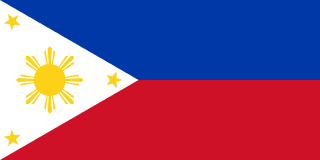
- description: two equal horizontal bands of blue (top) and red; a white equilateral triangle is based on the left side; the center of the triangle has a yellow sun with eight rays, each split into smaller rays; the triangle's corners each have a small five-pointed yellow star
meaning: blue stands for peace and justice, red for courage, and the triangle for equality; the rays represent the first eight provinces that sought independence from Spain, and the stars represent the country's three parts: Luzon, Visayas, and Mindanao
history: the design dates to 1897
note: in wartime, the flag is flown upside-down with the red band at the top - National symbol(s)
- three stars and sun, Philippine eagle
- National color(s)
- red, white, blue, yellow
- National coat of arms
- the coat of arms was adopted on 3 July 1946; the three gold stars represent the major island groups of Luzon, the Visayas, and Mindanao; the rays of the sun represent the provinces of the Philippines; the American eagle and lion of Spain represent the nation's colonial past
- National anthem(s)
- title: "Lupang Hinirang" (Chosen Land)
lyrics/music: collectively/Julian FELIPE
history: music adopted 1898 and lyrics adopted 1956; only sung in Tagalog - National heritage
- total World Heritage Sites: 6 (3 cultural, 3 natural)
selected World Heritage Site locales:
Baroque Churches of the Philippines (c); Tubbataha Reefs Natural Park (n); Rice Terraces of the Philippine Cordilleras (c); Historic Vigan (c); Puerto-Princesa Subterranean River National Park (n); Mount Hamiguitan Range Wildlife Sanctuary (n)