- Country name
- conventional long form: Republic of Palau
conventional short form: Palau
local long form: Beluu er a Belau
local short form: Belau
former: Trust Territory of the Pacific Islands, Palau District
etymology: from the Palauan name for the islands, Belau, which likely derives from the Palauan word beluu, meaning "village" - Government type
- presidential republic in free association with the US
- Capital
- name: Ngerulmud
geographic coordinates: 7 30 N, 134 37 E
time difference: UTC+9 (14 hours ahead of Washington, DC, during Standard Time)
etymology: the name comes from a Palauan term meaning "place of fermented angelfish;" the site of the capital was the traditional location for women to gather and offer fermented angelfish to the gods - Administrative divisions
- 16 states; Aimeliik, Airai, Angaur, Hatohobei, Kayangel, Koror, Melekeok, Ngaraard, Ngarchelong, Ngardmau, Ngatpang, Ngchesar, Ngeremlengui, Ngiwal, Peleliu, Sonsorol
- Legal system
- mixed system of civil, common, and customary law
- Constitution
- history: ratified 9 July 1980, effective 1 January 1981
amendment process:
proposed by a constitutional convention (held at least once every 15 years with voter approval), by public petition of at least 25% of eligible voters, or by a resolution adopted by at least three fourths of National Congress members; passage requires approval by a majority of votes in at least three fourths of the states in the next regular general election - International law organization participation
- has not submitted an ICJ jurisdiction declaration; non-party state to the ICCt
- Citizenship
- citizenship by birth: no
citizenship by descent only: at least one parent must be a citizen of Palau
dual citizenship recognized: no
residency requirement for naturalization: note - no procedure for naturalization - Suffrage
- 18 years of age; universal
- Executive branch
- chief of state: President Surangel WHIPPS, Jr. (since 21 January 2021)
head of government: President Surangel WHIPPS, Jr. (since 21 January 2021)
cabinet:
Cabinet appointed by the president with the advice and consent of the Senate; also includes the vice president; the Council of Chiefs consists of chiefs from each of the states who advise the president on issues concerning traditional laws, customs, and their relationship to the constitution and laws
election/appointment process: president and vice president directly elected on separate ballots by absolute-majority popular vote in 2 rounds, if needed, for a 4-year term (eligible for a second term)
most recent election date: 5 November 2024
election results:
2024: Surangel WHIPPS, Jr. elected president in second round; percent of vote - Surangel WHIPPS, Jr. (independent) 57.7%, Tommy REMENGESAU (independent) 42.1%, other 0.2%
2020: Surangel WHIPPS, Jr. elected president in second round; percent of vote - Surangel WHIPPS, Jr. (independent) 56.7%, Raynold OILUCH (independent) 43.3%
expected date of next election: November 2028
note: the president is both chief of state and head of government - Legislative branch
- legislature name: National Congress (Olbiil Era Kelulau)
legislative structure: bicameral - Legislative branch - lower chamber
- chamber name: House of Delegates
number of seats: 16 (all directly elected)
electoral system: plurality/majority
scope of elections: full renewal
term in office: 4 years
most recent election date: 11/5/2024
percentage of women in chamber: 25%
expected date of next election: November 2028 - Legislative branch - upper chamber
- chamber name: Senate
number of seats: 15 (all directly elected)
electoral system: plurality/majority
scope of elections: full renewal
term in office: 4 years
most recent election date: 11/5/2024
percentage of women in chamber: 13.3%
expected date of next election: November 2028 - Judicial branch
- highest court(s): Supreme Court (consists of the chief justice and 3 associate justices organized into appellate trial divisions; the Supreme Court organization also includes the Common Pleas and Land Courts)
judge selection and term of office: justices nominated by a 7-member independent body consisting of judges, presidential appointees, and lawyers and appointed by the president; judges can serve until mandatory retirement at age 65
subordinate courts: National Court and other inferior courts - Political parties
- although not expressly forbidden by law, Palau does not have political parties or coalitions
- Diplomatic representation in the US
- chief of mission: Ambassador Hersey KYOTA (since 12 November 1997)
chancery: 1701 Pennsylvania Avenue NW, Suite 200, Washington, DC 20006
telephone: [1] (202) 349-8598
FAX: [1] (202) 452-6281
email address and website:
info@palauembassy.org
https://www.palauembassy.org/
consulate(s): Tamuning (Guam) - Diplomatic representation from the US
- chief of mission: Ambassador Joel EHRENDREICH (since 29 September 2023)
embassy: Omsangel/Beklelachieb, Airai 96940
mailing address: 4260 Koror Place, Washington, DC 20521-4260
telephone: [680] 587-2920
FAX: [680] 587-2911
email address and website:
ConsularKoror@state.gov
https://pw.usembassy.gov/ - International organization participation
- ACP, ADB, AOSIS, FAO, IAEA, IBRD, ICAO, ICRM, IDA, IFC, IFRCS, ILO, IMF, IMO, IMSO, IOC, IPU, MIGA, OPCW, PIF, Sparteca, SPC, UN, UNAMID, UNCTAD, UNESCO, WHO, WIPO
- Independence
- 1 October 1994 (from the US-administered UN trusteeship)
- National holiday
- Constitution Day, 9 July (1981); Independence Day, 1 October (1994)
- Flag
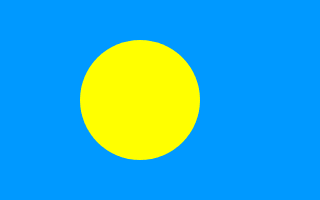
- description: light blue with a large yellow disk to the left side
meaning: blue stands for the ocean, and the disk for the moon, which is considered a symbol of peace, love, and tranquility - National symbol(s)
- bai (native meeting house)
- National color(s)
- blue, yellow
- National anthem(s)
- title: "Belau rekid" (Our Palau)
lyrics/music: multiple/Ymesei O. EZEKIEL
history: adopted 1980 - National heritage
- total World Heritage Sites: 1 (mixed)
selected World Heritage Site locales: Rock Islands Southern Lagoon