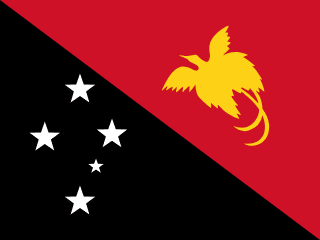
- Country name
- conventional long form: Independent State of Papua New Guinea
conventional short form: Papua New Guinea
local short form: Papuaniugini
former: German New Guinea, British New Guinea, Territory of Papua and New Guinea
abbreviation: PNG
etymology:
the name derives from the Malay word pua-pua, describing the tightly curled hair of the Papuan people; Spanish explorer Ynigo ORTIZ de RETEZ applied the term "Nueva Guinea" to the island in 1545 because he thought the locals resembled the peoples of the Guinea coast of Africa - Government type
- parliamentary democracy under a constitutional monarchy; a Commonwealth realm
- Capital
- name: Port Moresby
geographic coordinates: 9 27 S, 147 11 E
time difference: UTC+10 (15 hours ahead of Washington, DC, during Standard Time)
time zone note: Papua New Guinea has two time zones, including Bougainville (UTC+11)
etymology: named in 1873 by Captain John MORESBY in honor of his father, British Admiral Sir Fairfax MORESBY (1786-1877) - Administrative divisions
- 20 provinces, 1 autonomous region*, and 1 district**; Bougainville*, Central, Chimbu, Eastern Highlands, East New Britain, East Sepik, Enga, Gulf, Hela, Jiwaka, Madang, Manus, Milne Bay, Morobe, National Capital**, New Ireland, Northern, Southern Highlands, Western, Western Highlands, West New Britain, West Sepik
- Legal system
- mixed system of English common law and customary law
- Constitution
- history: adopted 15 August 1975, effective at independence 16 September 1975
amendment process:
proposed by the National Parliament; passage has prescribed majority vote requirements depending on the constitutional sections being amended – absolute majority, two-thirds majority, or three-fourths majority - International law organization participation
- has not submitted an ICJ jurisdiction declaration; non-party state to the ICCt
- Citizenship
- citizenship by birth: no
citizenship by descent only: at least one parent must be a citizen of Papua New Guinea
dual citizenship recognized: no
residency requirement for naturalization: 8 years - Suffrage
- 18 years of age; universal
- Executive branch
- chief of state: King CHARLES III (since 8 September 2022); represented by Governor General Grand Chief Sir Bob DADAE (since 28 February 2017)
head of government: Prime Minister James MARAPE (since 30 May 2019)
cabinet: National Executive Council appointed by the governor general on the recommendation of the prime minister
election/appointment process:
the monarchy is hereditary; governor general nominated by the National Parliament and appointed by the chief of state; following legislative elections, the governor general usually appoints the leader of the majority party or majority coalition as prime minister, pending a National Parliament vote
election results: James MARAPE reelected prime minister; National Parliament vote - 105 out of 118 - Legislative branch
- legislature name: National Parliament
legislative structure: unicameral
number of seats: 118 (all directly elected)
electoral system: plurality/majority
scope of elections: full renewal
term in office: 5 years
most recent election date: 7/4/2022 to 7/22/2022
parties elected and seats per party: Papua & Niugini Union Pati (PANGU) (39); People's National Congress Party (PNC) (15); United Resource Party (URP) (11); Others (40); Independents (10)
percentage of women in chamber: 2.7%
expected date of next election: July 2027 - Judicial branch
- highest court(s):
Supreme Court (consists of the chief justice, deputy chief justice, 35 justices, and 5 acting justices); National Courts (consists of 13 courts located in the provincial capitals, with a total of 19 resident judges)
judge selection and term of office:
Supreme Court chief justice appointed by the governor general on advice of the National Executive Council (cabinet) after consultation with the National Justice Administration minister; deputy chief justice and other justices appointed by the Judicial and Legal Services Commission, a 5-member body that includes the Supreme Court chief and deputy chief justices, the chief ombudsman, and a member of the National Parliament; full-time citizen judges appointed for 10-year renewable terms; non-citizen judges initially appointed for 3-year renewable terms and after first renewal can serve until age 70; appointment and tenure of National Court resident judges NA
subordinate courts: district, village, and juvenile courts, military courts, taxation courts, coronial courts, mining warden courts, land courts, traffic courts, committal courts, grade five courts - Political parties
- Destiny Party
Liberal Party
Melanesian Alliance Party or MAP
Melanesian Liberal Party or MLP
National Alliance Party or NAP
Our Development Party or ODP
Papua and Niugini Union Party or PANGU PATI
Papua New Guinea Greens Party
Papua New Guinea National Party
Papua New Guinea Party or PNGP
People's First Party or PFP
People's Movement for Change or PMC
People's National Congress Party or PNC
People’s National Party
People's Party or PP
People's Progress Party or PPP
People's Reform Party or PRP
Social Democratic Party or SDP
Triumph Heritage Empowerment Party or THE
United Labor Party or ULP
United Resources Party or URP - Diplomatic representation in the US
- chief of mission: Ambassador Arnold Karibone AMET (since 5 September 2025)
chancery: 1825 K Street NW, Suite 1010, Washington, DC 20006
telephone: [1] (202) 745-3680
FAX: [1] (202) 745-3679
email address and website:
info@pngembassy.org
http://www.pngembassy.org/ - Diplomatic representation from the US
- chief of mission: Ambassador Ann Marie YASTISHOCK (since 22 February 2024); note - also accredited to the Solomon Islands and Vanuatu
embassy: Harbour City Road, Konedobu, Port Moresby, NCD, Papua New Guinea
mailing address: 4240 Port Moresby Pl, Washington DC 20521-4240
telephone: [675] 308-9100
email address and website:
ConsularPortMoresby@state.gov
https://pg.usembassy.gov/ - International organization participation
- ACP, ADB, AOSIS, APEC, ARF, ASEAN (observer), C, CD, CP, EITI (candidate country), FAO, G-77, IAEA, IBRD, ICAO, ICRM, IDA, IFAD, IFC, IFRCS, IHO, ILO, IMF, IMO, Interpol, IOC, IOM, IPU, ISO (correspondent), ITSO, ITU, MIGA, NAM, OPCW, PIF, Sparteca, SPC, UN, UNCTAD, UNESCO, UNIDO, UNMISS, UNWTO, UPU, WCO, WFTU (NGOs), WHO, WIPO, WMO, WTO
- Independence
- 16 September 1975 (from the Australia-administered UN trusteeship)
- National holiday
- Independence Day, 16 September (1975)
- Flag
- description: divided diagonally from upper-left corner; the upper triangle is red and has a soaring yellow bird of paradise in the center; the lower triangle is black with five five-pointed white stars of the Southern Cross constellation
meaning: red, black, and yellow are the country's traditional colors; the bird of paradise is an emblem of regional tribal culture and represents the emergence of Papua New Guinea as a nation; the Southern Cross symbolizes the country's connection with Australia and several other countries in the South Pacific - National symbol(s)
- bird of paradise
- National color(s)
- red, black
- National coat of arms
- Papua New Guinea's coat of arms was adopted on July 1, 1971, and features the country's national symbol, the Raggiana bird-of-paradise; the bird stands for the nation's freedom and rich natural environment; the traditional spear under the bird represents the country's ethnic groups and the protection of its heritage, and the Kundu drum, which is used in ceremonies, represents local artistic traditions and communication
- National anthem(s)
- title: "O Arise, All You Sons"
lyrics/music: Thomas SHACKLADY
history: adopted 1975 - National heritage
- total World Heritage Sites: 1 (cultural)
selected World Heritage Site locales: Kuk Early Agricultural Site