- Country name
- conventional long form: Democratic People's Republic of Korea
conventional short form: North Korea
local long form: Choson-minjujuui-inmin-konghwaguk
local short form: Choson
abbreviation: DPRK
etymology: derived from the Chinese name for Goryeo, which was the Korean dynasty that united the peninsula in the 10th century A.D.; the North Korean name "Choson" means "[Land of the] Morning Calm" - Government type
- dictatorship, single-party communist state
- Capital
- name: Pyongyang
geographic coordinates: 39 01 N, 125 45 E
time difference: UTC+9 (14 hours ahead of Washington, DC, during Standard Time)
time zone note: on 5 May 2018, North Korea reverted to UTC+9, the same time zone as South Korea
etymology: the name translates as "flat land" in Korean - Administrative divisions
- 9 provinces (do, singular and plural) and 4 special administration cities (si, singular and plural)
provinces: Chagang, Hambuk (North Hamgyong), Hamnam (South Hamgyong), Hwangbuk (North Hwanghae), Hwangnam (South Hwanghae), Kangwon, P'yongbuk (North Pyongan), P'yongnam (South Pyongan), Ryanggang
special administration cities: Kaesong, Nampo, P'yongyang, Rason
note: P'yongyang is considered a directly controlled city; Kaesong, Nampo, and Rason are designated as special cities - Legal system
- civil law system based on the Prussian model; influenced by Japanese traditions and Communist legal theory
- Constitution
- history: previous 1948, 1972; latest adopted 1998
amendment process: proposed by the Supreme People’s Assembly (SPA); passage requires more than two-thirds majority vote of the total SPA membership - International law organization participation
- has not submitted an ICJ jurisdiction declaration; non-party state to the ICCt
- Citizenship
- citizenship by birth: no
citizenship by descent only: at least one parent must be a citizen of North Korea
dual citizenship recognized: no
residency requirement for naturalization: unknown - Suffrage
- 17 years of age; universal and compulsory
- Executive branch
- chief of state: State Affairs Commission President KIM Jong Un (since 17 December 2011)
head of government: Supreme People's Assembly President CHOE Ryong Hae (since 11 April 2019)
cabinet: Cabinet or Naegak members appointed by the Supreme People's Assembly, except the Minister of People's Armed Forces
election/appointment process: chief of state and premier indirectly elected by the Supreme People's Assembly
most recent election date: 11 April 2019
election results: 2019: KIM Jong Un reelected unopposed
expected date of next election: March 2024
note 1: KIM Jong Un's titles include general secretary of the Workers' Party of Korea (KWP), chairman of the KWP Central Military Commission, president of the State Affairs Commission, and supreme commander of the Korean People's Army
note 2: in the North Korean system, KIM Jong Un's role as chief of state is secondary to his role as general secretary of the Korean Workers' Party; chief of state is used to engage with non-communist countries such as the US; North Korea revised its constitution in 2019 to define "the Chairman of the State Affairs Commission" as "the supreme leader who represents the state"; functions as the commander-in-chief and chief executive; the specific titles associated with this office have changed multiple times under KIM's tenure, but KIM Jong Un has been supreme leader since his father's death in 2011
note 3: the head of government functions as the technical head of state and performs related duties, such as receiving ambassadors' credentials - Legislative branch
- legislature name: Supreme People's Assembly (Choe Go In Min Hoe Ui)
legislative structure: unicameral
number of seats: 687 (all directly elected)
electoral system: plurality/majority
scope of elections: full renewal
term in office: 5 years
most recent election date: 3/10/2019
percentage of women in chamber: 17.6%
expected date of next election: December 2025
note: the SPA functions as a rubberstamp legislature; the Korean Workers' Party selects all candidates - Judicial branch
- highest court(s): Supreme Court or Central Court (consists of one judge and 2 "People's Assessors" or, for some cases, 3 judges)
judge selection and term of office: judges elected by the Supreme People's Assembly for 5-year terms
subordinate courts: lower provincial courts as determined by the Supreme People's Assembly - Political parties
- major parties:
Korean Workers' Party or KWP (formally known as Workers' Party of Korea)
General Association of Korean Residents in Japan (Chongryon; under KWP control)
minor parties:
Chondoist Chongu Party (under KWP control)
Social Democratic Party or KSDP (under KWP control) - Diplomatic representation in the US
- none
note: North Korea has a Permanent Mission to the UN in New York - Diplomatic representation from the US
- embassy: none; the Swedish Embassy in Pyongyang represents the US as consular protecting power
- International organization participation
- ARF, FAO, G-77, ICAO, ICRM, IFAD, IFRCS, IHO, IMO, IMSO, IOC, IPU, ISO, ITSO, ITU, NAM, UN, UNCTAD, UNESCO, UNIDO, UNWTO, UPU, WFTU (NGOs), WHO, WIPO, WMO
- Independence
- 15 August 1945 (from Japan)
- National holiday
- Founding of the Democratic People's Republic of Korea (DPRK), 9 September (1948)
- Flag
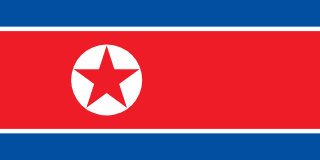
- description: three horizontal bands of blue (top), red (triple-width), and blue; the red band is edged in white; on the left side of the red band is a white disk with a red five-pointed star
meaning: the red band stands for revolutionary traditions, the white for purity, strength, and dignity; blue for sovereignty, peace, and friendship; the red star represents socialism - National symbol(s)
- red star, chollima (winged horse)
- National color(s)
- red, white, blue
- National anthem(s)
- title: "Aegukka" (Patriotic Song)
lyrics/music: PAK Se Yong/KIM Won Gyun
history: adopted 1947; North Korea's and South Korea's anthems have the same name and a similar melody, but different lyrics; the North Korean anthem is also known as "Ach'imun pinnara" (Let Morning Shine) - National heritage
- total World Heritage Sites: 2 (both cultural, one mixed)
selected World Heritage Site locales: Koguryo Tombs Complex; Historic Monuments and Sites in Kaesong; Mount Kumgang – Diamond Mountain from the Sea (m)