- Country name
- conventional long form: Portuguese Republic
conventional short form: Portugal
local long form: Republica Portuguesa
local short form: Portugal
etymology:
name derives from the Roman designation "Portus Cale," meaning "Port of Cale;" Cale was located in present-day northern Portugal, and its name is said to come from the Latin word calere (to be warm) because the harbor never iced over - Government type
- semi-presidential republic
- Capital
- name: Lisbon
geographic coordinates: 38 43 N, 9 08 W
time difference: UTC 0 (5 hours ahead of Washington, DC, during Standard Time)
daylight saving time: +1hr, begins last Sunday in March; ends last Sunday in October
time zone note: Portugal has two time zones, including the Azores (UTC-1)
etymology: the origin of the name is unclear; some trace it back to the legendary Greek hero Ulysses; others claim a derivation from the Phoenician alis-ubbo, or "joyful bay" - Administrative divisions
- 18 districts (distritos, singular - distrito) and 2 autonomous regions* (regioes autonomas, singular - regiao autonoma); Aveiro, Acores (Azores)*, Beja, Braga, Braganca, Castelo Branco, Coimbra, Evora, Faro, Guarda, Leiria, Lisboa (Lisbon), Madeira*, Portalegre, Porto, Santarem, Setubal, Viana do Castelo, Vila Real, Viseu
- Legal system
- civil law system; Constitutional Court reviews legislative acts
- Constitution
- history: several previous; latest adopted 2 April 1976, effective 25 April 1976
amendment process: proposed by the Assembly of the Republic; adoption requires two-thirds majority vote of Assembly members - International law organization participation
- accepts compulsory ICJ jurisdiction with reservations; accepts ICCt jurisdiction
- Citizenship
- citizenship by birth: no
citizenship by descent only: at least one parent must be a citizen of Portugal
dual citizenship recognized: yes
residency requirement for naturalization: 10 years; 6 years if from a Portuguese-speaking country - Suffrage
- 18 years of age; universal
- Executive branch
- chief of state: President Marcelo REBELO DE SOUSA (since 9 March 2016)
head of government: Prime Minister Antonio Luis MONTENEGRO (since 2 April 2024)
cabinet: Council of Ministers appointed by the president on the recommendation of the prime minister
election/appointment process:
president directly elected by absolute-majority popular vote in 2 rounds, if needed, for a 5-year term (eligible for a second term); following legislative elections, the president usually appoints the leader of the majority party or majority coalition as prime minister
most recent election date: 24 January 2021
election results:
2021: Marcelo REBELO DE SOUSA reelected president in the first round; percent of vote - Marcelo REBELO DE SOUSA (PSD) 60.7%, Ana GOMES (ran as an independent but is a member of PS) 13%, Andre VENTURA (CH) 11.9%, João FERREIRA (PCP-PEV) 4.3%, other 10.1%
2016: Marcelo REBELO DE SOUSA elected president in the first round; percent of vote - Marcelo REBELO DE SOUSA (PSD) 52%, António SAMPAIO DA NOVOA (independent) 22.9%, Marisa MATIAS (BE) 10.1%, Maria DE BELEM ROSEIRA (PS) 4.2%, other 10.8%
expected date of next election: January 2026
note: there is also a Council of State that acts as a consultative body to the president - Legislative branch
- legislature name: Assembly of the Republic (Assembleia da Republica)
legislative structure: unicameral
number of seats: 230 (all directly elected)
electoral system: proportional representation
scope of elections: full renewal
term in office: 4 years
most recent election date: 5/18/2025
parties elected and seats per party: Social Democratic Party (PPD/PSD) - Democratic and Social Centre - People's Party (CDS-PP) (88); Chega (CH) (60); Socialist Party (PS) (58); Other (24)
percentage of women in chamber: 35.7%
expected date of next election: September 2029 - Judicial branch
- highest court(s): Supreme Court or Supremo Tribunal de Justica (consists of 12 justices); Constitutional Court or Tribunal Constitucional (consists of 13 judges)
judge selection and term of office:
Supreme Court justices nominated by the president and appointed by the Assembly of the Republic; judges can serve for life; Constitutional Court judges - 10 elected by the Assembly and 3 elected by the other Constitutional Court judges; judges elected for 6-year nonrenewable terms
subordinate courts: Supreme Administrative Court (Supremo Tribunal Administrativo); Audit Court (Tribunal de Contas); appellate, district, and municipal courts - Political parties
- Democratic Alliance or AD (2024 electoral alliance in the Azores, includes PSD, CDS-PP, PPM)
Democratic and Social Center/People's Party (Partido do Centro Democratico Social-Partido Popular) or CDS-PP
Ecologist Party "The Greens" or "Os Verdes" (Partido Ecologista-Os Verdes) or PEV
Enough (Chega)
Liberal Initiative (Iniciativa Liberal) or IL
LIVRE or L
People-Animals-Nature Party (Pessoas-Animais-Natureza) or PAN
People's Monarchist Party or PPM
Portuguese Communist Party (Partido Comunista Portugues) or PCP
Social Democratic Party (Partido Social Democrata) or PSD (formerly the Partido Popular Democratico or PPD)
Socialist Party (Partido Socialista) or PS
The Left Bloc (Bloco de Esquerda) or BE or O Bloco
Unitary Democratic Coalition (Coligacao Democratica Unitaria) or CDU (includes PCP and PEV) (2024) - Diplomatic representation in the US
- chief of mission: Ambassador Francisco Antonio DUARTE LOPES (since 7 June 2022)
chancery: 2012 Massachusetts Avenue NW, Washington, DC 20036
telephone: [1] (202) 350-5400
FAX: [1] (202) 462-3726
email address and website:
info.washington@mne.pt
https://washingtondc.embaixadaportugal.mne.gov.pt/en/
consulate(s) general: Boston, Newark (NJ), New York, San Francisco
consulate(s): New Bedford (MA), Providence (RI) - Diplomatic representation from the US
- chief of mission: Ambassador John Joseph ARRIGO (since 30 September 2025)
embassy: Avenida das Forcas Armadas, 1600-081 Lisboa
mailing address: 5320 Lisbon Place, Washington DC 20521-5320
telephone: [351] (21) 727-3300
FAX: [351] (21) 726-9109
email address and website:
conslisbon@state.gov
https://pt.usembassy.gov/
consulate(s): Ponta Delgada (Azores) - International organization participation
- ADB (nonregional member), AfDB (nonregional member), Australia Group, BIS, CD, CE, CERN, CPLP, EAPC, EBRD, ECB, EIB, EMU, ESA, EU, FAO, FATF, IADB, IAEA, IBRD, ICAO, ICC (national committees), ICCt, ICRM, IDA, IEA, IFAD, IFC, IFRCS, IHO, ILO, IMF, IMO, IMSO, Interpol, IOC, IOM, IPU, ISO, ITSO, ITU, ITUC (NGOs), LAIA (observer), MIGA, NATO, NEA, NSG, OAS (observer), OECD, OPCW, OSCE, Pacific Alliance (observer), Paris Club (associate), PCA, Schengen Convention, SELEC (observer), UN, UNCTAD, UNESCO, UNHCR, UNIDO, Union Latina, UNOOSA, UNWTO, UPU, Wassenaar Arrangement, WCO, WFTU (NGOs), WHO, WIPO, WMO, WTO, ZC
- Independence
- 1143 (Kingdom of Portugal recognized); 1 December 1640 (independence reestablished after 60 years of Spanish rule); 5 October 1910 (republic proclaimed)
- National holiday
- Portugal Day (Dia de Portugal), 10 June (1580)
note: also called Camoes Day, the day that revered national poet Luis DE CAMOES (1524-80) died - Flag
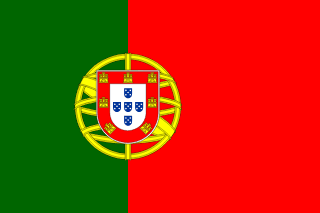
- description: two vertical bands of green (left side, two-fifths) and red (three-fifths), with the national coat of arms (armillary sphere and national shield) centered on the dividing line
meaning: explanations for the color meanings are ambiguous, but a popular interpretation says that green symbolizes hope and red the blood of those defending the nation - National symbol(s)
- armillary sphere (a spherical astrolabe for modeling objects in the sky)
- National color(s)
- red, green
- National anthem(s)
- title: "A Portugesa" (The Song of the Portuguese)
lyrics/music: Henrique LOPES DE MENDOCA/Alfredo KEIL
history: adopted 1911; originally written to protest the Portuguese monarchy's acquiescence to the 1890 British ultimatum forcing Portugal to give up areas of Africa - National heritage
- total World Heritage Sites: 17 (16 cultural, 1 natural)
selected World Heritage Site locales:
Historic Évora (c); Central Zone of the Town of Angra do Heroismo in the Azores (c); Cultural Landscape of Sintra (c); Laurisilva of Madeira (n); Historic Guimarães (c); Monastery of the Hieronymites and Tower of Belém in Lisbon (c); Convent of Christ in Tomar (c); Prehistoric Rock Art Sites in the Côa Valley and Siega Verde (c); University of Coimbra – Alta and Sofia (c); Sanctuary of Bom Jesus do Monte in Braga (c)