- Country name
- conventional long form: Kingdom of Eswatini
conventional short form: Eswatini
local long form: Umbuso weSwatini
local short form: eSwatini
former: Swaziland
etymology: the country name derives from 19th century King MSWATI II, under whose rule Swati territory was expanded and unified
note: pronounced ay-swatini or eh-swatini - Government type
- absolute monarchy
- Capital
- name: Mbabane (administrative capital); Lobamba (royal and legislative capital)
geographic coordinates: 26 19 S, 31 08 E
time difference: UTC+2 (7 hours ahead of Washington, DC, during Standard Time)
etymology:
the origin of the name is unclear; it may come from the Mbabane River next to the city, whose name is said to derive from the word lubabe, a type of shrub; another theory cites a local chief, Mbabane KUNENE, as the source of the name - Administrative divisions
- 4 regions; Hhohho, Lubombo, Manzini, Shiselweni
- Legal system
- mixed system of civil, common, and customary law
- Constitution
- history: previous 1968, 1978; latest signed by the king 26 July 2005, effective 8 February 2006
amendment process:
proposed at a joint sitting of both houses of Parliament; passage requires majority vote by both houses and/or majority vote in a referendum, and assent of the king; passage of amendments affecting "specially entrenched" constitutional provisions requires at least three-fourths majority vote by both houses, passage by simple majority vote in a referendum, and assent of the king; passage of "entrenched" provisions requires at least two-thirds majority vote of both houses, passage in a referendum, and assent of the king - International law organization participation
- accepts compulsory ICJ jurisdiction with reservations; non-party state to the ICCt
- Citizenship
- citizenship by birth: no
citizenship by descent only: both parents must be citizens of Eswatini
dual citizenship recognized: no
residency requirement for naturalization: 5 years - Suffrage
- 18 years of age
- Executive branch
- chief of state: King MSWATI III (since 25 April 1986)
head of government: Prime Minister Russell DLAMINI (since 6 November 2023)
cabinet: Cabinet recommended by the prime minister, confirmed by the monarch; at least one-half of the cabinet membership must be appointed from among elected members of the House of Assembly
election/appointment process: the monarchy is hereditary; prime minister appointed by the monarch from among members of the House of Assembly - Legislative branch
- legislature name: Parliament (Libandla)
legislative structure: bicameral - Legislative branch - lower chamber
- chamber name: House of Assembly
number of seats: 74 (59 directly elected; 4 indirectly elected; 10 appointed)
electoral system: plurality/majority
scope of elections: full renewal
term in office: 5 years
most recent election date: 9/29/2023
percentage of women in chamber: 21.6%
expected date of next election: September 2028
note: four women, one representing each region, elected by the members if representation of elected women is less than 30% - Legislative branch - upper chamber
- chamber name: Senate
number of seats: 30 (10 indirectly elected; 20 appointed)
scope of elections: full renewal
term in office: 5 years
most recent election date: 11/6/2023
percentage of women in chamber: 46.7%
expected date of next election: November 2028 - Judicial branch
- highest court(s): Supreme Court (consists of the chief justice and at least 4 justices) and the High Court (consists of the chief justice ex officio and 4 justices)
judge selection and term of office:
justices of the Supreme Court and High Court appointed by the monarch on the advice of the Judicial Service Commission (JSC), a judicial advisory body consisting of the Supreme Court Chief Justice, 4 members appointed by the monarch, and the chairman of the Civil Service Commission; justices of both courts eligible for retirement at age 65 with mandatory retirement at age 75
subordinate courts: magistrates' courts; National Swazi Courts for administering customary/traditional laws (jurisdiction restricted to customary law for Swazi citizens)
note: the Supreme Court has jurisdiction in all constitutional matters - Political parties
- political parties exist but conditions for their operations, particularly in elections, are undefined, legally unclear, or culturally restricted; the following are considered political associations:
African United Democratic Party or AUDP
Ngwane National Liberatory Congress or NNLC
People's United Democratic Movement or PUDEMO
Swazi Democratic Party or SWADEPA - Diplomatic representation in the US
- chief of mission: Ambassador Kennedy Fitzgerald GROENING (7 June 2022)
chancery: 1712 New Hampshire Avenue NW, Washington, DC 20009
telephone: [1] (202) 234-5002
FAX: [1] (202) 234-8254
email address and website: swaziland@compuserve.com - Diplomatic representation from the US
- chief of mission: Ambassador (vacant) Chargé d’Affaires Marc WEINSTOCK (since August 2025)
embassy: Corner of MR 103 and Cultural Center Drive, Ezulwini, P.O. Box D202, The Gables, H106
mailing address: 2350 Mbabane Place, Washington DC 20521-2350
telephone: (268) 2417-9000
FAX: [268] 2416-3344
email address and website:
ConsularMbabane@state.gov
Homepage - U.S. Embassy in Eswatini (usembassy.gov) - International organization participation
- ACP, AfDB, AU, C, COMESA, FAO, G-77, IAEA, IBRD, ICAO, ICRM, IDA, IFAD, IFC, IFRCS, ILO, IMF, IMO, Interpol, IOC, IOM, ISO (correspondent), ITSO, ITU, ITUC (NGOs), MIGA, NAM, OPCW, PCA, SACU, SADC, UN, UNCTAD, UNESCO, UNIDO, UNWTO, UPU, WCO, WHO, WIPO, WMO, WTO
- Independence
- 6 September 1968 (from the UK)
- National holiday
- Independence Day (Somhlolo Day), 6 September (1968)
- Flag
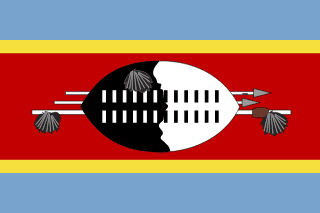
- description: three horizontal bands of blue (top), red (triple-width), and blue; the red band is edged in yellow, with a large black-and-white shield in the center that covers two horizontal spears and a staff with feather tassels
meaning: blue stands for peace and stability, red for past struggles, and yellow for the mineral resources of the country; the shield, spears, and staff symbolize protection from enemies, and the shield colors stand for ethnic groups living in peaceful coexistence - National symbol(s)
- lion, elephant
- National color(s)
- blue, yellow, red
- National coat of arms
- the national coat of arms was adopted in 1968 after independence from the United Kingdom; two national symbols, the lion (representing the king of Eswatini) and the elephant (representing the queen mother), support a traditional Nguni shield; above the shield is the king's lidlabe, or crown of feathers, and at the bottom is Eswatini's motto, Siyinqaba, or "We are the fortress”
- National anthem(s)
- title: "Nkulunkulu Mnikati wetibusiso temaSwati" (O God, Bestower of the Blessings of the Swazi)
lyrics/music: Andrease Enoke Fanyana SIMELANE/David Kenneth RYCROFT
history: adopted 1968; uses elements of both ethnic Swazi and Western music styles