- Country name
- conventional long form: none
conventional short form: Taiwan
local long form: none
local short form: Taiwan
former: Formosa
etymology: the name may derive from the Chinese words tai (terrace) and wan (bay), referring to the island's terrain; in 1590, the Portuguese named it Formosa, meaning "beautiful" - Government type
- semi-presidential republic
- Capital
- name: Taipei
geographic coordinates: 25 02 N, 121 31 E
time difference: UTC+8 (13 hours ahead of Washington, DC, during Standard Time)
etymology: the name means "Northern Taiwan," from the Chinese words tai (a short form of Taiwan) and bei (north), reflecting the city's position in the far north of the island - Administrative divisions
- includes main island of Taiwan, plus smaller islands nearby and off coast of China's Fujian Province; Taiwan is divided into 13 counties (xian, singular and plural), 3 cities (shi, singular and plural), and 6 special municipalities directly under the jurisdiction of the Executive Yuan
counties: Changhua, Chiayi, Hsinchu, Hualien, Kinmen, Lienchiang, Miaoli, Nantou, Penghu, Pingtung, Taitung, Yilan, Yunlin
cities: Chiayi, Hsinchu, Keelung
special municipalities: Kaohsiung (city), New Taipei (city), Taichung (city), Tainan (city), Taipei (city), Taoyuan (city)
note: Taiwan uses a variety of romanization systems for names; a modified Wade-Giles system still dominates, but the city of Taipei has adopted a Pinyin romanization for street and place names; other local authorities use different romanization systems - Legal system
- civil law system
- Constitution
- history: previous 1912, 1931; latest adopted 25 December 1946, promulgated 1 January 1947, effective 25 December 1947
amendment process:
proposed by at least one fourth of the Legislative Yuan membership; passage requires approval by at least three-fourths majority vote of at least three fourths of the Legislative Yuan membership and approval in a referendum by more than half of eligible voters - International law organization participation
- has not submitted an ICJ jurisdiction declaration; non-party state to the ICCt
- Citizenship
- citizenship by birth: no
citizenship by descent only: at least one parent must be a citizen of Taiwan
dual citizenship recognized: yes, except that citizens of Taiwan are not recognized as dual citizens of the People's Republic of China
residency requirement for naturalization: 5 years - Suffrage
- 20 years of age; universal
- Executive branch
- chief of state: President LAI Ching-te (since 20 May 2024)
head of government: Premier CHO Jung-tai (President of the Executive Yuan) (since 20 May 2024)
cabinet: Executive Yuan; ministers appointed by president on recommendation of premier
election/appointment process:
president and vice president directly elected on the same ballot by simple-majority popular vote for a 4-year term (eligible for a second term); premier appointed by the president; vice premiers appointed by the president on the recommendation of the premier
most recent election date: 13 January 2024
election results:
2024: LAI Ching-te elected president; percent of vote - LAI Ching-te (DPP) 40.1%, HOU Yu-ih (KMT) 33.5%, KO Wen-je (TPP) 26.5%)
2020: TSAI Ing-wen reelected president; percent of vote - TSAI Ing-wen (DPP) 57.1%, HAN Kuo-yu (KMT) 38.6%, James SOONG (PFP) 4.3%
expected date of next election: 2028 - Legislative branch
- legislature name: Legislative Yuan
legislative structure: unicameral
number of seats: 113 (directly elected)
electoral system: plurality/majority
scope of elections: full renewal
term in office: 4 years
most recent election date: 13 January 2024
parties elected and seats per party: Kuomintang (KMT) 52, Democratic Progressive Party (DPP) 51, Taiwan People's Party (TPP) 8, independent 2
percentage of women in chamber: 41.6%
expected date of next election: January 2028 - Judicial branch
- highest court(s):
Supreme Court (consists of the court president, vice president, and approximately 100 judges organized into civil and criminal panels, each with a chief justice and 4 associate justices); Constitutional Court (consists of the court president, vice president, and 13 justices)
judge selection and term of office:
Supreme Court justices appointed for life by the president; Constitutional Court justices appointed by the president, with approval of the Legislative Yuan, for 8-year terms, with half the membership renewed every 4 years
subordinate courts: high courts; district courts; hierarchy of administrative courts - Political parties
- Democratic Progressive Party or DPP
Kuomintang or KMT (Nationalist Party)
Taiwan People's Party or TPP
note: the DPP and the KMT are the two major political parties; more than 30 parties garnered votes in the 2024 election - Diplomatic representation in the US
- chief of mission: none
Taipei Economic and Cultural Offices (branch offices): Atlanta, Boston, Chicago, Denver (CO), Hagatna (Guam), Honolulu, Houston, Los Angeles, Miami, New York, San Francisco, Seattle, Washington DC
note: Note: commercial and cultural relations with its citizens in the US are maintained through an unofficial instrumentality, the Taipei Economic and Cultural Representative Office in the United States (TECRO), a private nonprofit corporation that performs citizen and consular services similar to those at diplomatic posts, represented by Ambassador Alexander YUI (since 11 December 2023); office: 4201 Wisconsin Avenue NW, Washington, DC 20016; telephone: [1] (202) 895-1800; fax: [1] (202) 363-0999 - Diplomatic representation from the US
- chief of mission:
the US does not have an embassy in Taiwan; commercial and cultural relations with the people of Taiwan are maintained through an unofficial instrumentality, the American Institute in Taiwan (AIT), a private nonprofit corporation that performs citizen and consular services similar to those at diplomatic posts; it is managed by Director Raymond F. GREENE (since 8 July 2024)
mailing address: 4170 AIT Taipei Place, Washington DC 20521-4170
telephone: [886] 2-2162-2000
FAX: [886] 2-2162-2251
email address and website:
TaipeiACS@state.gov
https://www.ait.org.tw/
branch office(s):
American Institute in Taiwan
No. 100, Jinhu Road,
Neihu District 11461, Taipei City
other offices: Kaohsiung (Branch Office) - International organization participation
- ADB (Chinese Taipei), APEC (Chinese Taipei), BCIE, CABEI, IOC, ITUC (NGOs), SICA (observer), WTO (Chinese Taipei)
note: separate customs territory of Taiwan, Penghu, Kinmen, and Matsu - National holiday
- Republic Day (National Day), 10 October (1911)
note: celebrates the anniversary of the Chinese Revolution, also known as Double Ten (10-10) Day - Flag
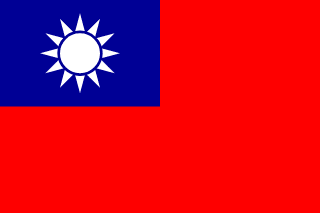
- description: red field with a dark blue rectangle in the upper-left corner, bearing a white sun with 12 triangular rays
meaning: blue stands for liberty, justice, and democracy; red for fraternity, sacrifice, and nationalism; white for equality, frankness, and the people's livelihood; the 12 rays represent the months of the year and the traditional Chinese hours (each ray equals two hours)
history: the blue-and-white design of the canton (symbolizing the sun of progress) dates to 1895
note: similar to the flag of Samoa - National symbol(s)
- white sun with 12 rays on a blue field
- National color(s)
- blue, white, red
- National anthem(s)
- title: "Zhonghua Minguo guoge" (National Anthem of the Republic of China)
lyrics/music: HU Han-min, TAI Chi-t'ao, and LIAO Chung-k'ai/CHENG Mao-yun
history:
adopted 1937; also the song of the Kuomintang Party; informally known as "San Min Chu I" or "San Min Zhu Yi" (Three Principles of the People); the anthem is banned from performance in mainland China, Hong Kong, and Macau