- Country name
- conventional long form: Republic of Uganda
conventional short form: Uganda
etymology: the name is derived from the Swahili word u, meaning "land" or "country," and the Ganda people; the origin of the Ganda name is unclear - Government type
- presidential republic
- Capital
- name: Kampala
geographic coordinates: 0 19 N, 32 33 E
time difference: UTC+3 (8 hours ahead of Washington, DC, during Standard Time)
etymology: the name is said to come from an African antelope, the impala - Administrative divisions
- 134 districts and 1 capital city*; Abim, Adjumani, Agago, Alebtong, Amolatar, Amudat, Amuria, Amuru, Apac, Arua, Budaka, Bududa, Bugiri, Bugweri, Buhweju, Buikwe, Bukedea, Bukomansimbi, Bukwo, Bulambuli, Buliisa, Bundibugyo, Bunyangabu, Bushenyi, Busia, Butaleja, Butambala, Butebo, Buvuma, Buyende, Dokolo, Gomba, Gulu, Hoima, Ibanda, Iganga, Isingiro, Jinja, Kaabong, Kabale, Kabarole, Kaberamaido, Kagadi, Kakumiro, Kalaki, Kalangala, Kaliro, Kalungu, Kampala*, Kamuli, Kamwenge, Kanungu, Kapchorwa, Kapelebyong, Karenga, Kasese, Kasanda, Katakwi, Kayunga, Kazo, Kibaale, Kiboga, Kibuku, Kikuube, Kiruhura, Kiryandongo, Kisoro, Kitagwenda, Kitgum, Koboko, Kole, Kotido, Kumi, Kwania, Kween, Kyankwanzi, Kyegegwa, Kyenjojo, Kyotera, Lamwo, Lira, Luuka, Luwero, Lwengo, Lyantonde, Madi-Okollo, Manafwa, Maracha, Masaka, Masindi, Mayuge, Mbale, Mbarara, Mitooma, Mityana, Moroto, Moyo, Mpigi, Mubende, Mukono, Nabilatuk, Nakapiripirit, Nakaseke, Nakasongola, Namayingo, Namisindwa, Namutumba, Napak, Nebbi, Ngora, Ntoroko, Ntungamo, Nwoya, Obongi, Omoro, Otuke, Oyam, Pader, Pakwach, Pallisa, Rakai, Rubanda, Rubirizi, Rukiga, Rukungiri, Rwampara, Sembabule, Serere, Sheema, Sironko, Soroti, Tororo, Wakiso, Yumbe, Zombo
- Legal system
- mixed system of English common law and customary law
- Constitution
- history: several previous; latest adopted 27 September 1995, promulgated 8 October 1995
amendment process:
proposed by the National Assembly; passage requires at least two-thirds majority vote of the Assembly membership in the second and third readings; proposals affecting "entrenched clauses," including the sovereignty of the people, supremacy of the constitution, human rights and freedoms, the democratic and multiparty form of government, presidential term of office, independence of the judiciary, and the institutions of traditional or cultural leaders, also requires passage by referendum, ratification by at least two-thirds majority vote of district council members in at least two thirds of Uganda's districts, and assent of the president of the republic - International law organization participation
- accepts compulsory ICJ jurisdiction; accepts ICCt jurisdiction
- Citizenship
- citizenship by birth: no
citizenship by descent only: at least one parent or grandparent must be a native-born citizen of Uganda
dual citizenship recognized: yes
residency requirement for naturalization: an aggregate of 20 years and continuously for the last 2 years prior to applying for citizenship - Suffrage
- 18 years of age; universal
- Executive branch
- chief of state: President Yoweri Kaguta MUSEVENI (since 26 January 1986)
head of government: Prime Minister Robinah NABBANJA (since 14 June 2021)
cabinet: Cabinet appointed by the president from among elected members of Parliament or persons who qualify to be elected as members of Parliament
election/appointment process: president directly elected by absolute-majority popular vote in 2 rounds, if needed, for a 5-year term (no term limits)
most recent election date: 14 January 2021
election results:
2021: Yoweri Kaguta MUSEVENI reelected president in the first round; percent of vote - Yoweri Kaguta MUSEVENI (NRM) 58.6%, Robert Kyagulanyi SSENTAMU (aka Bobi WINE) (NUP) 34.8%, Patrick Oboi AMURIAT (FDC) 3.2%, other 3.4%
expected date of next election: 2026 - Legislative branch
- legislature name: Parliament
legislative structure: unicameral
number of seats: 529 (499 directly elected; 30 indirectly elected)
electoral system: plurality/majority
scope of elections: full renewal
term in office: 5 years
most recent election date: 1/14/2021 to 1/18/2021
parties elected and seats per party: National Resistance Movement (NRM) (336); National Unity Platform (NUP) (57); Forum for Democratic Change (FDC) (32); Independents (74); Other (30)
percentage of women in chamber: 34.1%
expected date of next election: January 2026 - Judicial branch
- highest court(s): Supreme Court of Uganda (consists of the chief justice and at least 6 justices)
judge selection and term of office:
justices appointed by the president of the republic in consultation with the Judicial Service Commission, an 8-member independent advisory body, and approved by the National Assembly; justices serve until mandatory retirement at age 70
subordinate courts:
Court of Appeal (also acts as the Constitutional Court); High Court (includes 12 High Court Circuits and 8 High Court Divisions); Industrial Court; Chief Magistrate Grade One and Grade Two Courts throughout the country; qadhis courts; local council courts; family and children courts - Political parties
- Democratic Party or DP
Forum for Democratic Change or FDC
Justice Forum or JEEMA
National Resistance Movement or NRM
National Unity Platform
People's Progressive Party or PPP
Uganda People's Congress or UPC - Diplomatic representation in the US
- chief of mission: Ambassador Robie KAKONGE (since 12 December 2022)
chancery: 5911 16th Street NW, Washington, DC 20011
telephone: [1] (202) 726-7100
FAX: [1] (202) 726-1727
email address and website:
washington@mofa.go.ug
https://washington.mofa.go.ug/ - Diplomatic representation from the US
- chief of mission: Ambassador William W. POPP (since 20 September 2023)
embassy: 1577 Ggaba Road, Kampala
mailing address: 2190 Kampala Place, Washington DC 20521-2190
telephone: [256] (0) 312-306-001
FAX: [256] (0) 414-259-794
email address and website:
KampalaWebContact@state.gov
https://ug.usembassy.gov/ - International organization participation
- ACP, AfDB, ATMIS, AU, C, COMESA, EAC, EADB, FAO, G-77, IAEA, IBRD, ICAO, ICC (national committees), ICCt, IDA, IDB, IFAD, IFC, IFRCS, IGAD, ILO, IMF, IMO, Interpol, IOC, IOM, IPU, ISO (correspondent), ITC, ITSO, ITU, ITUC (NGOs), MIGA, NAM, OIC, OPCW, PCA, UN, UNCDF, UNCTAD, UNECA, UNDP, UNFPA, UNESCO, UNHCR, UNICEF, UNIDO, UNISFA, UNOCI, UNOPS, UNSOM, UNWTO, UPU, WCO, WFP, WFTU (NGOs), WHO, WIPO, WMO, WTO
- Independence
- 9 October 1962 (from the UK)
- National holiday
- Independence Day, 9 October (1962)
- Flag
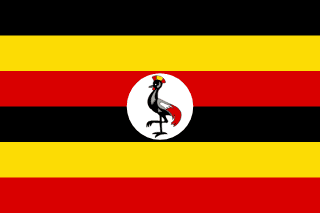
- description: six equal horizontal bands of black (top), yellow, red, black, yellow, and red; a white disk is at the center and shows a grey crowned crane (the national symbol)
meaning: black stands for the African people, yellow for sunshine and vitality, and red for African brotherhood - National symbol(s)
- grey crowned crane
- National color(s)
- black, yellow, red
- National anthem(s)
- title: "O Uganda, Land of Beauty!"
lyrics/music: George Wilberforce KAKOMOA
history: adopted 1962; one of the shortest national anthems in the world - National heritage
- total World Heritage Sites: 3 (1 cultural, 2 natural)
selected World Heritage Site locales: Bwindi Impenetrable National Park (n); Rwenzori Mountains National Park (n); Tombs of Buganda Kings at Kasubi (c)