- Country name
- conventional long form: Republic of Vanuatu
conventional short form: Vanuatu
local long form: Ripablik blong Vanuatu
local short form: Vanuatu
former: New Hebrides
etymology:
the name means "Our land forever" in several of the Austronesian languages spoken on the islands; the former name, New Hebrides, was given by Captain James COOK in 1774 because he thought they looked similar to the Hebrides islands off the coast of Scotland - Government type
- parliamentary republic
- Capital
- name: Port-Vila (on Efate)
geographic coordinates: 17 44 S, 168 19 E
time difference: UTC+11 (16 hours ahead of Washington, DC, during Standard Time)
etymology: the local name of Vila is sometimes used alone for the the port town; its meaning is unknown - Administrative divisions
- 6 provinces; Malampa, Penama, Sanma, Shefa, Tafea, Torba
- Legal system
- mixed system of English common law, French law, and customary law
- Constitution
- history: draft completed August 1979, finalized by constitution conference 19 September 1979, ratified by French and British Governments 23 October 1979, effective 30 July 1980 at independence
amendment process:
proposed by the prime minister or by the Parliament membership; passage requires at least two-thirds majority vote by Parliament in special session with at least three fourths of the membership; passage of amendments affecting the national and official languages, or the electoral and parliamentary system also requires approval in a referendum - International law organization participation
- has not submitted an ICJ jurisdiction declaration; accepts ICCt jurisdiction
- Citizenship
- citizenship by birth: no
citizenship by descent only: both parents must be citizens of Vanuatu; in the case of only one parent, it must be the father who is a citizen
dual citizenship recognized: no
residency requirement for naturalization: 10 years - Suffrage
- 18 years of age; universal
- Executive branch
- chief of state: President Nikenike VUROBARAVU (since 23 July 2022)
head of government: Prime Minister Jotham NAPAT (since 11 February 2025)
cabinet: Council of Ministers appointed by the prime minister, responsible to Parliament
election/appointment process:
president indirectly elected by an electoral college consisting of Parliament and presidents of the 6 provinces; national president serves a 5-year term; following legislative elections, the Parliament usually elects the leader of the majority party or majority coalition (who must also be a member of Parliament) as prime minister
most recent election date: 23 July 2022
election results: 2022: Nikenike VUROBARAVU elected president in eighth round; electoral college vote - Nikenike VUROBARAVU (VP) 48 votes, Solas MOLISA (VP) 4 votes
expected date of next election: 2027
note: the National Council of Chiefs (Malvatu Mauri) is a formal advisory body of chiefs recognized by the country's constitution; it advises the government on matters of culture and language - Legislative branch
- legislature name: Parliament
legislative structure: unicameral
number of seats: 52 (all directly elected)
electoral system: proportional representation
scope of elections: full renewal
term in office: 4 years
most recent election date: 1/16/2025
parties elected and seats per party:
Leaders Party of Vanuatu (LPV) (9); Vanua'aku Pati (VP) (7); Iauko Group (IG) (6); Union of Moderate Parties (UMP) (6); Rural Development Party (RDP) (6); Graon mo Jastis Pati (Land and Justice Party, GJP) (5); Reunification Movement for Change (RMC) (5); Other (8)
percentage of women in chamber: 1.9%
expected date of next election: January 2029 - Judicial branch
- highest court(s): Court of Appeal (consists of 2 or more judges of the Supreme Court designated by the chief justice); Supreme Court (consists of the chief justice and 6 puisne judges -- 3 local and 3 expatriate)
judge selection and term of office:
Supreme Court chief justice appointed by the president after consultation with the prime minister and the leader of the opposition; other judges appointed by the president on the advice of the Judicial Service Commission, a 4-member advisory body; judges serve until the age of retirement
subordinate courts: Magistrates Courts; Island Courts - Political parties
- Iauko Group (Eagle Party) or IG
Land and Justice Party (Graon mo Jastis Pati or GJP)
Leaders Party of Vanuatu or LPV
Rural Development Party or RDP
Reunification of Movement for Change or RMC
Union of Moderate Parties or UMP
Vanua'aku Pati (Our Land Party) or VP - Diplomatic representation in the US
- chief of mission:
Ambassador Odo TEVI (since 8 September 2017)
note - also Permanent Representative to the UN
chancery: 800 Second Avenue, Suite 400B, New York, NY 10017
telephone: [1] (212) 661-4303
FAX: [1] (212) 422-3427
email address and website:
vanunmis@aol.com
https://www.un.int/vanuatu/
note: the Vanuatu Permanent Mission to the UN serves as the embassy - Diplomatic representation from the US
- chief of mission: Ambassador Ann Marie YASTISHOCK (since 16 April 2024); note - also accredited to the Papua New Guinea and the Solomon Islands, based in Port Moresby, Papua New Guinea
embassy: Port Vila
email address and website: https://vt.usembassy.gov/ - International organization participation
- ACP, ADB, AOSIS, C, FAO, G-77, IBRD, ICAO, ICRM, IDA, IFC, IFRCS, ILO, IMF, IMO, IMSO, IOC, IOM, ITU, ITUC (NGOs), MIGA, NAM, OAS (observer), OIF, OPCW, PIF, Sparteca, SPC, UN, UNCTAD, UNESCO, UNIDO, UNWTO, UPU, WCO, WFTU (NGOs), WHO, WIPO, WMO, WTO
- Independence
- 30 July 1980 (from France and the UK)
- National holiday
- Independence Day, 30 July (1980)
- Flag
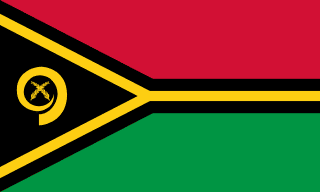
- description: two equal horizontal bands of red (top) and green with a black isosceles triangle (based on the left side); a black-edged yellow stripe in the shape of a horizontal "Y" faces the left side and encloses the triangle; a boar's tusk in the triangle circles two crossed namele fern fronds, all in yellow
meaning: red stands for unity and the blood of men and boars, green for the richness of the islands, and black for the ni-Vanuatu people; the yellow "Y" reflects the islands' layout in the Pacific Ocean and symbolizes the light of the Gospel; the boar's tusk is a symbol of prosperity; the ferns represent peace
note: one of four national flags that reflect the shape of the country in the flag design; the others are Bosnia and Herzegovina, Brazil, and Eritrea - National symbol(s)
- boar's tusk with crossed fern fronds
- National color(s)
- red, black, green, yellow
- National anthem(s)
- title: "Yumi, Yumi, Yumi" (We, We, We)
lyrics/music: Francois Vincent AYSSAV
history: adopted 1980; the anthem is written in the native Bislama - National heritage
- total World Heritage Sites: 1 (cultural)
selected World Heritage Site locales: Chief Roi Mata’s Domain