- Country name
- conventional long form: Republic of South Africa
conventional short form: South Africa
former: Union of South Africa
abbreviation: RSA
etymology:
self-descriptive name from the country's location on the continent; "Africa" is derived from the Roman designation of the area corresponding to present-day Tunisia "Africa terra," which meant "Land of the Afri" (the tribe resident in that area), but which eventually came to mean the entire continent - Government type
- parliamentary republic
- Capital
- name: Pretoria (administrative capital); Cape Town (legislative capital); Bloemfontein (judicial capital)
geographic coordinates: 25 42 S, 28 13 E
time difference: UTC+2 (7 hours ahead of Washington, DC, during Standard Time)
etymology:
Pretoria was named in honor of Boer statesman Andries PRETORIUS in 1855; Cape Town's name refers to its location on the Cape of Good Hope; Bloemfontein was named after the farm on which it was built in 1846, whose name combined the Dutch words bloem (flower) and fontein (fountain) - Administrative divisions
- 9 provinces; Eastern Cape, Free State, Gauteng, KwaZulu-Natal, Limpopo, Mpumalanga, Northern Cape, North West, Western Cape
- Legal system
- mixed system of Roman-Dutch civil law, English common law, and customary law
- Constitution
- history: several previous; latest drafted 8 May 1996, approved by the Constitutional Court 4 December 1996, effective 4 February 1997
amendment process:
proposed by the National Assembly of Parliament; passage of amendments affecting constitutional sections on human rights and freedoms, non-racism and non-sexism, supremacy of the constitution, suffrage, the multi-party system of democratic government, and amendment procedures requires at least 75% majority vote of the Assembly, approval by at least six of the nine provinces represented in the National Council of Provinces, and assent of the president of the republic; passage of amendments affecting the Bill of Rights, and those related to provincial boundaries, powers, and authorities requires at least two-thirds majority vote of the Assembly, approval by at least six of the nine provinces represented in the National Council, and assent of the president - International law organization participation
- has not submitted an ICJ jurisdiction declaration; accepts ICCt jurisdiction
- Citizenship
- citizenship by birth: no
citizenship by descent only: at least one parent must be a citizen of South Africa
dual citizenship recognized: yes, but requires prior permission of the government
residency requirement for naturalization: 5 year - Suffrage
- 18 years of age; universal
- Executive branch
- chief of state: President Matamela Cyril RAMAPHOSA (since 19 June 2024)
head of government: President Matamela Cyril RAMAPHOSA (since 19 June 2024)
cabinet: Cabinet appointed by the president
election/appointment process: president indirectly elected by the National Assembly for a 5-year term (eligible for a second term)
most recent election date: 29 May 2024
election results:
2024: Matamela Cyril RAMAPHOSA (ANC) elected president by the National Assembly unopposed
2019: Matamela Cyril RAMAPHOSA (ANC) elected president by the National Assembly unopposed
expected date of next election: May 2029
note: the president is both chief of state and head of government - Legislative branch
- legislature name: Parliament
legislative structure: bicameral - Legislative branch - lower chamber
- chamber name: National Assembly
number of seats: 400 (all directly elected)
electoral system: proportional representation
scope of elections: full renewal
term in office: 5 years
most recent election date: 6/15/2024
percentage of women in chamber: 44.7%
expected date of next election: May 2029 - Legislative branch - upper chamber
- chamber name: National Council of Provinces
number of seats: 90 (all appointed)
scope of elections: full renewal
term in office: 5 years
most recent election date: 5/29/2024
percentage of women in chamber: 44.4%
expected date of next election: June 2029
note: the Council has special powers to protect regional interests, including safeguarding cultural and linguistic traditions among ethnic minorities - Judicial branch
- highest court(s): Supreme Court of Appeals (consists of the court president, deputy president, and 21 judges); Constitutional Court (consists of the chief and deputy chief justices and 9 judges)
judge selection and term of office:
Supreme Court of Appeals president and vice president appointed by the national president after consultation with the Judicial Services Commission (JSC), a 23-member body chaired by the chief justice; other Supreme Court judges appointed by the national president on the advice of the JSC and hold office until discharged from active service by an Act of Parliament; Constitutional Court chief and deputy chief justices appointed by the president of South Africa after consultation with the JSC and with heads of the National Assembly; other Constitutional Court judges appointed by the national president after consultation with the chief justice and leaders of the National Assembly; Constitutional Court judges serve 12-year nonrenewable terms or until age 70
subordinate courts: High Courts; Magistrates' Courts; labor courts; land claims courts - Political parties
- African Christian Democratic Party or ACDP
African Independent Congress or AIC
African National Congress or ANC
African People's Convention or APC
Agang SA
Congress of the People or COPE
Democratic Alliance or DA
Economic Freedom Fighters or EFF
Freedom Front Plus or FF+
GOOD
Inkatha Freedom Party or IFP
National Freedom Party or NFP
Pan-Africanist Congress of Azania or PAC
United Christian Democratic Party or UCDP
United Democratic Movement or UDM - Diplomatic representation in the US
- chief of mission: Ambassador (vacant); Chargé d’Affaires Ismail ESAU (since 17 March 2025)
chancery: 3051 Massachusetts Avenue NW, Washington, DC 20008
telephone: [1] (240) 937-5760
FAX: [1] (202) 265-1607
email address and website:
Info.saembassyDC@dirco.gov.za
https://www.saembassy.org/
consulate(s) general: Los Angeles, New York - Diplomatic representation from the US
- chief of mission: Ambassador-designate Leo Brent BOZELL III; Chargé d’Affaires Marc DILLARD (since October 2025)
embassy: 877 Pretorius Street, Arcadia, Pretoria
mailing address: 9300 Pretoria Place, Washington DC 20521-9300
telephone: [27] (12) 431-4000
FAX: [27] (12) 342-2299
email address and website:
ACSJohannesburg@state.gov
https://za.usembassy.gov/
consulate(s) general: Cape Town, Durban, Johannesburg - International organization participation
- ACP, AfDB, AIIB, AU, BIS, BRICS, C, CD, FAO, FATF, G-20, G-24, G-5, G-77, IAEA, IBRD, ICAO, ICC (national committees), ICCt, ICRM, IDA, IFAD, IFC, IFRCS, IHO, ILO, IMF, IMO, IMSO, Interpol, IOC, IOM, IPU, ISO, ITSO, ITU, ITUC (NGOs), MIGA, MONUSCO, NAM, NSG, OECD (enhanced engagement), OPCW, Paris Club (associate), PCA, SACU, SADC, UN, UNAMID, UNCTAD, UNESCO, UNHCR, UNIDO, UNISFA, UNITAR, UNOOSA, UNWTO, UPU, Wassenaar Arrangement, WCO, WFTU (NGOs), WHO, WIPO, WMO, WTO, ZC
- Independence
- 31 May 1910 (Union of South Africa formed from four British colonies: Cape Colony, Natal, Transvaal, and Orange Free State); 22 August 1934 (Status of the Union Act); 31 May 1961 (republic declared); 27 April 1994 (majority rule)
- National holiday
- Freedom Day, 27 April (1994)
- Flag
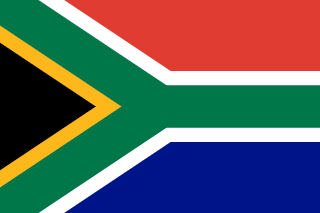
- description: two equal-width horizontal bands of red (top) and blue separated by a central green band that splits into a horizontal Y; a black isosceles triangle is in the Y, with narrow yellow bands around it; the red and blue bands are bordered by narrow white stripes
meaning: the colors have no official meaning, but the Y stands for "the convergence of diverse elements within South African society, taking the road ahead in unity"
note: South Africa has one of two national flags that display six colors as part of the primary design -- the other is South Sudan's - National symbol(s)
- springbok (antelope), king protea flower
- National color(s)
- red, green, blue, yellow, black, white
- National anthem(s)
- title: "National Anthem of South Africa"
lyrics/music: Enoch SONTONGA and Cornelius Jacob LANGENHOVEN/Enoch SONTONGA and Marthinus LOURENS de Villiers
history:
adopted 1997; a combination of "N'kosi Sikelel' iAfrica" (God Bless Africa) and "Die Stem van Suid Afrika" (The Call of South Africa), which were respectively the anthems of the non-white and white communities under apartheid; official lyrics contain a mixture of Xhosa, Zulu, Sesotho, Afrikaans, and English (the five most widely spoken of South Africa's 11 official languages) - National heritage
- total World Heritage Sites: 12 (7 cultural, 4 natural, 1 mixed)
selected World Heritage Site locales:
Fossil Hominid Sites of South Africa (c); iSimangaliso Wetland Park (n); Robben Island (c); Maloti-Drakensberg Park (m); Mapungubwe Cultural Landscape (c); Cape Floral Region Protected Areas (n); Vredefort Dome (n); Richtersveld Cultural and Botanical Landscape (c); Khomani Cultural Landscape (c); Barberton Makhonjwa Mountains (n); Human Rights, Liberation and Reconciliation: Nelson Mandela Legacy Sites (c); The Emergence of Modern Human Behaviour: The Pleistocene Occupation Sites of South Africa (c)