- Country name
- conventional long form: Republic of Zambia
conventional short form: Zambia
former: Northern Rhodesia
etymology: name is derived from the Zambezi River, which flows through the western part of the country and forms the southern border with Zimbabwe - Government type
- presidential republic
- Capital
- name: Lusaka
geographic coordinates: 15 25 S, 28 17 E
time difference: UTC+2 (7 hours ahead of Washington, DC, during Standard Time)
etymology: named after a village with a headman (chief) called LUSAAKAS - Administrative divisions
- 10 provinces; Central, Copperbelt, Eastern, Luapula, Lusaka, Muchinga, Northern, North-Western, Southern, Western
- Legal system
- mixed system of English common law and customary law
- Constitution
- history: several previous; latest adopted 24 August 1991, promulgated 30 August 1991
amendment process:
proposed by the National Assembly; passage requires two-thirds majority vote by the Assembly in two separate readings at least 30 days apart; passage of amendments affecting fundamental rights and freedoms requires approval by at least one half of votes cast in a referendum prior to consideration and voting by the Assembly - International law organization participation
- has not submitted an ICJ jurisdiction declaration; accepts ICCt jurisdiction
- Citizenship
- citizenship by birth: only if at least one parent is a citizen of Zambia
citizenship by descent only: yes, if at least one parent was a citizen of Zambia
dual citizenship recognized: yes
residency requirement for naturalization: 5 years for those with an ancestor who was a citizen of Zambia, otherwise 10 years residency is required - Suffrage
- 18 years of age; universal
- Executive branch
- chief of state: President Hakainde HICHILEMA (since 24 August 2021)
head of government: President Hakainde HICHILEMA (since 24 August 2021)
cabinet: Cabinet appointed by president from among members of the National Assembly
election/appointment process: president directly elected by absolute-majority popular vote in 2 rounds, if needed, for a 5-year term (eligible for a second term)
most recent election date: 12 August 2021
election results:
2021: Hakainde HICHILEMA elected president; percent of the vote - Hakainde HICHILEMA (UPND) 57.9%, Edgar LUNGU (PF) 37.3%, other 4.8%
2016: Edgar LUNGU reelected president; percent of vote - Edgar LUNGU (PF) 50.4%, Hakainde HICHILEMA (UPND) 47.6%, other 2%; note - the president is both chief of state and head of government
expected date of next election: 2026 - Legislative branch
- legislature name: National Assembly
legislative structure: unicameral
number of seats: 167 (156 directly elected; 8 appointed)
electoral system: plurality/majority
scope of elections: full renewal
term in office: 5 years
most recent election date: 44420
parties elected and seats per party: United Party for National Development (UPND) (82); Patriotic Front (PF) (60); Independents (13); Other (1)
percentage of women in chamber: 15%
expected date of next election: August 2026 - Judicial branch
- highest court(s): Supreme Court (consists of the chief justice, deputy chief justice, and at least 11 judges); Constitutional Court (consists of the court president, vice president, and 11 judges)
judge selection and term of office:
Supreme Court and Constitutional Court judges appointed by the president of the republic upon the advice of the 9-member Judicial Service Commission, which is headed by the chief justice, and ratified by the National Assembly; judges normally serve until age 65
subordinate courts:
Court of Appeal; High Court; Industrial Relations Court; subordinate courts (3 levels, based on upper limit of money involved); Small Claims Court; local courts (2 grades, based on upper limit of money involved) - Political parties
- Alliance for Democracy and Development or ADD
Forum for Democracy and Development or FDD
Movement for Multiparty Democracy or MMD
Party of National Unity and Progress or PNUP
Patriotic Front or PF
United Party for National Development or UPND - Diplomatic representation in the US
- chief of mission: Ambassador Chibamba KANYAMA (since 30 June 2023)
chancery: 2200 R Street NW, Washington, DC 20008
telephone: [1] (202) 234-4009
FAX: [1] (202) 332-0826
email address and website:
info@zambiaembassy.org
https://www.zambiaembassy.org/ - Diplomatic representation from the US
- chief of mission: Ambassador Michael C. GONZALES (since 16 September 2022)
embassy: Eastern end of Kabulonga Road, Ibex Hill, Lusaka
mailing address: 2310 Lusaka Place, Washington DC 20521-2310
telephone: [260] (0) 211-357-000
FAX: [260] (0) 211-357-224
email address and website:
ACSLusaka@state.gov
https://zm.usembassy.gov/ - International organization participation
- ACP, AfDB, AU, C, COMESA, EITI (compliant country), FAO, G-77, IAEA, IBRD, ICAO, ICCt, ICRM, IDA, IFAD, IFC, IFRCS, ILO, IMF, Interpol, IOC, IOM, IPU, ISO (correspondent), ITSO, ITU, ITUC (NGOs), MIGA, MONUSCO, NAM, OPCW, PCA, SADC, UN, UNCTAD, UNDOF, UNESCO, UNHCR, UNIDO, UNISFA, UNMIL, UNMISS, UNOCI, UNWTO, UPU, WCO, WHO, WIPO, WMO, WTO
- Independence
- 24 October 1964 (from the UK)
- National holiday
- Independence Day, 24 October (1964)
- Flag
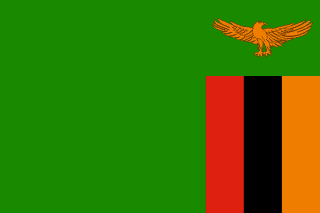
- description: green field with a soaring orange eagle in the upper-right corner; a panel of three vertical bands is under the eagle, in red (left side), black, and orange
meaning: green stands for the country's natural resources and vegetation, red for the struggle for freedom, black for the people, and orange for the country's mineral wealth; the eagle represents the people's ability to rise above the nation's problems - National symbol(s)
- African fish eagle
- National color(s)
- green, red, black, orange
- National anthem(s)
- title: "Lumbanyeni Zambia" (Stand and Sing of Zambia, Proud and Free)
lyrics/music: multiple/Enoch Mankayi SONTONGA
history: adopted 1964; the melody, which comes from the popular song "God Bless Africa," a popular song and anthem in southern Africa - National heritage
- total World Heritage Sites: 1 (natural)
selected World Heritage Site locales: Mosi-oa-Tunya/Victoria Falls